
Biochemistry of Ketosis Simplified with Nuanced Perspectives and Personal Experiences
Explaining the mysteries of ketogenesis and gluconeogenesis based on deep research and my decades of experimentation
I choose ketosis as a lifestyle as humans evolved and survived with the power of ketogenesis and gluconeogenesis for millions of years. Yet in the modern world we still debate and even some people categorize ketosis inducing lifestyle factors as useless and even dangerous. Since I have significant experience and intense research on the topic, I want to show nuances with pros and cons of self-induced ketosis without going into scientific and technical details.
While studying biochemistry at a postgraduate level the most interesting and lifechanging subjects for me was ketogenesis, gluconeogenesis, and nutritional biochemistry. I learned that while ketosis is ideal for some patients like those with epilepsy and it has nothing to do with starvation, Ketosis does not suit the needs of some patients with type I diabetes or some type II diabetes with special circumstances.
Ketosis was life-changing for me because it helped me to overcome abdominal obesity, prediabetes, chronic inflammation, arthritis, mood swings, hunger pangs, cognitive decline, and brain fog.
I have been living a keto lifestyle for many years, as documented in numerous stories before. This unique lifestyle is about nutritional biochemistry, where we eat low carbs with adequate healthy fats and moderate bioavailable proteins, stick to a specific eating window, and get moving with moderate and tailored workouts.
Through decades of research and experimentation, I have learned how ketosis, gluconeogenesis, and glycogen stores interact. I thought sharing this tacit knowledge in this story would be helpful to my readers. I aim to give a valuable perspective on a frequently asked question concerning some readers.
Some of my friends and readers are passionate about getting into ketosis, which is a good thing. However, they say they follow all the tips from magazines and online sources, hoping to see that magical purple color on their pee sticks. Unfortunately, many beginners get disappointed. Some friends humorously say that if one day they see that purple color in their pee sticks, they will throw a party. I have empathy and compassion for them.
I felt disappointed like them when I enthusiastically started a keto lifestyle with no tangible observations in the first few weeks. However, I missed the nuanced information hidden in the old textbooks, epilepsy research, and disguised scientific papers recently gaining popularity.
What are ketogenesis and gluconeogenesis in simple terms, and why do they matter for health and wellness?
Ketosis is a biological process deeply integrated within metabolic pathways essential for sustenance. This physiological state arises when the body perceives a deficiency in glucose or overall energy availability to supply its energy demands adequately. Specifically, when glycogen reserves deplete, the liver produces ketone bodies to serve as an alternative energy substrate for select organs.
The principal objective of ketosis is to generate alternative energy sources for organs to sustain themselves, given that glucose is the primary energy substrate for several organs. Many organs, including the brain and heart, readily utilize ketones, particularly β-hydroxybutyrate, as an alternative energy source. Nonetheless, specific organs like the liver cannot metabolize ketones for energy production.
Therefore, during ketosis, the body initiates gluconeogenesis to produce glucose and meet the energy demands of all sugar-hungry organs and tissues. Even without carbohydrate intake for extended periods, such as in my case, as I follow a near zero-carb diet, the body can synthesize glucose from amino acids and even fat molecules.
Moreover, the bloodstream maintains a certain level of ketones, which increase as glucose levels decline. Alongside β-hydroxybutyrate, the body generates two other ketone bodies: acetoacetate and acetone in lesser quantities. Therefore, thanks to our evolution, we don’t run out of energy during fasting or calory deficit diets which are needed for some patients.
As documented in this NIH book chapter, gluconeogenesis is a group of metabolic reactions in cytosol and mitochondria that maintain the blood glucose level constant throughout the fasting state. Reactions in the gluconeogenesis pathway are regulated locally and globally (by insulin, glucagon, and cortisol); some are highly exergonic and irreversible.
In simple terms, gluconeogenesis is a metabolic process through which the body synthesizes glucose from non-carbohydrate precursors, such as amino acids, lactate, and glycerol. This process primarily occurs in the liver and, to a lesser extent, in the kidneys.
Gluconeogenesis is essential for maintaining blood glucose levels during periods of fasting, low carbohydrate intake, or intense exercise when glucose demand is high but dietary sources are limited. It is a vital mechanism for providing energy to tissues, particularly those, like the brain, that rely heavily on glucose as a fuel source.
You might wonder about the connection between glycogen, our body’s energy reserve, and ketosis. Glycogen, stored in the liver and muscles, serves as a quick source of energy, especially when we consume refined carbohydrates that rapidly convert to sugar.
While glycogen acts as our immediate energy backup, our primary energy reservoir lies in our fat stores, which sustain us long-term. However, when glycogen levels drop, typically due to reduced carb intake or intense workouts, our bodies initiate ketosis in the liver.
This metabolic shift taps into our genetic backup plan, evolved to help our ancestors endure periods of famine and adversity. Ketones, unique fat molecules, then step in as our new energy source during this transition while the liver still produces essential glucose through the gluconeogenesis process.
The human physiology underlying ketosis is ancient, evolving over millions of years to ensure our survival. Criticisms of ketosis often stem from a lack of nuanced understanding of the intricate biochemistry involved in ketogenesis and gluconeogenesis. It is essential to recognize the deep-rooted mechanisms that have allowed humans to adapt and thrive throughout history, even in modern times.
A critical review in 2017 found that ketone bodies mimic the life span, extending properties of caloric restriction. You can learn more about the biochemistry of ketogenesis from this chapter of the NIH book. Another book chapter from NIH details the biochemistry of gluconeogenesis.
How can we enter ketosis and initiate gluconeogenesis?
Several methods exist to induce ketosis, with intermittent fasting being particularly effective based on my personal experience.
However, for those aiming for deep ketosis, such as maintaining 3+ nmol β-hydroxybutyrate in the bloodstream, long-term fasting may be more suitable. Despite its proven benefits, ketosis may not be suitable for everyone, especially individuals with certain medical conditions.
Ketogenic and fast-mimicking diets are also beneficial for achieving low or moderate ketosis. Furthermore, supplements like MCT oil and ketone salts are available over the counter and can aid in ketosis induction.
Research into ketogenic diets looks promising. For example, a recent clinical trial on humans found it better than the Dash diet, producing excellent outcomes for metabolically broken people with insulin resistance, high blood sugar, and high blood pressure.
As MCT oil can have side effects, it is essential to exercise caution when using it. Similarly, although ketone salts are publicly available and considered safe, the long-term risks associated with them have not been thoroughly studied yet. Therefore, supplementation should be approached with care.
Based on my experience, natural ketosis, primarily through fasting and nutritional means, is valuable for maintaining overall health and cognitive function. Consequently, I have chosen a ketogenic diet, consuming relatively high levels of fat (around 200 grams per day), combined with a time-restricted eating regimen to obtain the benefits of ketosis for cellular, metabolic, and mental health.
Ketosis has proven effective for me in reducing visceral fat, maintaining a healthy weight, and improving mental clarity. Some people adopt ketosis to mitigate the risk of neurodegenerative diseases and for potential longevity benefits. Some longevity clinics use it successfully. My goal is to prevent cardiometabolic disorders, neurodegenerative diseases like dementia, and cancers, as ketosis can lower the risks of these conditions.
Several older friends subscribed to those services and reaped benefits. But I don’t need them because I know how to enter ketosis at my convenience and measure my ketones. Early this year, as a New Year celebration for my health, wellness, and blessings, I had a ten-day fast, showing a glucose level of 5.3 and ketones level of 7.3, as recorded in the attached story.
Today, I wrote this story on an empty stomach on the seventh day of my second long-term fasting this year. Here are my glucose and ketone levels that I tested a few hours ago after some barefoot walks giving me joy and mental clarity with no hunger or mood fluctuations despite such a low glucose level in my blood stream.
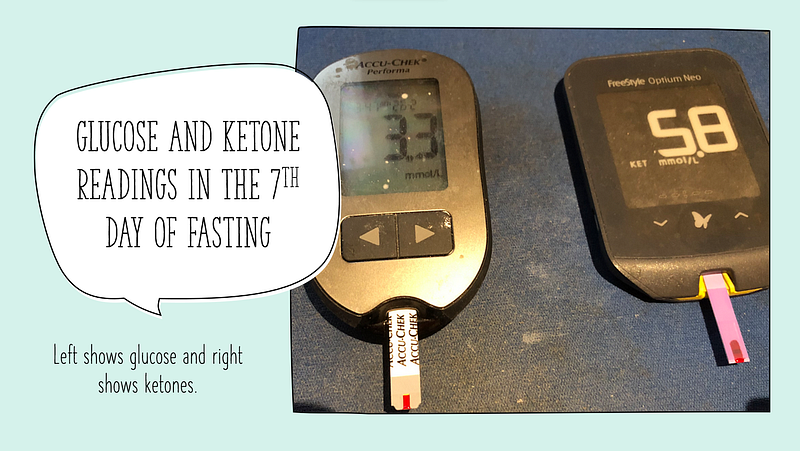
If this low blood sugar happens a diabetic or prediabetic person they need to go to the emergy room or eat a lot of carbs or drink sugary beverages. Sugar levels were lower than in my previous 10-day fast in this measurement because I walked a lot. When I start resting and meditating, it goes back to normal.
I will be candid here. Entering ketosis wasn’t a walk in the park initially decades ago. In the early stages, I experienced what many refer to as the “keto flu,” leaving me feeling drained and sluggish.
However, after a few weeks, I managed to alleviate these symptoms by addressing dehydration and electrolyte deficiencies, particularly sodium and magnesium. By increasing my water intake and electrolytes, the keto flu dissipated permanently.
When insulin levels decrease and glycogen stores are depleted, we lose substantial fluids, which is good to prevent bloating. However, we also lose critical minerals, so electrolytes are critical in ketosis. I documented the side effects of fasting and keto diets especially for sleeping in previous stories.
I prefer staying in ketosis longer as I age because it gives me the ability to power mitochondria, increase my energy, lower inflammation, speed up recovery from workouts, and give me mental clarity thanks to the power of β-hydroxybutyrate which is not only an energy source but also a signaling molecule talking to cells, mitochondria, and genes.
One of ketosis’s most significant benefits for me is its role in combating chronic inflammation. This has been instrumental in alleviating the symptoms associated with arthritis, an inflammatory autoimmune condition characterized by joint pain and discomfort. Ketosis has demonstrated its ability to reduce chronic inflammation and enhance metabolic and mental well-being through six fundamental mechanisms.
Ketosis helped my my body to be insulin sensitive and fat adapted. Some fat-adapted athletes love ketosis because they gain unlimited energy from their fat stores compared to the little power held in the glycogen stores. I have witnessed bodybuilders and athletes doing heavy work on an empty stomach with high performance.
If you are considering going keto and fast to enter ketosis, you must go easy on yourself. It takes time for the body to catch up with the new fuel system. If you want to learn more about ketosis, you might check this article I wrote before: Why and How to Enter Ketosis via Lifestyle Choices.
Herbivores, carnivores, and omnivores all can enter ketosis, as it does not discriminate people’s diets. You can still enter ketosis if you eat some carbs. But you need to refrain from refined carbs. Let me give you a few quick pointers to transition to a ketogenic lifestyle from mild to deep ketosis as required.
Key Takeaway Points
- Transition gradually into a low-carb eating regimen to avoid shocking your system. For beginners, skipping a meal, like breakfast or lunch, and eliminating snacks can ease the transition.
- Based on individual needs and dietary preferences, consume nutrient-dense foods like vegetables, nuts, healthy fats from avocados or fish, and adequate bioavailable protein from meat if you are not vegetarian.
- Stay hydrated by drinking enough water, tea, or coffee without added sugar, especially as the body loses water during the adjustment period when insulin levels decrease and glycogen stores are depleted.
- Ensure electrolyte balance, crucial in a keto lifestyle due to fluid and mineral loss during ketosis. While whole foods can provide electrolytes, supplementation may be necessary during fasting or intense exercise.
- Be cautious with fruit juices, sugary beverages, and alcohol, as they can rapidly replenish glycogen stores and prevent ketosis until glycogen reserves are emptied.
- Understand that ketosis and adopting a keto lifestyle is a journey. Initial side effects are part of the process but can be managed with time and adjustment.
- Be mindful of ketoacidosis, a distinct condition primarily affecting patients with type 1 diabetes, and consult healthcare professionals if uncertain about any aspect of the ketogenic diet.
- Recognize that ketosis may not suit everyone’s needs and conditions. Therefore, seeking guidance from a physician, dietitian, or registered nutritionist specializing in ketogenic diets is necessary.
Please remember that if your body is insulin-resistant, it is impossible to become fat-adapted and enjoy the remarkable benefits of ketosis. Therefore, as I documented in this recent story, you must make your body insulin-sensitive. The attached list provides further resources on ketosis and related lifestyle topics.
Thank you for reading my perspectives. I wish you a healthy and happy life.
To inform my new readers, I wrote numerous articles that might inform and inspire you. My topics include brain and cognitive function, significant health conditions, longevity, nutrition/food, valuable nutrients, ketogenic lifestyle, self-healing, weight management, writing/reading, and humor.
I publish my health and wellness stories on EUPHORIA. My posts do not include professional or health advice. I only document my reviews, observations, experiences, and perspectives to provide information and create awareness. 100+ Insightful Life Lessons from My Circles for the Last 50+ Years
If you are a writer, you are welcome to join my publications by sending a request via this link. I support 27K+ writers who contribute to my publications on this platform. I also have another profile to write and curate tech stories.
Importance and Value of Medium Friendship for Writers and Readers


