avatarAvi Kotzer

Free AI web copilot to create summaries, insights and extended knowledge, download it at here

3600

Abstract

the dogs.)</p><p id="48bb">In a column printed in various newspapers, Damon Runyon described a fight between “Yankee Schwartz, the old Philadelphia boxer,” and another man that Schwartz beat up.</p><blockquote id="abee"><p>“No Bimbo can lick me,” he said, breathlessly, at the finish. “What’s a Bimbo?” somebody asked “Tiny” Maxwell, on the assumption that “Tiny” ought to be familiar with the Philadelphia lingo. A bimbo,” said “Tiny,” “is t-t-two degrees lower than a coo-coo — cootie.”</p></blockquote><p id="735b">The Evening Public Ledger, a Philly newspaper, published this on May 25, 1920, regarding a boxing match: “Fitzsimmons Is No Bimbo”. I assume Fitzsimmons won.</p><p id="8c9d">According to <a href="http://www.etymonline.com">www.etymonline.com</a>, the term bimbo quickly turned into an insult for women, equivalent to “floozie”, thanks to a 1920 song, “My Little Bimbo Down on Bamboo Isle,” in which the singer narrates the story of his shipwreck on an island in Fiji and how he left a “little Bimbo” on that “Bamboo isle”. He also begs the listener not to alert his wife. No word on if the listener complied.</p><p id="203a">For the next twenty years or so, <i>bimbo</i> was an insult applied to both men and women. After World War II the word waned from the popular lexicon, and <i>bimbo</i> lived in a limbo — silly rhyme intended — for several decades. During the 1980s it started making a comeback thanks to the political sex scandals in the 1980s and 90s, but this time almost exclusively applied to women.</p><p id="d584">In response to that “offensive discrimination”, back-formed terms like himbo, <b>mimbo</b>, and — as <a href="undefined">Sheila Tracy</a> pointed out to me —<b> bimboy</b> popped up in order to designate dull-brained but attractive men. Sociologist Michael Kimmel drew a further distinction in 1994 by claiming there are two types of <b>himbos</b>: those created for women, like the model Fabio, and those created for men, like Arnold Schwarzenegger or Sylvester Stallone. Kimmel explained that “a man’s himbo” usually had some kind of skill or prowess, like Charles Atlas or Stallone, while “a woman’s himbo” tended to be gentler, like Woody Harrelson or Fabio.</p><h2 id="ff0b">Mexican bread</h2><p id="9f1d">In 1945, Mexican accountant, businessman, and philanthropist Lorenzo Servitje Sendra founded a company that ended up becoming the largest bakery on the face of the planet: <b>Grupo Bimbo</b>. If you’re wondering about Lorenzo’s last name, it came from Catalonia Spain, where his parents were originally from.</p><p id="ee0d">Servitje started a small baking company and expanded it into a “multinational conglomerate that has acquired more than 100 domestic and international brands, including Thomas’, Entenmann’s, Stroehmann, Oroweat and Freihofer’s.”</p><p id="fe7c">Growing up in Venezuela, I didn’t hear about Bimbo or its bread until the 1990s, when I was already an adult. The most popular brands of bread there, until then, were Holsum and a national brand called Puropan (literally, “pure bread”):</p><figure id="a008"><img src="https://cdn-images-1.readmedium.com/v2/resize:fit:800/1*c7xpktD069wEDaq4rKqQKw.png"><figcaption>Credit: RetroTV3Blog</figcaption></figure><p id="b477">Holsum licensed their brand to Bimbo and disappeared off the face of Venezuela. And then Bimbo out-muscled Puropan, if I recall correctly.</p><p id="5698">Although Bimbo’s founder, Lorenzo Servitje, was born around the time <i>bimbo</i> became a popular insult for men, the company’s name has nothing to do with that. According to <a href="http://www.din

Options

eroenimagen.com">www.dineroenimagen.com</a>, the name of the company was a portmanteau of bingo (yes, the game) and <i>Bambi</i>, as in the Disney movie that had come out three years before the company came into existence.</p><figure id="7280"><img src="https://cdn-images-1.readmedium.com/v2/resize:fit:800/0*qN5oJLD6aYw0HeRm.jpg"><figcaption>Screenshotted by Iva Reztok</figcaption></figure><p id="55b5">The bear on the logo was “discovered” when Jaime Jorba, the company’s first sales manager, received a Christmas card with a drawing of a polar bear on it. Jaime Sendra’s wife, who was then Bimbo’s chief of staff, put an apron and hat on the bear, and thus was born the famous character that has graced the brand’s packaging for decades.</p><p id="92be">My American friends who visited Venezuela would laugh when they saw the ads for Bimbo. Then Bimbo came to the U.S. in 1998, and everyone got a taste of the “floozy” bread.</p><figure id="ba61"><img src="https://cdn-images-1.readmedium.com/v2/resize:fit:800/1*dowxt3SSWjpd3sL3sV1bRA.png"><figcaption>Photo by Mike Mozart</figcaption></figure><p id="b4f1">I live in Spain now, where the company is the number one commercial bread-maker, which I guess makes them… the “breadwinner”? (Cue groans from readers.) This is one of the Bimbo breads that I buy on a regular basis. It’s “artisanal-style” semi-whole-wheat bread with a touch of honey.</p><figure id="6261"><img src="https://cdn-images-1.readmedium.com/v2/resize:fit:800/0*vpHhPRiFSa7534tY"><figcaption>Screenshotted by Iva Reztok</figcaption></figure><p id="f073">I don’t eat it, though. I just buy it for someone else. To be honest, I’m not a big fan of Bimbo’s bread. Despite having written almost 400 words about their history and product.</p><p id="3bf1">I assume the New York Times did not include bimbo in today’s list of answers for the Spelling Bee because they consider it offensive. Interestingly, they do accept the word <i>gigolo</i></p><p id="6d99">And because there is no way to convince them that the word is an “equal-opportunity” offender, the editors of the Spelling Bee decided that <i>bimbo</i> is a <a href="https://www.merriam-webster.com/words-at-play/dord-a-ghost-word"><b>dord</b></a>.</p><p id="2d12">You can check out my previous entry on another <b>dord </b>here:</p><div id="ba77" class="link-block"> <a href="https://readmedium.com/cricoid-d6d9fccc33a3"> <div> <div> <h2>Cricoid</h2> <div><h3>Prepare your throaty voice to read this article</h3></div> <div><p>medium.com</p></div> </div> <div> <div style="background-image: url(https://miro.readmedium.com/v2/resize:fit:320/1*f0zfjwlVW19xR6CIiKvIAA.jpeg)"></div> </div> </div> </a> </div><p id="6681">*What the heck is a <b>dord, </b>you ask? Here’s the answer:</p><div id="c9b7" class="link-block"> <a href="https://www.merriam-webster.com/words-at-play/dord-a-ghost-word"> <div> <div> <h2>'Dord': A Ghost Word</h2> <div><h3>One of the questions people like to ask lexicographers is this: Can you sneak something into the dictionary? Can you…</h3></div> <div><p>www.merriam-webster.com</p></div> </div> <div> <div style="background-image: url(https://miro.readmedium.com/v2/resize:fit:320/0*VURFmq9ffclpyfo7)"></div> </div> </div> </a> </div></article></body>

Bimbo

A male brute? A female airhead? A Mexican bread?!?
Photo by Denisse Leon on Unsplash

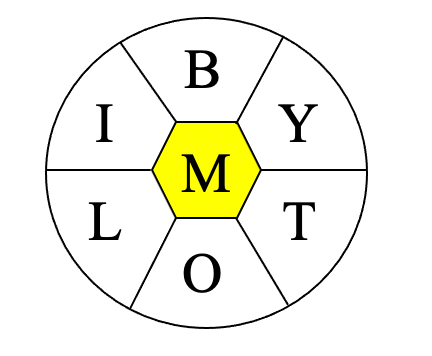
Today’s New York Times Spelling Bee letters:
Art: Iva Reztok

B, I, L, O, T, Y, and center M (all words must include M)

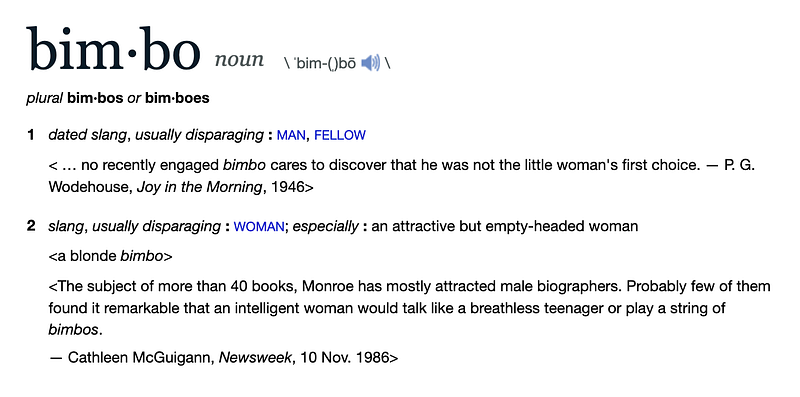
Merriam-Webster says…
Credit: merriam-webster.com

Silly little dictionary! Don’t you know bimbo can’t possibly be a word if the New York Times says it ain’t?

For further fascinating facts, check out the Spelling Bee Master.

What’s your favorite dord* from today’s puzzle?

My Two Cents

Today the word bimbo is used almost exclusively as an insult to women, although — as Magdalene Taylor explained in Mel Magazine — there is now a movement headed by Alicia Amira that is trying to own the term by proudly self-identifying as bimbos.

To that end, she has created a clothing brand aptly named Be a Bimbo, where she sells “pink, shiny and gaudy fashions associated with the bimbo identity”.

This reminds me a bit of how Jennifer Bleyer empowered the Jewish community against the slur “hebe” by founding a Jewish lifestyle and culture magazine called Heeb, even getting Steven Spielberg to back her financially. The magazine used to be in print but is currently in online format only, and doesn’t seem to have been updated in a couple of years.
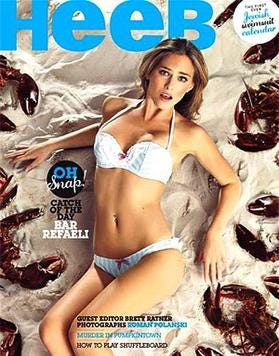
Yeah, I can certainly see a plethora of Jewish culture on that cover…

American history

Bimbo didn’t start as a dis on women, or certain “type” of women. According to Merriam-Webster, the origin of the term is uncertain, possibly from the Italian word bimbo, meaning “baby boy” or “male child”. Because Italian words have gender, the equivalent for “baby girl” is bimba.

The logical conclusion of the origin story tells us bimbo would have been an insult to men, which it was. The first recorded use is around 1918 or 1919. According to www.etymonline.com, the connotation of bimbo as “a stupid or ineffectual man” began as a slang term used by Philadelphia boxers. (and when I say boxers I mean the prizefighters, not the dogs.)

In a column printed in various newspapers, Damon Runyon described a fight between “Yankee Schwartz, the old Philadelphia boxer,” and another man that Schwartz beat up.

“No Bimbo can lick me,” he said, breathlessly, at the finish. “What’s a Bimbo?” somebody asked “Tiny” Maxwell, on the assumption that “Tiny” ought to be familiar with the Philadelphia lingo. A bimbo,” said “Tiny,” “is t-t-two degrees lower than a coo-coo — cootie.”

The Evening Public Ledger, a Philly newspaper, published this on May 25, 1920, regarding a boxing match: “Fitzsimmons Is No Bimbo”. I assume Fitzsimmons won.

According to www.etymonline.com, the term bimbo quickly turned into an insult for women, equivalent to “floozie”, thanks to a 1920 song, “My Little Bimbo Down on Bamboo Isle,” in which the singer narrates the story of his shipwreck on an island in Fiji and how he left a “little Bimbo” on that “Bamboo isle”. He also begs the listener not to alert his wife. No word on if the listener complied.

For the next twenty years or so, bimbo was an insult applied to both men and women. After World War II the word waned from the popular lexicon, and bimbo lived in a limbo — silly rhyme intended — for several decades. During the 1980s it started making a comeback thanks to the political sex scandals in the 1980s and 90s, but this time almost exclusively applied to women.

In response to that “offensive discrimination”, back-formed terms like himbo, mimbo, and — as Sheila Tracy pointed out to me — bimboy popped up in order to designate dull-brained but attractive men. Sociologist Michael Kimmel drew a further distinction in 1994 by claiming there are two types of himbos: those created for women, like the model Fabio, and those created for men, like Arnold Schwarzenegger or Sylvester Stallone. Kimmel explained that “a man’s himbo” usually had some kind of skill or prowess, like Charles Atlas or Stallone, while “a woman’s himbo” tended to be gentler, like Woody Harrelson or Fabio.

Mexican bread

In 1945, Mexican accountant, businessman, and philanthropist Lorenzo Servitje Sendra founded a company that ended up becoming the largest bakery on the face of the planet: Grupo Bimbo. If you’re wondering about Lorenzo’s last name, it came from Catalonia Spain, where his parents were originally from.

Servitje started a small baking company and expanded it into a “multinational conglomerate that has acquired more than 100 domestic and international brands, including Thomas’, Entenmann’s, Stroehmann, Oroweat and Freihofer’s.”

Growing up in Venezuela, I didn’t hear about Bimbo or its bread until the 1990s, when I was already an adult. The most popular brands of bread there, until then, were Holsum and a national brand called Puropan (literally, “pure bread”):
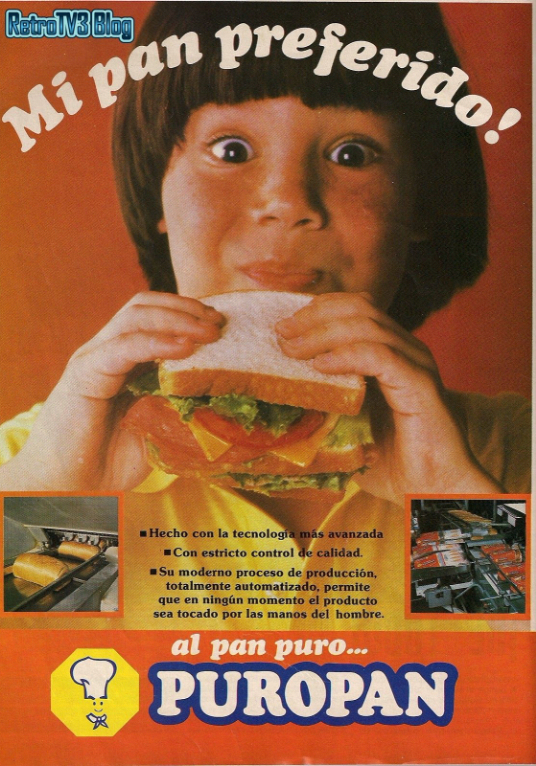
Credit: RetroTV3Blog

Holsum licensed their brand to Bimbo and disappeared off the face of Venezuela. And then Bimbo out-muscled Puropan, if I recall correctly.

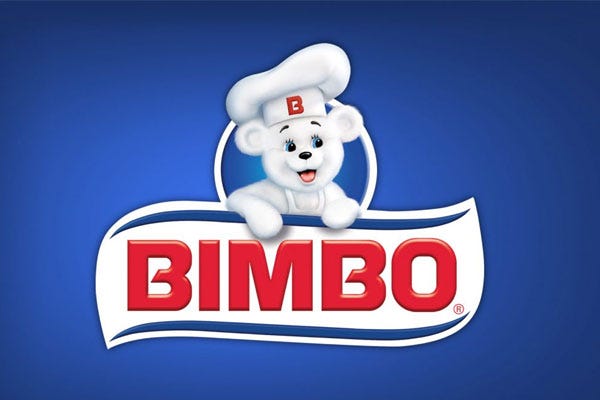
Although Bimbo’s founder, Lorenzo Servitje, was born around the time bimbo became a popular insult for men, the company’s name has nothing to do with that. According to www.dineroenimagen.com, the name of the company was a portmanteau of bingo (yes, the game) and Bambi, as in the Disney movie that had come out three years before the company came into existence.
Screenshotted by Iva Reztok

The bear on the logo was “discovered” when Jaime Jorba, the company’s first sales manager, received a Christmas card with a drawing of a polar bear on it. Jaime Sendra’s wife, who was then Bimbo’s chief of staff, put an apron and hat on the bear, and thus was born the famous character that has graced the brand’s packaging for decades.

My American friends who visited Venezuela would laugh when they saw the ads for Bimbo. Then Bimbo came to the U.S. in 1998, and everyone got a taste of the “floozy” bread.
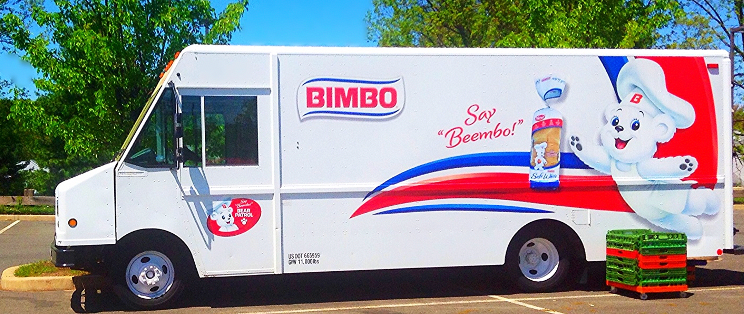
Photo by Mike Mozart

I live in Spain now, where the company is the number one commercial bread-maker, which I guess makes them… the “breadwinner”? (Cue groans from readers.) This is one of the Bimbo breads that I buy on a regular basis. It’s “artisanal-style” semi-whole-wheat bread with a touch of honey.
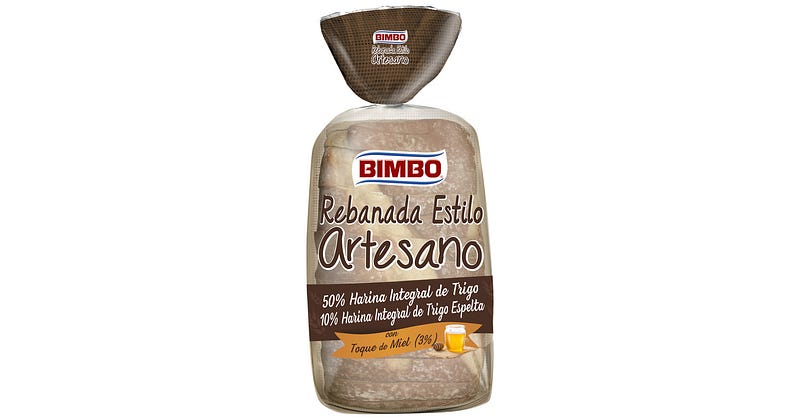
Screenshotted by Iva Reztok

I don’t eat it, though. I just buy it for someone else. To be honest, I’m not a big fan of Bimbo’s bread. Despite having written almost 400 words about their history and product.

I assume the New York Times did not include bimbo in today’s list of answers for the Spelling Bee because they consider it offensive. Interestingly, they do accept the word gigolo

And because there is no way to convince them that the word is an “equal-opportunity” offender, the editors of the Spelling Bee decided that bimbo is a dord*.

You can check out my previous entry on another dord* here:

*What the heck is a dord, you ask? Here’s the answer:

Spelling Bee
Language
History
Mexico
Culture
Recommended from ReadMedium