
Biden: Electric Vehicles To Be 50% of US Auto Sales by 2030
Investments to make before it becomes reality
I don’t use my phone much anymore; but two apps I do use often, for market news, are CNBC and WSJ.
On Thursday (8/5) I checked both and saw a bold goal: to have half of all new auto sales in the US be from electric vehicles. I figured if both these large media outlets are covering the same topic, there will be money moving in that direction soon.
Back in March, I wrote an article bringing attention to four companies that could benefit from the Biden administrations' renewal energy movement.
Similarly, based on this announcement and assumed government spending in this industry, there are investments that I believe will benefit.
Auto Manufacturers
The most obvious companies that will benefit from this goal are car companies.
The target goal of 50% is supported by the big US auto manufacturers, such as GM, Ford, and Stellantis (formerly Fiat Chrysler.) Executives of these companies were in attendance at the event Thursday. And later issued the following statement:
Ford, GM and Stellantis announce their shared aspiration to achieve sales of 40–50% of annual U.S. volumes of electric vehicles by 2030
In terms of stocks, GM and Ford have been lousy for years. In the last ten years, they have lagged the market.
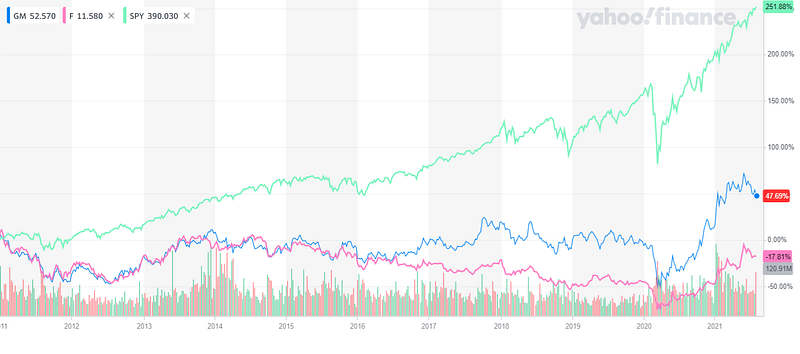
While these companies thrived fifty years ago, they have lost market share over time, for a variety of reasons, including foreign competition.
There were no representatives from foreign automakers at the event.
Some car companies have their own electric goals, such as Volvo which plans to go all-electric by 2030 and GM’s goal to only offer electric vehicles by 2035.
Another notable company without its top executive present: Tesla. Tesla sells the majority of all-electric vehicles in the US, but in terms of overall auto sales, they pale in comparison to the likes of Ford, GM, and Stellantis.
The US is the third-largest market for electric vehicles. But, electric vehicles sales made up only 3% of the total U.S. market in May and June. IHS Markit predicts U.S. all-electric sales to be 25% to 30% of new vehicles in 2030 and 45% to 50% by 2035.
As exciting as the announcement is, I am not sold on any of the three auto manufacturers performing well above the market over the next decade.
Aptiv
While auto companies are an option to invest in, the technology behind them is what is appealing to me. Technology has shown time after time it can outperform the market.
I wrote about Aptiv in my previously mentioned “Green Investments” article but I am such a fan of them, and they apply better to this situation, I will briefly touch on them again.
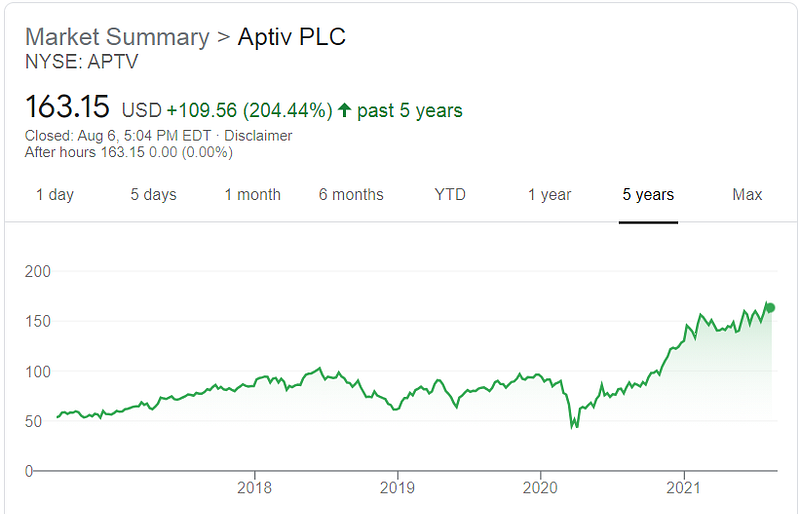
Aptiv is an auto parts company based in Ireland. Their electrical components help power electric vehicles and distribute data throughout the vehicle. Their major customers include Hyundai, GM, and Volkswagen, among others.
Aptiv’s stock is up 94% the last year and 200% the last five years.
Charging Stations
The part of this industry I’m most intrigued by is charging stations. They are completely new but just a copy of something old. Instead of gas stations, will we have electric stations?
The name I’ve seen the most in this area is ChargePoint. The company went public via a SPAC in late 2020. They saw their stock price shoot up to $46, only to fall back to earth, and are currently around $23.
ChargePoint operates over 114,000 charging stations in 14 countries, and both of those numbers will likely grow.
Another popular name is Blink Charging. Their stock tumbled to under $2 in 2019. But time rewards investors — the stock is now around $34, after hitting highs in February over $50.
Their focus is strategically placed stations in areas such as airports, hotels, and universities. From what I’ve read, they are viewed favorably because of their cloud-based approach, which allows for tracking all of its charging stations and the associated data.
A third name worth watching is Tortoise Acquisition II Corporation. This SPAC is in talks to merge with Volta Charging Inc.
While I’m intrigued by a charging station play, I don’t know how the industry will play out to know if this is the smart play.
One thing worth considering — besides the 50% goal, the infrastructure bill contains funds that should go to this segment of the industry.
Final Thoughts
Vehicles are important. They get us to and from locations and transport billions worth of goods.
I don’t know enough about cars to know if this is an achievable goal in terms of production, infrastructure, and most importantly, consumer adoption. The goal seems ambitious.
Under the Obama administration, a previous goal of selling 1 million EVs from 2012–2015 was short as the final tally was about 400,000 sold.
But one thing is clear, electric vehicles are the direction the future is going. It might be in one decade or three decades. Only time will tell.
The above references an opinion and is for information purposes only. It is not investment advice. Seek a duly licensed professional for investment advice.


