
Bended
No more wedding proposals, according to the Spelling Bee!

Today’s New York Times Spelling Bee letters:

D, E, M, N, O, T, and center B (all words must include B)
Merriam-Webster says…

Silly little dictionary! Don’t you know that bended can’t possibly be a word if the New York Times says it ain’t?
For further fascinating facts, check out the Spelling Bee Master.
What’s your favorite dord* from today’s puzzle?
My Two Cents
When I first saw the photo at the top of today’s column, I thought the two people in it were women. Which was actually very cool, since it sidesteps the cliché of a man proposing to a woman. And yes, I’m aware the rest of that picture is very cliché. But then, when I looked closer, it seemed to me that the person on the left, the one on bended knee, might actually have a beard. It’s hard to tell.
Still, today a beard means nothing when it comes to gender. And that’s fine by me. So, my dear readers, you can use your imagination and come up with your own story regarding who is proposing to whom in this image. As that old Burger King slogan goes, “have it your way”. What’s important is that the person on the left has a knee that’s bended.
Why did the Spelling Bee reject this word? I mean, the phrase “on bended knee” is quite common, and not just for romantic and clichéd proposals. Read on to find out more!
Diamonds are forever
The dictionary laconically states that bended is the “archaic past tense of bend”, which is not very helpful if you have no clue what bend means. For those of you who don’t know, the verb bend has a bunch of meanings. Ten, according to Merriam-Webster. But the two that concern us in the case of bended is “to constrain or strain to tension by curving” and “to turn or force from straight or even to curved or angular”.

The person in the above picture has a bunch of bended body parts: her spine, some fingers, her knees… even some of her toes! It seems like most of their body is bended in some way or another. But I find that image too distracting, so in order to focus your attention on the bended knee, I’ll direct your eyes to this one, which shows not one, but two of them:

Who knows, maybe it’s the same person years after being stranded on that rock by the photographer.
Our friends at Merriam-Webster have this to say about the phrase on bended knee.
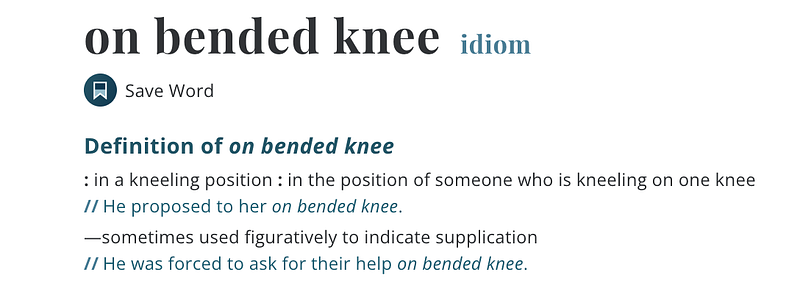
As you can see at the top right corner, this expression can sometimes be used as idiom. Idioms are phrases with a meaning that can’t always be understood by taking the words literally. For example, “it’s a piece of cake” is an answer you can give when someone at a birthday party asks you what you’re eating… but it can also be an idiom you use to indicate that a task is very easy. “It’s raining cats and dogs” is an expression that literally almost never happens ––or at least I hope it never does–– but figuratively means that it’s pouring. “It’s raining men”, on the other hand, is something completely different.
According to Mary McMahon in languagehumanities.org, “The use of ‘bended’ is actually archaic; ‘bent’ emerged around the 1600s, but ‘bended’ has been retained specifically in this phrase since then. The term ‘on bent knee’ is also correct, although it sounds slightly less exciting and romantic.” As to the idiomatic meaning, she explains this:
The implication of bending or kneeling is that the person who is bending is submitting. People often adopt bent positions to pray, indicating a submission to God’s will. People have also historically bent to mark respect for and submission to people who are of a higher social rank. This has been especially true in circumstances in which people wish to request something, such as a boon of land, titles, or clemency from a lord historically. When someone says that he or she made a request “on bended knee,” the implication is that he or she asked as humbly as possible, in a way which might be said to be bordering on groveling or pleading.
Today, Western society usually frowns upon asking for things on your knees, be they bended or bent. People look down upon those scenarios and make fun of those who resort to that strategy. Even the person to whom you’re making your supplication might simply see you as pathetic and reject you.
But there is one case in which asking s. As McMahon says, “The tradition of kneeling to ask for someone’s hand is a reminder of an era in which kneeling was a sign of deep respect, indicating an intense desire for something.”
In many cultures, marriage proposals are typically associated with an engagement ring, and engagement rings are typically associated with diamonds. But that was not always the case. In ancient Rome, engagement rings were signs of ownership and were sometimes made of material other than gold: ivory, copper, iron, and even bone. It was Pope Nicholas I in the year 850 who declared that “an engagement ring symbolized a statement of man’s intent to marry” and the ring was meant to represent financial sacrifice. By then gold was the most popular material used for making rings, at least in Europe.
One of the first recorded uses of diamonds on an engagement ring happened in 1477, when Archduke Maximilian of Austria set diamonds in the shape of an M when he proposed to his fiancée, Mary of Burgundy. But it took another four and a half centuries for diamonds to become the go-to precious stone for marriage proposals. If you have no idea who’s responsible, well, you clearly don’t know your Leonardo DiCaprio movies.
In an article in The Knot, Sarah Hanlon explains how a certain infamous diamond conglomerate found a way to sell their product during one of the toughest economic times in the history of the U.S., the Great Depression:
The diamond industry was struggling to sell products due to the financial strain US citizens faced. As the leading diamond retailer at the time, De Beers launched a marketing campaign that aimed to increase the sale of diamond engagement rings. It’s important to note that, up until this point, diamond rings were not the norm for engagement jewelry. In order to change this narrative (and improve their business profit), De Beers’ campaign claimed that diamond engagement rings were a true symbol of love, and that buyers should commit one month of their salary to the purchase. According to the American Gem Society, this ad campaign increased diamond sales by 50%. By the end of the 20th century, about 80% of engagement rings included diamonds. This marketing campaign lasted through the years, and by the 1980s the number was upped two months, which eventually turned into three months’ worth of your salary.
Over the last couple of decades there’s been some backlash against both DeBeers and blood diamonds in general, with people either selecting other stones to use, or even choosing ring-less ways to affirm their love commitment to each other. If you’re still into the jewelry part of it but want options other than diamonds, The Knot has some for you here.
Boyz II Men is also forever
Did you know this band, who shot to fame in the late 1980s and early 1990s, is still together, active, and currently on tour (scroll down) in the States and Canada?
Boyz II Men (pronounced boys to men) is a vocal harmony group from Philadelphia, Pennsylvania, best known for their emotional ballads and a cappella harmonies. The group originally was a quartet featuring baritone Nathan Morris, tenors Wanya Morris and Shawn Stockman, and bass singer Michael McCary. The latter member left the group in 2003 due to back spasms that eventually turned out to be multiple sclerosis.
Their first huge hit was the 1992 song “End of the Road”, included in the soundtrack of Eddie Murphy’s film Boomerang. This tune became number one on the Billboard Hot 100 in August of that year and stayed there for a record-setting 13 weeks until November.
The band is perhaps best-known for “One Sweet Day”, their 1995 collaboration with Mariah Carey ––the song ranks first in Rolling Stone’s reader’s poll for the Best Collaboration of All Time. This tune spent 16 weeks as number one on the Billboard Hot 100, a record that wasn’t broken until 2019, when Lil Nas X’s “Old Town Road” lasted 19 weeks.
In 1994, however, Boyz II Men had incredible success on their own, doing something that hadn’t been done since the Beatles. Their single “I’ll Make Love to You” was charting at the top of the Billboard Hot 100 in the U.S., when another song replaced it. The artist? Boyz II Men. The song? “On Bended Knee”. (See? There is a connection to today’s word!)
This was the first time in 30 years that an act had replaced itself at number one on this American music chart. The previous ones to do it were the Beatles, when “I Want to Hold Your Hand”, “She Loves You”, and “Can’t Buy Me Love” stayed as number ones for a combined 14 weeks.
Interestingly, the lyrics of “On Bended Knee” have nothing to do with marriage proposals. The connection is closer to the idiomatic sense of the expression. The singer begs “on bended knee” for his ex-lover to come back to him, and apologizes for his wrongdoing. The official music video shows the four band members as they break up and make up with their girlfriends, played by well-know actresses Kim Fields, Renée Jones, Victoria Rowell, and Lark Voorhies (of Saved by the Bell fame).
Enjoy the song!
I wonder if Boyz II Men can be hired for weddings…
Now you know. If you’re ever being pressured to propose to your significant other, just tell them that it’s impossible for you to do it. See, you’d love to get down on bended knee… but because the editors of the Spelling Bee decided that bended is a dord*.
You can check out my previous entry on another dord* here:
*What the heck is a dord, you ask? Here’s the answer: