
Adyta
Let’s delve deep into temples
Today’s New York Times Spelling Bee letters:
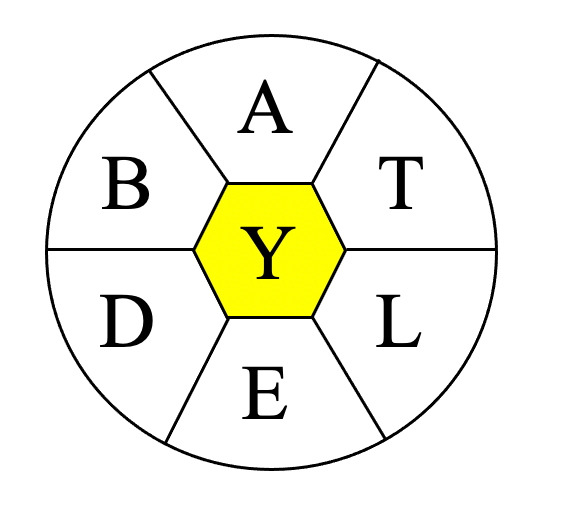
A, B, D, E, L, T, and center Y (all words must include Y)
Merriam-Webster says…
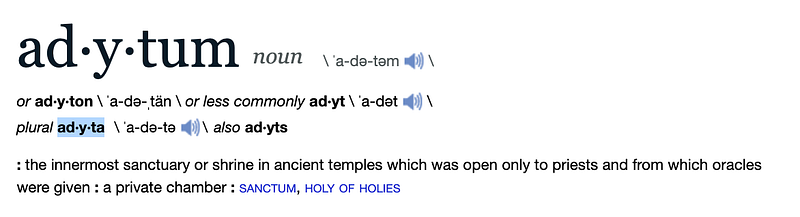
Silly little dictionary! Don’t you know that adyta can’t possibly be a word if the New York Times says it ain’t?
For further fascinating facts, check out the Spelling Bee Master.
What’s your favorite dord* from today’s puzzle?
My Two Cents
I highlighted the word adyta in the screenshot of the entry provided by Merriam-Webster. Just in case you happen to be a new reader and aren’t familiar with the way this column works. Contrary to the editors of the Spelling Bee, we accept most variations and irregular plurals and conjugations, so long as they appear in the dictionary. In this case, adyta is an irregular plural of adytum — a “regular” plural would have been adytums… I think. Interestingly, there is a different regular plural listed, adyts, for the variant adyt. The plural for the variant adyton (which one presumes would be adytons) is not mentioned.
And thank goodness for the irregular plural adyta, as the options in today’s list of rejected words was not very inspiring:
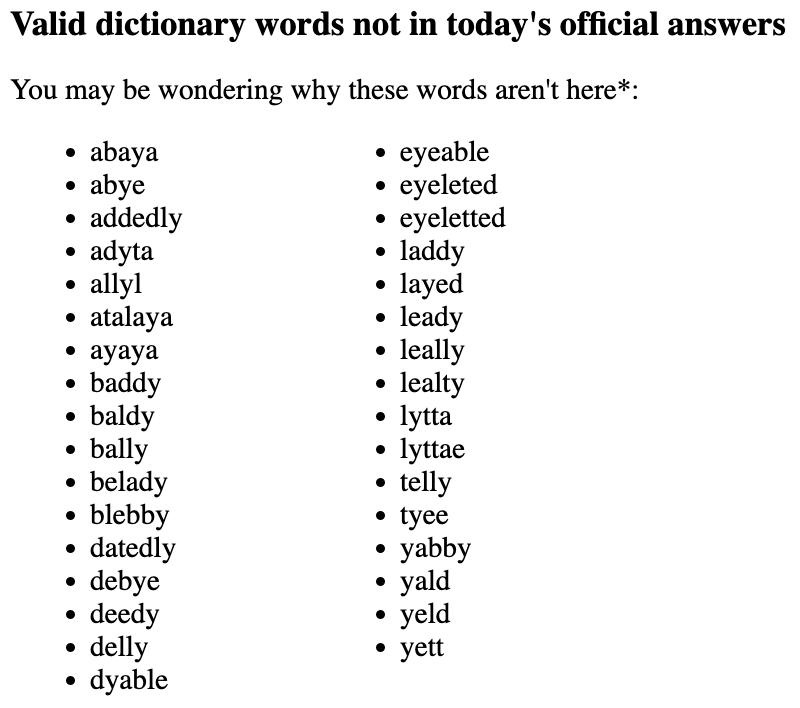
That’s a typical problem I face when the center letter is Y, as is the case today. Most of the valid words in today’s puzzle end in Y –-as do most of the dords* in the above list–– which means they are usually verbs, adjectives, or adverbs. The ideal part of speech for us here at Silly Little Dictionary! is the noun. Verbs can work well, too. Adjectives and adverbs not so much.
As for the four words above that begin with Y, well, yald is not in the dictionary; yeld is a variant of eild, which is Scottish for a barren (as in animals); yett means “gate” in Scottish; and yabby is a word I wrote about in April of last year. If you decide to read that article, you’ll be able to see footage of the extinct Tasmanian tiger, aka Tasmanian wolf. Just promise to come back and continue reading all about the adyta.
Holy of Holies
Our friends at Merriam-Webster explain that the word adytum was borrowed from the Latin adytum, itself borrowed from the Greek ádyton (ἄδυτον) the neuter form of ádytos, meaning “not to be entered”.
In ancient Greece the most famous adytum belonged to the temple of Apollo in Delphi. In general, it seems as though adyta were usually associated to this god’s various temples, and were spaces from which most people were excluded. Only oracles, priestesses, or priests could enter the adyta. Perhaps the best-known among them was Pythia, a high priestess and oracle who served at Delphi. The Oracle of Delphi was the go-to person when it came to making important decisions back then.
The ancient Greeks thought that Delphi was the location of the world’s navel. I’m not kidding. A stone monument called the omphalos had been placed where they thought the exact center of the world was located.
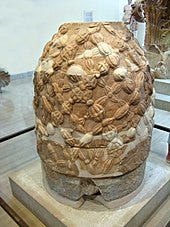
Legend has it that Zeus, the god-in-chief back then, ordered two eagles to fly towards each other from the two ends of the Earth in order to locate its exact center. The eagles’ paths crossed right above Delphi, so Zeus placed the umbilical stone there.
One theory posits that this stone was kept in the adytum, which I guess would have allowed the high priestess to do some serious navel gazing.
In more modern usage, the term adytum has been applied to other cultures, for example, the ancient Egyptian temples or the tabernacle used by the Israelites while they wandered around the desert for 40 years before entering the Promised Land. The tabernacle was the “portable earthly dwelling place” of God and also where the Ark of the Covenant was kept. Yeah, that’s right. This ark:
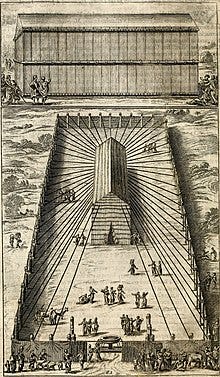
The ark contained the stone tablets upon which were inscribed the Ten Commandments. The place where the ark rested was known as the Holy of Holies (קֹדֶשׁ הַקֳּדָשִׁים in Hebrew). Below is an engraving of the tabernacle done in 1683 by Robert Arnauld d’Andilly based on a description by Jewish-Roman historian Flavius Josephus…
…and here is a modern model in Timna Valley Park, Israel:
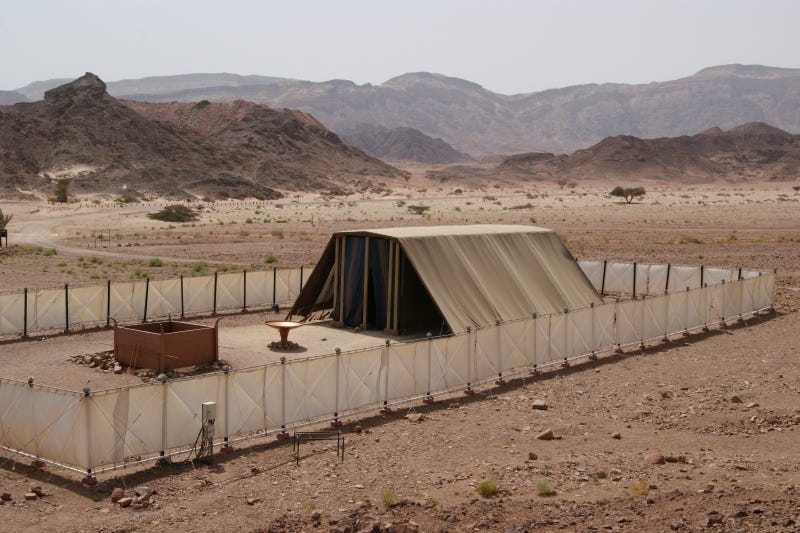
The tabernacle was still used for a few hundred years after the Israelites settled in Canaan, until Solomon built the first temple in Jerusalem. Then the ark was moved into a new Holy of Holies that had been built inside the temple. The Holy of Holies was entered only once a year by only one person. This happened on Yom Kippur (known as the Day of Atonement), and the only person authorized to go inside was the High Priest, to sprinkle the blood of sacrificial animals and offer incense upon the Ark of the Covenant.
For obvious reasons, today the precise location of the Jewish adytum is much debated. There are three main theories as to where the Temple itself stood: where the Dome of the Rock is now located; to the north of the Dome of the Rock, or to the east of it. Therefore, the location of the Holy of Holies would depend on first establishing where the Temple actually was almost 3,000 years ago.
Hollywood of Holies
While doing my usual intensive 15-minute research for this article, I happened upon an interesting use of the word adytum. Turns out there is a school of Western mysticism and esotericism named Builders of the Adytum (B.O.T.A. or BOTA for short).
This is their logo…
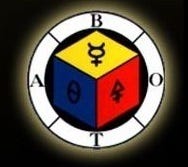
…and this is the explanation on their website’s home page:
Adytum is derived from a Greek word that means Inner Shrine or Holy of Holies. Like Jesus, who many believe was trained in Qabalah, members of the Order aspire to build the Inner Temple, to construct the Holy of Holies within. People of all faiths are welcome to study the teachings of this Order. B.O.T.A. recognizes Qabalah as the root of Judaism and Christianity. Its ultimate purpose is to hasten the true Brotherhood of mankind and to make manifest the truth that love is the only real power in the universe.
According to the Wikipedia article about them, BOTA was founded in 1922, which would make this year their centennial. But I couldn’t verify that date anywhere, even on their website. The closest I got was the phrase “that have sustained Builders of the Adytum for nearly 80 years”, but that information isn’t much help because I couldn’t find out when it was written.
In any case, the founder of Builders of the Adytum was Paul Foster Case, an occultist of the early 20th century who wrote books about the connections between Hermetic Qabalah (not to be confused with Jewish Kabbalah) and the tarot cards. He also authored many of the lessons for people who decided to join BOTA. And what do these lessons teach? “These instructions and practical secrets constitute what is known as Ageless Wisdom. It is called ‘Ageless’ because it is not susceptible to the mutations of time. Ageless Wisdom is not primarily a product of man’s thinking. It is “written by God upon the face of nature,” and is always there for men and women of all epochs to read,” according to the web site.
When Paul Foster Case died in 1954, his secretary Ann Davies became the head of B.O.T.A., helping it flourish and expanded to Europe and Australia. There is even a couple of offices here in Spain, where I live. I found it interesting to peruse their website and skim some of the free content they offer in the old newsletters and publications. You can even apply to become a member. If you’re curious, here is the link.
Now you know. Next time you visit an ancient temple, ask the tour guide if there are any adyta they can show you. Don’t be surprised if they kick you out, though. Not because you were being rude… but because the editors of the Spelling Bee decided that adyta is a dord*.
You can check out my previous entry on another dord* here:
*What the heck is a dord, you ask? Here’s the answer: