
Being Happy is the Meaning of Life — for Adult Babies
Albert Brooks’ conservative sales pitch for capitalism’s takeover of philosophy
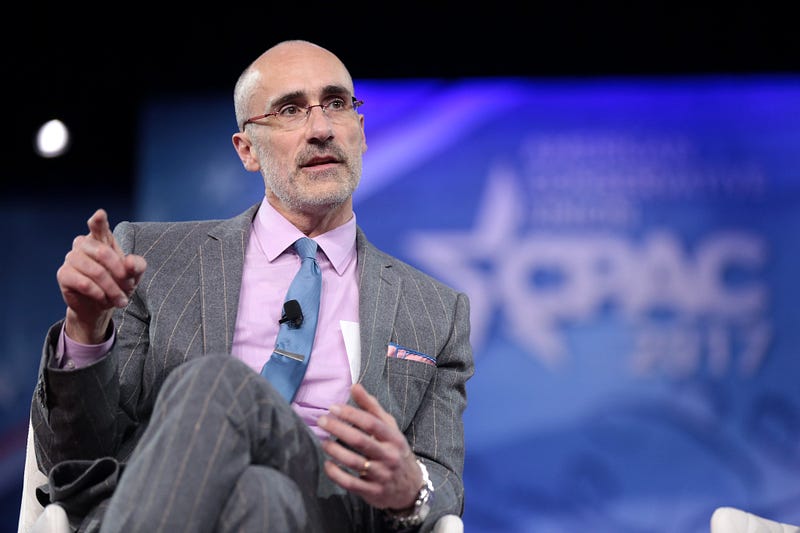
In an editorial for The Atlantic, Albert C. Brooks, the conservative professor of management practice at the Harvard Business School, former president of American Enterprise Institute, and author of The Road to Freedom: How to Win the Fight for Free Enterprise suggests, as he says in the title, that “The Meaning of Life Is Surprisingly Simple.”
But we should be suspicious of his facile solution.
Happiness and the Meaning of Life
For Brooks, you just break down the problem of life’s meaning into three concepts of positive psychology. These are:
- “coherence” or “how events fit together,” which is “an understanding that things happen in your life for a reason”
- “purpose” or “the existence of goals and aims,” which amounts to “the belief that you are alive in order to do something”
- and “significance” or “life’s inherent value,” which is “the sense that your life matters.”
These three dimensions are like “macronutrients,” says Brooks, in that a meaningful life is made up of a healthy, balanced diet of them. This appeal to balance is in line with ancient Greek virtue theory and specifically with Aristotle’s view that happiness is the practice of human flourishing.
The meaning of life isn’t a big mystery, for Brooks or for positive psychologists. It’s just a question of learning the techniques of how to be happy. The meaning of human life is to discover our purpose, which is ultimately that of being happy, and there are practical steps we can take to achieve that goal. The rest is philosophical or religious over-analysis and obfuscation.
Brooks’s point in the editorial, though, seems to be to warn the reader about some extremes that upset the balance. When we’re off course, he says, we might feel out of control, we might lack big plans, or we might worry that our life has no value and that it wouldn’t matter if we just disappeared. To get back on track we should focus on searching productively for worthy goals and on working hard to achieve them. Only then will we be happy.
But Brooks stresses that we shouldn’t search too hard since “Your quest for meaning will be counterproductive if it hinders your happiness.”
That breathtaking declaration is based on the psychologist’s distinction between “presence” and “search.” If you feel like you know your life’s meaning, you’re present, and if you don’t you search. But it’s possible to search too much since searching can present you with too many choices. Life will seem as overwhelming and absurd as the choice of cereals or jams at the supermarket.
“Presence is highly correlated with well-being,” says Brooks, “but search seems to have no bearing on it — and pondering your meaning in life too much could even lead you to dissatisfaction.”
Moreover, says Brooks, ‘Philosophy is often unhelpful, offering abstract ideas such as Aristotle’s human function or Kant’s “highest good” that are hard to comprehend, let alone put into action.’
In this implicit battle between philosophy/religion and positive psychology, Brooks makes one concession to philosophy at the end of his editorial. He concedes that there’s a problem of whether life really does have any meaning. Albert Camus, for example, argued that we’d be better off, like Sisyphus, accepting that life is absurd.
Brooks confesses that he “cannot say for certain” whether meaning in life is real, but that’s only because this matter ‘is, as we say in my business, an “untestable hypothesis.”’
The Conservative’s Fear of Philosophy
Brooks’ account is what happens when philosophy and religion are denigrated until they fall by the wayside, to be replaced with pop psychology that provides propaganda for runaway capitalism.
The relevant problem with philosophy and with religion isn’t that they’re too abstract and hard to understand; rather, it’s that they call into question the presuppositions and intentions of positive psychologists and of conservatives like Brooks.
If philosophy and authentic religion seem too esoteric, perhaps the fault lies with the economic system that keeps most people ignorant, infantile, greedy, shallow, and preoccupied with drudgery and with consuming vapid entertainments.
Brooks and the Harvard Business School are concerned, of course, with maximizing productivity. The unstated goal in his article is to co-opt the philosophical question of life’s meaning and to reframe it in psychological terms that reinforce the economic and natural imperatives of increasing growth and productivity and of accepting certain power inequalities, however monstrous those inequalities might seem from a more enlightened perspective.
After all, different people will naturally have different opportunities and thus purposes or goals to pursue that are beyond the pale for other members of society. The rich, for example, will be disposed to rule, while the hoi palloi are condemned to toil away in their more menial tasks.
The contention that being happy is the meaning of life is consistent with that infamous, longstanding social hierarchy, so beloved by conservatives, because happiness is contentment relative to a purpose. You should stay upbeat, Brooks is saying, within your station in life, and you should keep your head down and don’t overthink it with meta-reflections. Above all, you should finish your work because you’re happiest when you’re absorbed in achieving your purpose.
That’s how Aristotle managed to reconcile his ethical system with patriarchy and slavery: women and slaves have their proper stations, relative to which they’ll be happy, he assumed, while Greek men are naturally inclined to rule. Upset that social order and you’ve violated the natural rights to which the conservative defers — even while he or she often pretends to be suckered by the noble lies of an inauthentic, debased religion such as white Evangelical American Christianity.
Progress Towards Posthumanity
Suppose this productive, well-functioning society breaks down, as it did with the rise of modernity in the second half of the second millennium CE, when the peasants revolted against the royals in the name of personal liberty or Protestant defiance of the corrupt elites. In that case, the moderate response of the conservative virtue theorist or of the positive psychologist would be to condemn the revolution that throws everything into disorder. Meaning in life is impossible if society blows up and we’re unable to engross ourselves in our work.
Of course, the radical progressive’s response to that dogmatic, fallacious submission to natural, animal norms was to challenge what had been the conservative’s or “traditionalist’s” preferred way of organizing society for thousands of years, namely feudal monarchy. And that revolutionary response was based precisely on the deep reflections that Brooks thinks are counterproductive.
Indeed, if you subordinate the search for life’s meaning to the goal of being happy, which is to say the goal of being content in the purpose you’re best equipped to achieve, deep reflection will be counterproductive because you’ll be liable to question the available options. This happened also in the 1960s, when a breakout of entheogens (psychedelic drugs) drove young adults in the US and the UK into open rebellion against the governments and their conservative or neoliberal apologists.
The Vietnam War was sold as part of America’s purpose, to defeat communism for the sake of capitalist enterprise, just as American and South African apartheid was sold in dubious Christian terms. But the hippies briefly saw through the charades, even as the first charade — American economic hegemony — revealed the depravity at its core in Nixon’s Watergate scandal, and as white supremacy seemed increasingly scandalous and preposterous after the defeat of the Nazis in WWII. The result was a civil rights revolution.
Such radicalism isn’t about being happy in the sense of being content within a productive social order. The idea is to look beyond society, to stretch the mind and to begin to outline what a transhuman way of life would be like. A human social order is still largely animalistic in that we adopt nature’s way of organizing groups to our species’ skillset. We keep the dominance hierarchies and the winner-take-all systems, changing only the propaganda and the social mechanisms as needed when theocratic monarchy gives way to secular plutocracies and dictatorships, for example. But we don’t yet transcend the noble lies needed to sustain such oppression and rapacity.
Aristotle defined virtue and honour as being relative to human nature. What Friedrich Nietzsche saw is that human nature is a bridge between the animal and the posthuman. Our greatest potential isn’t to serve masters as quasi-animals or as enslaved cogs in a megamachine, nor is it to rule as such corrupted masters; rather, we should be creating a new, virtually supernatural or anti-natural world order. That’s the freedom found in our capacities for rational self-determination and for peak states of awareness and understanding.
That enlightened perspective would call into question, for example, precisely the productivity Brooks extolls, for being ultimately self-destructive and degrading. We may be happy as consumers but only because we don’t know any better or we’re too busy to think hard about what consumerism entails in the long run.
American workers were content for decades with no increase in the minimum wage even as productivity kept rising — until the 2020 covid pandemic drove most people to the sidelines, forcing us to ruminate on the status of our life. The result is a massive labour shortage in the “deregulated” US, as many Americans refuse to return to the job market that’s been rigged against them.
How Runaway Capitalism Deprives Life of Meaning
Indeed, if anything, “free-market” capitalism’s prioritizing of the profit motive makes our life less meaningful, by facilitating the rise of what anthropologist David Graeber called “bullshit jobs,” such as corporate lawyers, “manufactured middle managers,” “public relations consultants, telemarketers, brand managers, and countless administrative specialists” — to use Graeber’s examples.
Partly, this is the result of the growing automation of labour which leaves less for humans to do during the workday. But as we also saw from the covid pandemic, the so-called “necessary workers” — the teachers, firefighters, police, construction workers, healthcare workers, food providers, garbage collectors, and so on — complained that they were being overworked for relatively little pay, while the richest ten percent of the population, whom Matthew Stewart calls the “new American aristocracy,” were able to perform their bullshit jobs at leisure from their home, with video conferencing.
That’s a perverse outcome of the kind of capitalism that Brooks is elsewhere at pains to defend: the necessary jobs in society are the least well-rewarded or respected, while the most prestigious and handsomely paid jobs are also often the least important or fulfilling.
No wonder the upper class tends to lose its scruples or to have its inherent amorality reinforced. It’s not just that power corrupts. Rich people’s selfishness and cruelty may also be ways for them to lash out at the indifferent world that puts them in charge; their meanspirited, social Darwinian impulses look like resentments for having to pretend that they’ve earned their privileges and that their “happy” life isn’t a grotesque sham.
Perhaps most of all, bullshit workers must resent the emptiness and the futility of their being thrust into leadership roles in a society that’s evidently out of control.
Human Happiness is Irresponsible and Infantile
Should our highest goal be contentment? If so, a lobotomy will suffice. Return to the Matrix, keep your head down, don’t think too much, and you can be happy even making pennies a day in a poor country that’s been run into the ground by rampaging puppet regimes and warlords. In other words, let nature or animal instinct take its course and override your higher calling. Let the many be exploited by the few and let reality stay hidden behind a veil of feel-good lies.
If you have transhuman (radical, progressive, philosophical, or spiritual/existential) inklings, though, you’ll suspect that happiness is fit only for sheeple, and that the positive psychologist or the free-market apologist who reduces the problem of life’s meaning to one of productivity is a shepherd who just wants us to stay in our lanes. Those lanes are the animal prejudices that make feudal or neofeudal oligarchy the civilizational default.
To wonder whether the meaning of our life is only a sideshow is to begin to understand where our entire species and history fit into the universal order.
If you’re thinking about life’s meaning, you should ask not how to fit into the productive social roles that serve especially the corrupt rulers. Instead, ponder what a non-deluded, wholly honourable (transhuman or enlightened) social order would look like, and ask whether that society would depend on the babyish, decadent urge to be content with the plethora of absurdities that haunt the inquisitive mind.


