
Befriend your Dread Buddy
Pre-meeting anxiety doesn’t have to ruin your day
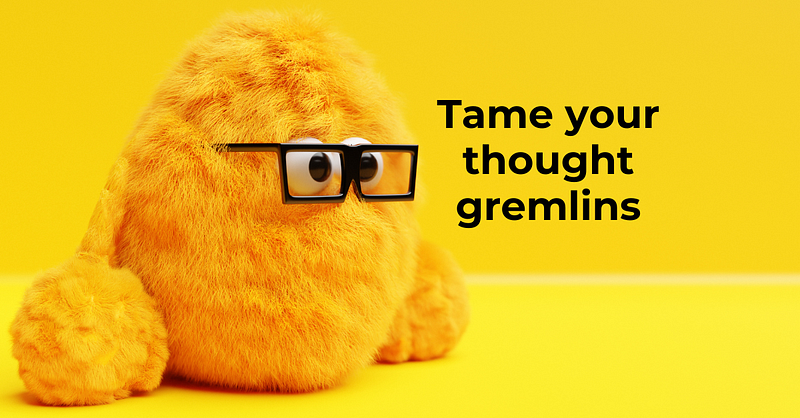
I used to have a problem with a thought gremlin I call Dread Buddy.
This little monster would visit me in the hours before an important meeting and wreak all sorts of havoc on my day.
“Oh look who showed up 3 hours early to my weekly meeting, it’s Dread Buddy!”
Past me might have let Dread Buddy run wild, trampling my calendar and headspace. Nowadays, I let this doom pet sit beside me. If it starts getting fussy, I take a moment to hear it out and then say, “Psst. Simmer down, I’ve got work to do.”
Here’s how I tamed and befriended Dread Buddy.
Two linguistic magic tricks for bewildering beasts
I was eventually able to calm my pre-meeting dread. It started with some useful magic words that gave me a necessary perspective shift.
“This is the part where…”
Just like how it can be hard to see what’s going on with the chair you’re sitting in, sometimes we need to get emotional distance from a situation.
“[This is the part where] helps us access a future perspective. We’re looking at it from a place where the story has already moved on and we can look back with more peace and compassion.” — Master Coach Kara Loewentheil in a podcast episode called This is the part where…
To cast your time-travel spell, start with the phrase, “This is the part where…” and fill in the rest with a summary of your current situation.
Taking this perspective places you — as the storyteller of your own life — in a more observational position. That distance can be crucial for accepting what’s happening and inviting new ways of seeing in.
Applying ‘This is the part where…’ to my weekly meeting anxiety transformed the dread I felt into something more commonplace and expected, given my circumstances.
Specifically, this distance helped me realise that the reason I was feeling anxiety and dread was because I was lacking clarity — I wasn’t clear about my role in the weekly meeting and needed confirmation that I was fulfilling the expectations of the stakeholders.
Like it or not, Dread Buddy was there for a good reason. It was tugging on my sleeve, trying to let me know — the only way it knows how — that I was not getting the clarity and feedback I needed to move forward confidently. Once I heeded the message, Dread Buddy was pacified, and chilled out enough for me to shift focus to resolving the unmet need.
Name it (but don’t shame it)
The ability to name things is another linguistic trick we have up our human sleeves.
The magic in this method is not solely in the naming, but in what we do with these monikers. We can use our label makers as tools for good or as weapons for harm.
Labelling can help us create acceptance and closeness, such as when we bestow a name on something important (even if we don’t like that thing). Even having a name for a disease can help us acknowledge and familiarize ourselves with something nebulous and terrifying.
Labels give form to the unknown.
However, labels can do harm when used as cudgels for punishment, such as when we label something as a way to shame ourselves or others. That’s not helpful.
I could have called my anxiety gremlin Dread Demon, Anxiety Monster, or something else equally villainous. But I find it’s harder to accept it that way, much less befriend it.
So, Dread Buddy it is.
If that label works for you, feel free to name yours as such. Or find something that fits better. I’d love to hear what you come up with.
A multiverse of helpful monsters
Dread Buddy is just one of many thought gremlins.
In a long read by Tim Urban, he writes about taming your Social Survival Mammoth. This particular gremlin has “a craving for social approval and admiration, and a paralyzing fear of being disliked.”
Your Social Survival Mammoth is why you care what other people think of you…and why you might spend hours ruminating about that recent awkward interaction.
Thought gremlins such as Dread Buddy or Social Survival Mammoth come from primitive places. They all serve the same master — to alert you about something. As ancient, clumsy messengers, their delivery sucks. But they carry an important message.
The value of these dreadful messengers
As shown in neuroscience research by Dr. Tracy Dennis-Tiwary, there is wisdom in anxiety.
She argues that in our anxious states, with our thought gremlins grumbling and nipping at us, there’s also hope. Anxiety can be productive, in the sense that it can alert us to dangers or unmet needs. As such, the job of anxiety — and all its unsightly harbingers — is to keep us safe.
“Far from a sickness or malfunction, anxiety is an advantageous emotion that evolved to protect us and strengthen our creative and productive powers.” — Dr. Tracy Dennis-Tiwary
Because of this, I now see the value of Dread Buddy. In it’s disruptive way, it’s here to tell me something. It shows up when I’ve blown past all the more subtle warning signals…all while the productivity elves and other welcome thought fairies did absolutely nothing.
Nowadays, Dread Buddy rarely visits. Which is to say, I got real good at noticing my unmet needs, worries, and other anxieties long before a gremlin like Dread Buddy needs to step in to disrupt the system with its more blunt means.
Even our worst gremlins just want to feel heard
If we go with the premise that our thoughts drive our feelings and actions, then what we think can be the thing that both summons and subdues the gremlins of our minds.
We can use this knowledge to befriend the unexpected messengers. Or at least hear what they have to say.
Like any of us, once we feel heard, we usually settle down and may even take a break from all the grumbling.
Thought gremlins don’t go away forever. In moments when I’m not so on top of things, Dread Buddy or something else may reappear. The difference is that I know how to listen to them and how to heed their important-if-not-unsubtle message.
Kim is a life-long overthinker who has overcome many challenges to turn her mental energy into a superpower for getting things done and feeling great about it. She’s on a mission to help others do the same. Join the expert thinkers who are gaining clarity and focus with weekly insights in the Hold That Thought newsletter