
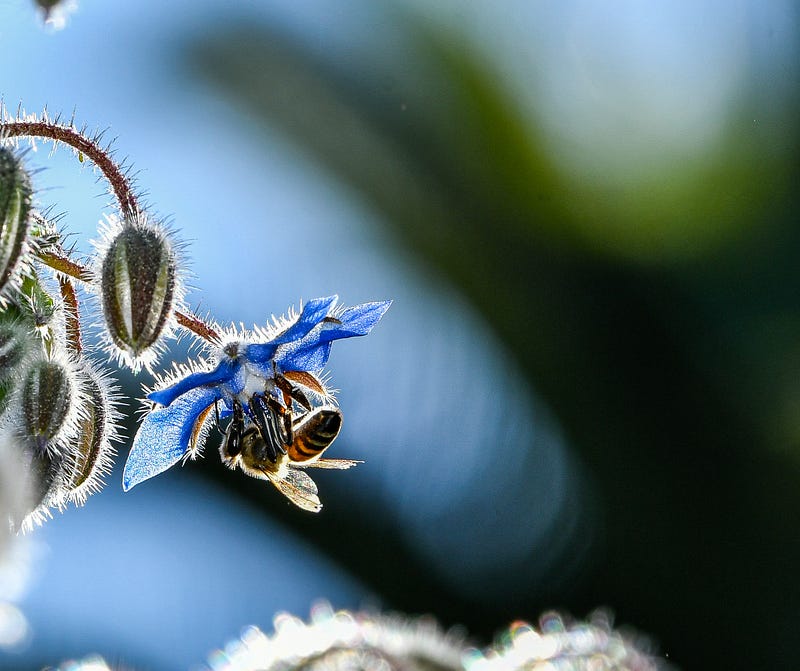
Bees on Borage
These precious pollinators adore the purple-flowered, ethereally haloed borage plant.
Bees love borage. Several times a year, I scatter seed packets and am rewarded with an almost ethereal show of purple blossoms and fuzzy haloed stems, followed by the buzzing of a parade of bees.
This winter, an unruly stand of borage sprung up, seemingly of its own will, right next to my meditation bench in the back yard. It seemed a fitting contradiction — a buzzing, prickly, wild bee paradise juxtaposed with the spot where I try to find a few moments of stillness each day.
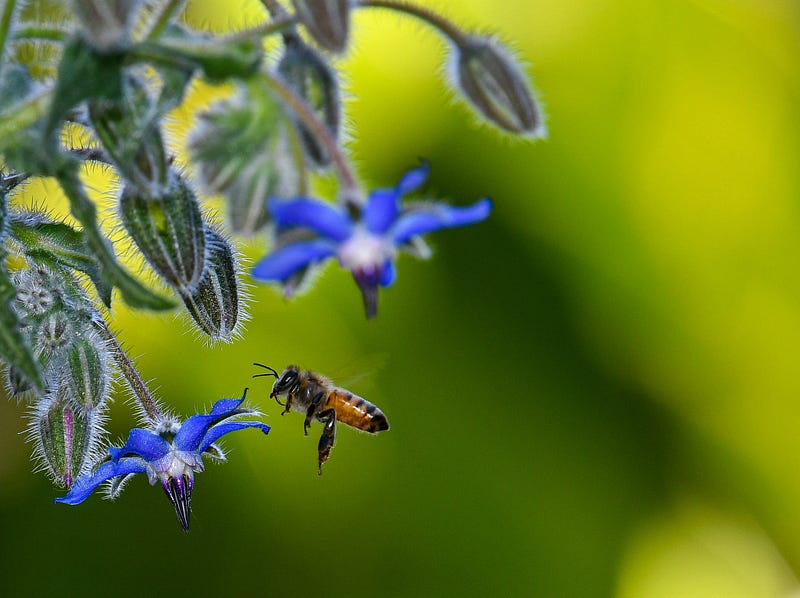
Sometimes it takes a little bit of cacophony to find stillness. I find it soothing to know that an entire world, which we might not otherwise notice unless we slowed down a bit, is alive in the nodding arms of the borage right next to me.
One afternoon, I grabbed my Nikon D500 and a telephoto lens and immersed myself in the bees’ world. I was amazed to be able to see the fuzz on their shoulders and the veining in their wings.
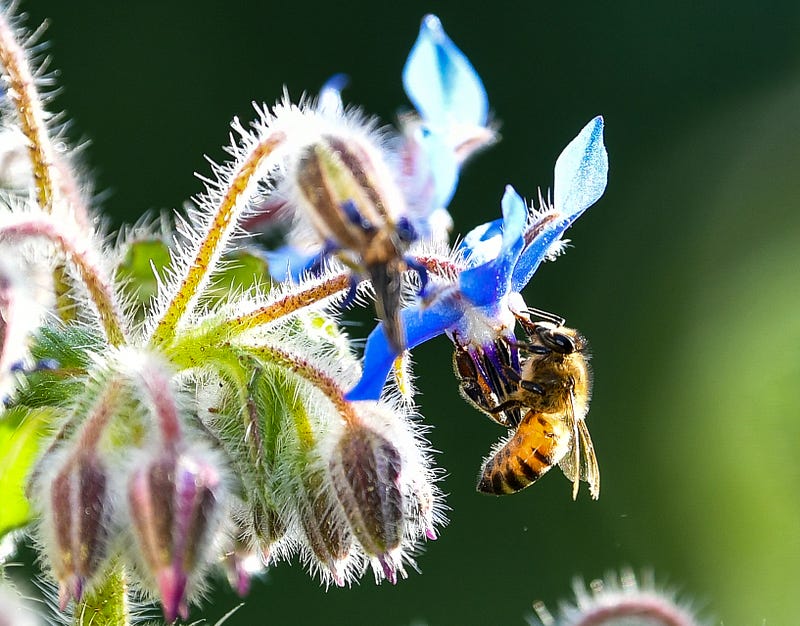
They collect pollen on their back legs, which are covered with tiny scopal hairs, to which the pollen clings. You can see in the photo above how much more developed the back legs are than the front ones.
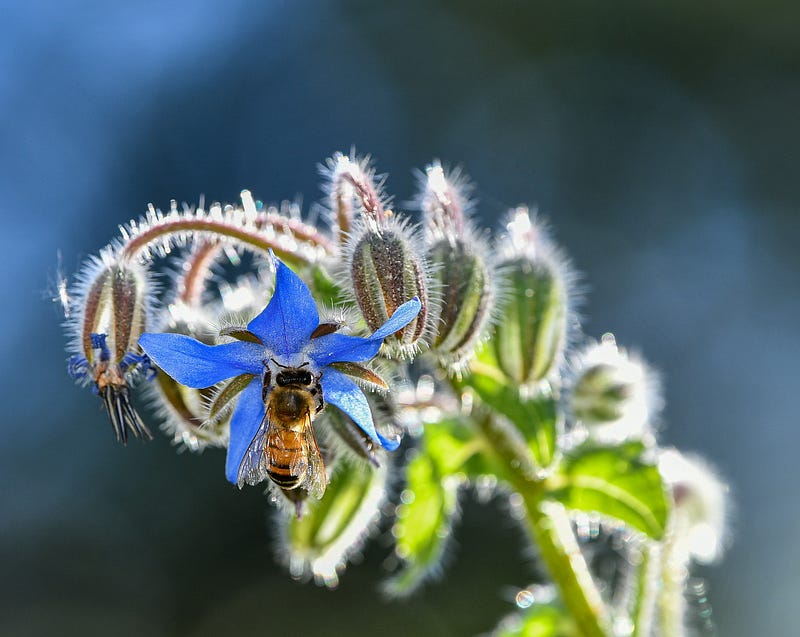
A pair of compound eyes cover much of the surface of their heads, allowing them a very large angle of view and the ability to detect fast movements. Between and above these larger eyes are three small simple eyes (ocelli) which provide information on light intensity and the polarization of the light.
In the photo below, you can see the three simple eyes in the center and the two larger, compound, eyes on the sides.
Busy little workers, they come and go constantly. A single bee can visit up to five thousand flowers a day. And to make one pound of honey, a hive of bees must travel over 55,000 miles and visit two million flowers!
I thought this little bee (photo below) looked a bit like a blimp gliding into a hanger on a slow approach.
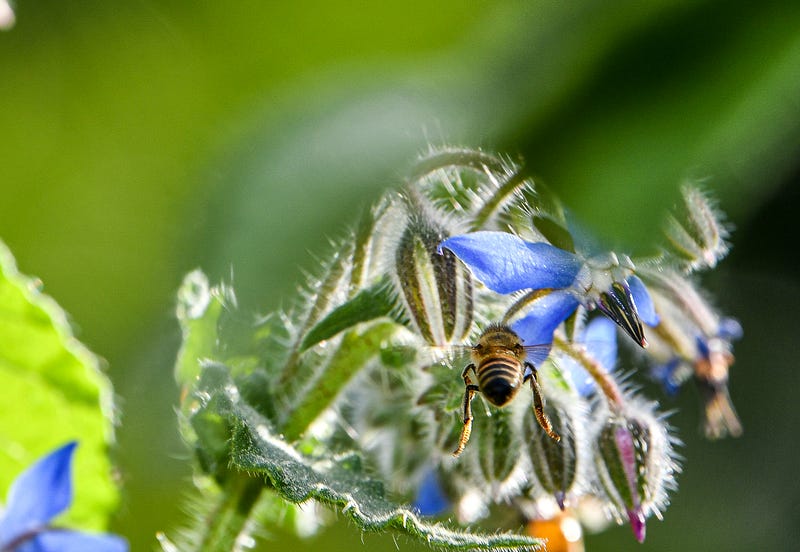
Ethologist Karl von Frisch studied how honey bees navigate. They communicate by means of a waggle dance, in which a worker indicates the location of a food source to other workers in the hive. Von Frisch demonstrated that bees can recognize a desired compass direction by three different means: the sun, the polarization pattern of the blue sky, and by the earth’s magnetic field. The direction of the sun is their preferred or main compass. The other mechanisms are mainly used when the skies are cloudy or when they are inside a dark beehive. Bees navigate using spatial memory with a rich, map-like organization.
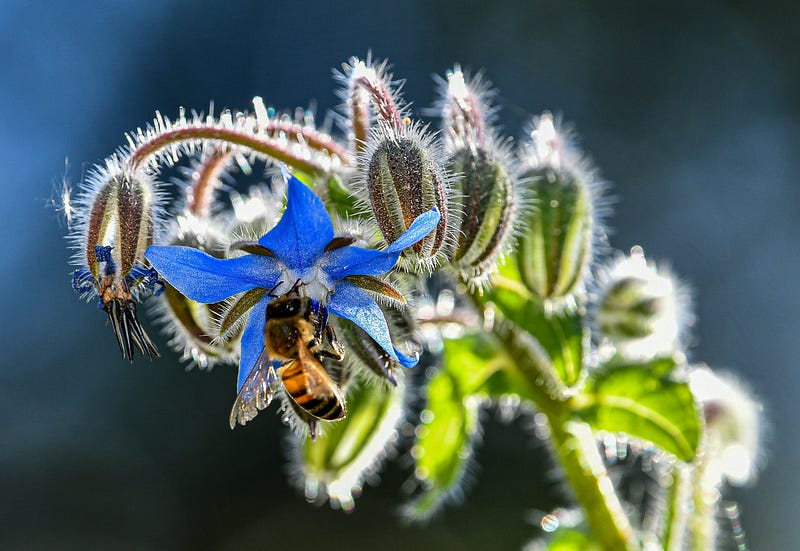

These delicate little creatures pollinate up to a third of the world’s food supply, pollinate 85% of all flowering plants and perform 90% of all pollen transfers on our orchard crops.
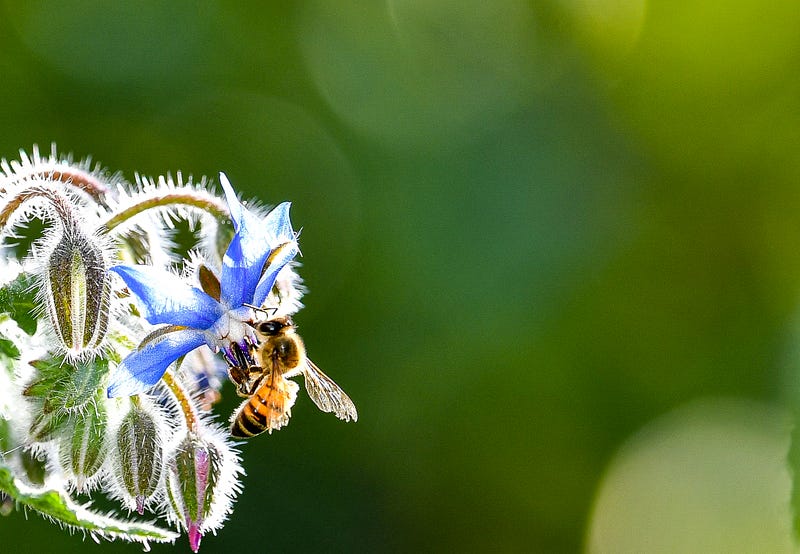
Honey bees can fly up to six miles from their hives at fifteen miles per hour with their wings beating 11,400 times per minute.
Bee populations are in sharp decline around the world, most likely due to the overuse of pesticides and climate change. Planting native pollinating plants might help maintain their populations. It certainly provides a beautiful show.
One of my favorite moments of every day is when I open my eyes from my meditation and am face-to-face with the buzzing, frenzied world of the bees in my borage plant.
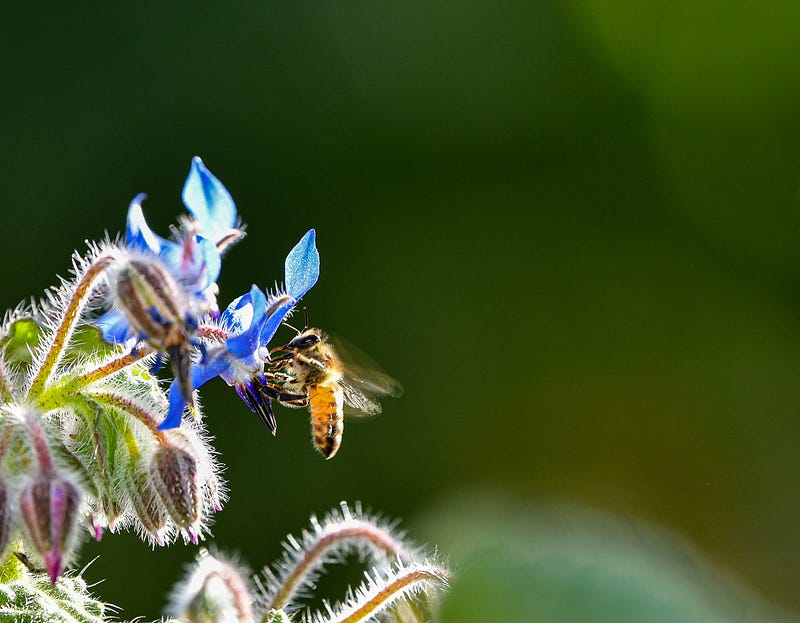
I hope you enjoyed this glimpse into the world of bees.
You might also enjoy:
Erika Burkhalter is a yogi, neurophilosopher, cat-mom, photographer, and lover of travel and nature, spreading her love and amazement for Mother Earth’s glories, one photo, poem or story at a time. (MS Neuropsychology, MA Yoga Studies). Erika is also an editor for Dharma Talk.
Photos and story ©Erika Burkhalter. All rights reserved.