
%22%3E)
Become a Better Writer: Blog Every Day… on Paper
How a pocket journal will help you tell better stories
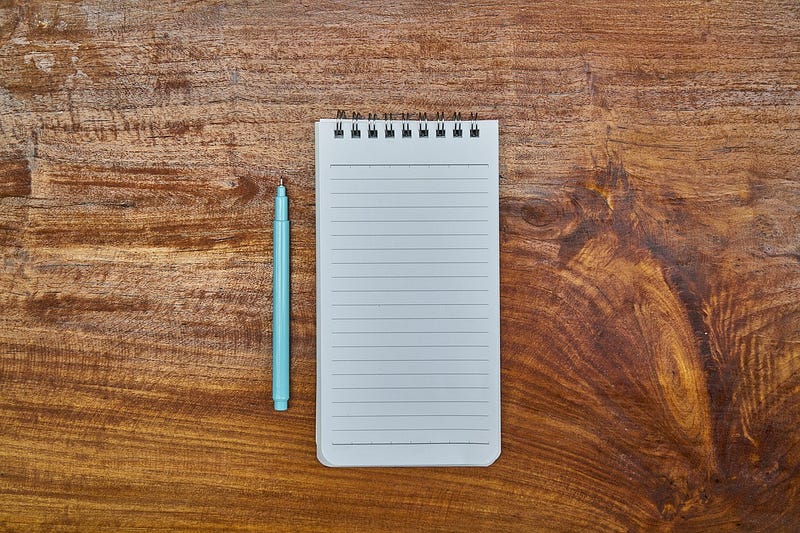
I wrote the title of the piece deliberately tongue-in-cheek. I recently started an experiment (because that’s what I do) and I dedicated one of my pocket journals to daily observation.
There seems to be a lot more writing advice than there are writers to absorb it, but a gentle constant is always there — write. every. damn. day. We can’t write 365 terrible stories in a row. That’s not possible unless we do it on purpose.
And if we wrote 365 deliberately bad stories those bad stories would become a thing on their own. You’d become known for it. You could do a book tour on bad stories alone — people would flock you like a rockstar “oh look, it’s bad story guy!”
But what if we allowed ourselves to be collectors of story, versus tellers of story?
When we change the mindset from creation to stenographer all the pressure is off. There’s so much more room to grow as a writer.
So, about the journaling
I used to journal for years. I wrote daily from age 13 to 25ish. No one told me to. I never shared the stuff with anyone. I had thousands and thousands of pages. Nothing worth keeping. I threw it all away as I got older. I didn’t want to share it, because the words didn’t matter.
The act of writing is what mattered.
I learned to observe people. I eavesdropped on conversations and catalogued human behavior at coffee shops. I wondered what people were thinking. I wrote shitty poems. I wrote anything that came to mind.
Journaling helped me through some very hard times.
Fast-forward 15–20 years. I write every day, but my writing efforts go towards books and articles. I also carry paper notebooks with me, because I don’t want my entire life to be digital stardust.
Five days ago I dedicated another pocket journal to daily observations.
Maybe I’ll go to a doctor’s appointment, or I’ll notice something about a cashier in the check-out line. As soon as I get a chance I’ll record the best observations in my little notebook.
The idea is that I’ll re-write each entry as a longer piece, maybe 300 words that I can repurpose in appropriate places to emphasize my work. And although this is non-fiction I know the observations will help my fiction dialogue as well.
This is the David Sedaris method.
David Sedaris, the bestselling satire/memoirist chronicles everything interesting that happens in his life. He takes notes in little pocket journals and re-types them the following day.
David Sedaris blogs every day on paper.
I’m using this method not only to capture interesting things that happen to me, but also to record my outsider’s opinion of the components of the observation.
I’ve become an amateur journalist for micro events in my life.
The pocket journal isn’t anything fancy. I make my own using beer box for covers, copy paper in the middle, and three staples as the binding. When we think our tools are fancy, we’re afraid to use them up.
I have so many notebooks I’ll never fill them in my lifetime. I love little notebooks. But I don’t think any of them are sacred — it’s the ideas on the page that are important.
We can only tell stories from that which we record
I’m a big fan of capture devices. A capture device is anything that prevents you from losing a great idea. Whether it’s digital recorder, a voicemail to yourself, paper, video, or smoke signals — we capture our ideas as soon as we think of them.
We can’t tell great stories if we don’t put great stories in.
We can’t write great dialogue if we don’t know what great dialogue sounds like — what great dialogue LOOKS like between two people, because so much of speaking is how our bodies behave and move.
It doesn’t matter if we write fiction or non-fiction. As writers we’ve got to become master of human behavior. And to gain that mastery we start be recording it.
I cannot emphasis enough how life-changing this can be for your creative work. You can take a daily observation and bend it into anything you want.
Maybe you find something funny. Maybe a trip to the dentist turns into a mystery novel. The other day I had a biopsy from a spot on top of my head. After the procedure I sat in my car and wrote as fast as I could.
The details of our daily lives can seem really mundane at the thousand-foot view, but when we zoom-in there’s all kinds of good stuff in the creamy center.
Blogging on paper?
We’re told to share all this daily life stuff on the internet — to chronicle our process and show our journey to the world, as we build our creative empires.
Well, maybe most of that daily nonsense isn’t worth the public consumption… but the daily process of writing can exponentially make you a better writer.
So, we curate the little interesting things.
We observe. We quote. We record.
We don’t have to know what we’ll use these little stories for, but we take paper notes and we build a full, short article about that happening and save it digitally.
Later, we scroll the archives and pull these stories out, using them as catalysts for bigger projects.
The best of this little project is there’s no agenda. You never know what oddball observation you’ll encounter. The event doesn’t have to be large. Today I noted a silly advertisement on the radio — how the wording for a jewelry store made their inventory sound fancier than it was.
Grab some paper and stuff it in your pocket.
Walk around until you find something worth noting — hell, note something even if it’s not worth noting. You’ll never know when you can use it later.
We want to read your best stuff. We need your observations.
We’re waiting for you.