
Beauty in Black & White
Magpie-robin can sing the sweetest songs
It was an evening wrapped in melancholy. The sun was descending, and the darkness was preparing to invade everything. A shiny day is saying goodbye; another day lost in the illusion called Time.
I feel low in this transition moment when the darkness gently comes around and devours everything with its mystery. I don’t know why I feel sad at what you call twilight.
I was sitting on a bench in front of the lake, a few minutes away from my home. On my right, a few coconut trees standing upright, and on my left, a dye-fig tree, where I saw my darlings a few days ago, bending towards the water. When I sit in this place, I always keep my ears sharp to hear all the sounds nature makes.
Anyway, I was witnessing the moment with a few herons flying on the lake and some fishes making noises under the water-hyacinth. I don’t know what I was thinking then. Maybe nothing — just enjoying the melancholy transition from light to soft darkness.
That moment, on a headless coconut tree, it started singing. My heart poured with joy as I gently moved my head in that direction.
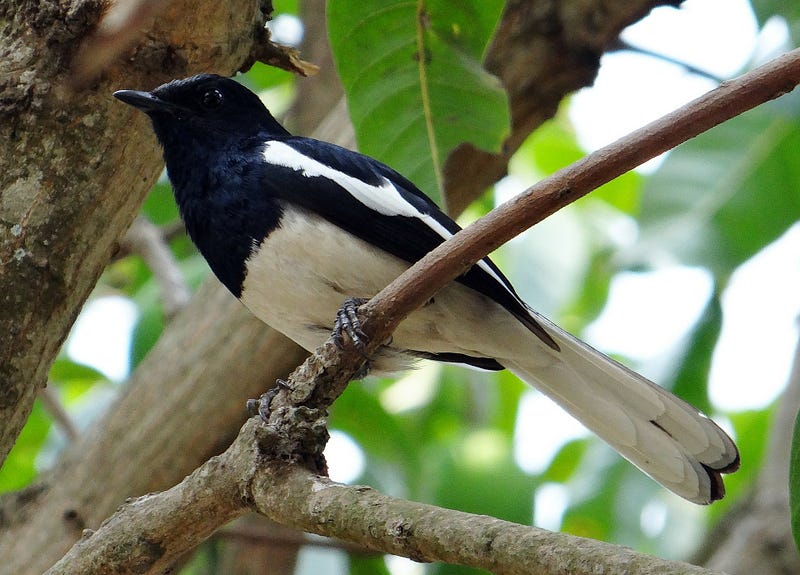
Yes, there it is — a lovely magpie-robin, a beauty in black & white with its irresistible call.
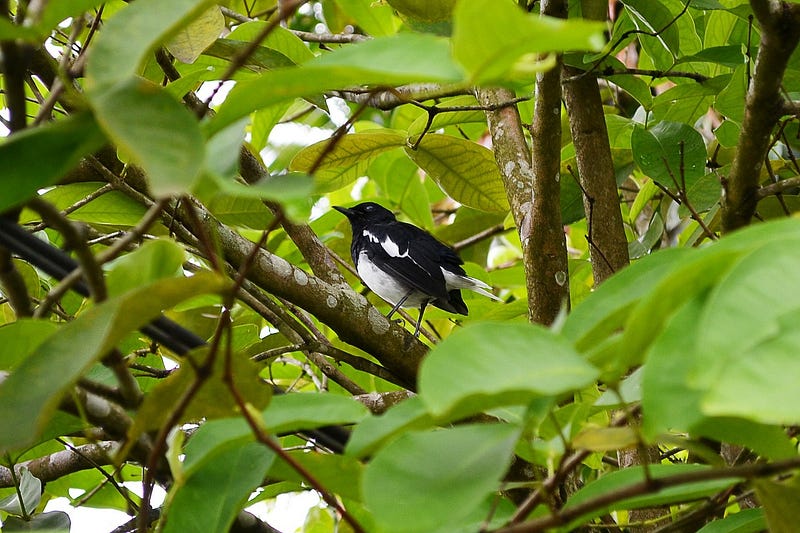
Oriental Magpie-robin is our national bird
This beautiful bird, Oriental magpie-robin (Copsychus saularis), is named our national bird. In Bangladesh, we call it doyel pakhi. These beautiful darlings are great singers.
They are relatively common and found in cities and rural areas where there are some greeneries around the human habitats. They live in the tropical countries in Southern Asia, including Bangladesh, Nepal, India, Sri Lanka, Pakistan, Indonesia, Thailand, etc.
This 19 cm long bird has a long tail. The male has black upperparts, head, and throat — while the shoulder patch, underpants, and tail-sides are white. Females are greyish black above and greyish white.
During courtship, the male birds sing from high perches during courtship, puffing up their feathers, raising the bill, and fanning the tail.
They eat mainly insects and other invertebrates and occasionally take flower nectar, geckos, leeches, centipedes, etc.
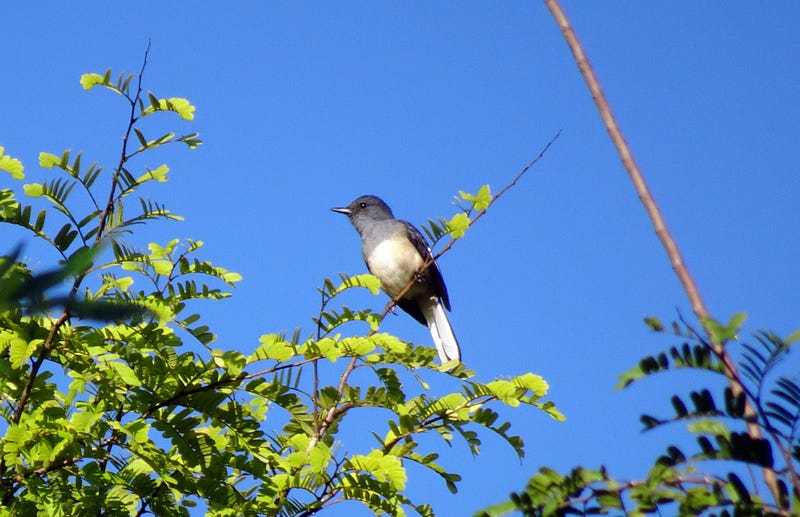
Magpie-robins are smuggled for their songs
Magpie-robins are considered as one of the “least concern” by IUCN, but in some areas, their numbers are declining. In Singapore and Hong Kong, they were common in the 1920s but declined from the 1970s due to competition with common mynas.
This bird has high demand as a cage-bird. And the shocking news is due to its lovely song, magpie-robins are smuggled in large numbers.
A recent report by TRAFFIC and the Department of Wildlife and National Parks Peninsular Malaysia (PERHILITAN) cites, Between 1st January 2015 and 31st December 2020, at least 26,950 Oriental Magpie-robins were intercepted in 44 seizures implicating Malaysia, averaging 613 birds per seizure.
The report also reveals that the majority (64%) of the seized birds were being trafficked from Malaysia to Indonesia.
This type of news can break anyone’s heart. We, human beings, have become so selfish that even little magpie-robins are not free from our cruelty.
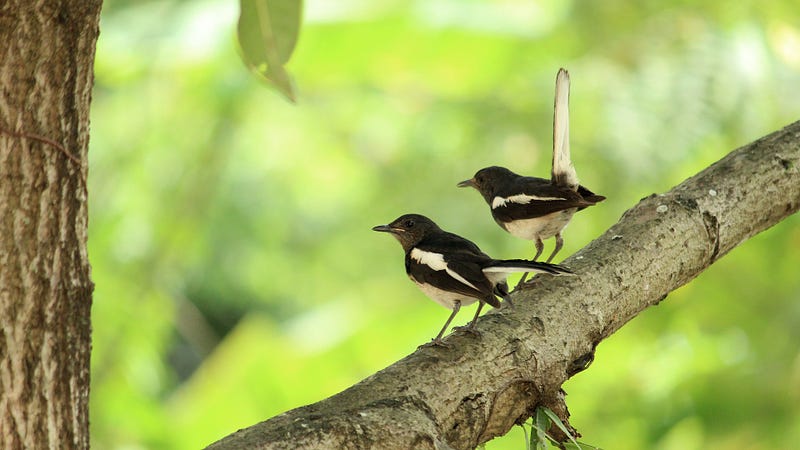
The magpie-robin sat there on the headless coconut tree for around five minutes and sung some beautiful songs to me. Then it flew away towards the destination unknown to me.
After a few minutes, when the black shadow encapsulated the world, I returned home not with the melancholy thoughts but with the sweetness that the magpie-robin passed to me.
Thank you for reading.
If you are a lover of the environment, nature, and wildlife, you may enjoy the following articles published in The Environment.
- The School of Nature
- I Saw My Darlings on a Dye-Fig Tree
- Color Your Life With Some Birds
- Where Have All the Birds Gone?
- Global Warming Is Going to Destroy Your Children’s Life
You can also share your love and concerns for this lovely planet. Just click the below image and write for The Environment
