
Beauty and the Black Dog
How an experience of the sublime can relieve depression.
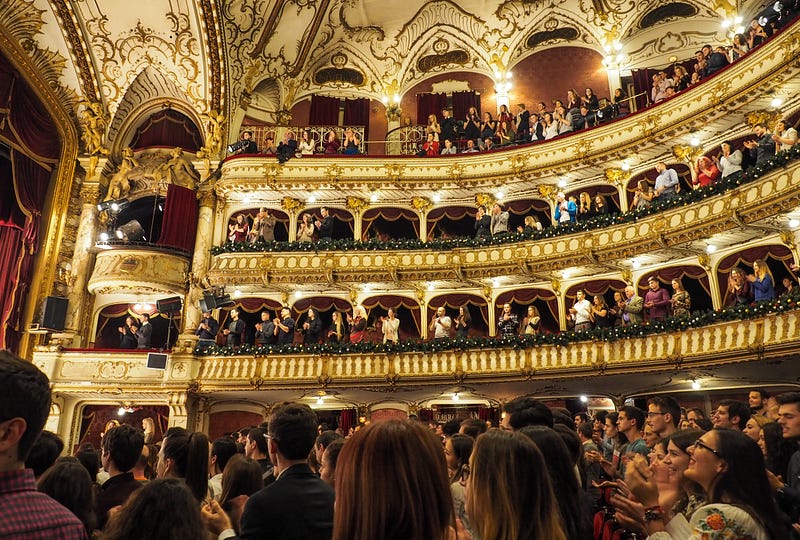
Who knows where the dark moods come from?
We all get them from time to time. I’m the luckiest person I know, free to live a life that corresponds closely to my own inner desires. But that big black dog still stalks me. Sometimes, when the low clouds don’t move for days and the rain falls until the end of the world, I can hear it snuffling at the bottom of the door, its claws scratching at the wood as it seeks a way inside.
But over the years, I’ve learned a couple of strategies to deal with these bouts of depression. And honestly, I’d rather talk to you about beautiful things than sad ones. Even though, quite often, the two are the same.
The young knight, the Rosenkavalier himself, may be the title character in Strauss’s opera.
But he isn’t the hero. That role belongs to the far more nuanced figure of the Marschellin, the aging noblewoman who starts the opera in bed with her young lover while her husband is away.
I’ve never been to an opera. But every Saturday, they play one on the radio. So on this particular gloomy day, alone in the house, I closed my eyes and turned up the volume and let the music wash over me.
It’s in the final scene of Der Rosenkavalier, a basically comic opera, that we see the pathos of the Marschellin fully. Her young lover has fallen for a younger woman, and she knows she has to let him go. All three characters express their conflicted feelings at once, the intertwined and multilayered female voices — Octavian, the knight of the rose, is played by a woman — forming a unified whole, a piece of music so beautiful that it lifts you out of yourself and your own dreary feelings.
Only via the medium of music can three or more people express themselves at once without it becoming merely noise. But all art has this transformative power, to take the base metals of your being and transmute them, if only for a little while, into gold.
And even art has no monopoly on beauty.
Vancouver’s Catholic cathedral hardly compares with the great basilicas of Europe. In a city that was only founded in 1886 as the railroad arrived from the east, you can’t expect Baroque splendor or Gothic magnificence. But the church tries, its neo-Gothic façade echoing that of the far older structure in Chartres. In fact, the church looks appealingly out of place, surrounded as it is by glass-fronted skyscrapers that reflect the grey stones of the building between them.
And the echoing silence within the church is all the more striking as the door closes between you and the constant hum of the city’s downtown core outside. Stained-glass windows cast light in vibrant patterns across the floor.
What is the empty cavern of any church but a physical expression of the yearning of our species? That part of us that can never be satisfied by the world as it is, the reaches out for transcendence, for this God or another? It’s that same part of you that responds to beauty, that leans toward it the way a tree points at the sun.
Your sadness may not be mine.
And your beauty will undoubtedly be your own. But wherever you find it, beauty can free you from the turmoil of an unquiet heart. The sublime, wrote Pseudo-Longinus in the first century, does not persuade audiences but rather transports them out of themselves. The job of the artist is not that of a teacher but of an enchanter. These raptures are a reliable cure for sorrow, the antidote to the slow drip of poison that turns us away from the world.
Depression, of course, is different from sadness. It’s a clinging fog in which nothing seems worthwhile. Nothing seems vibrant. Life becomes a dreary slog from one moment to the next, a sunless prison without reprieve.
An encounter with beauty can shatter the bars of that prison. Beauty is truth, truth beauty, Keats insisted. And the truth shall set you free.
In Strauss’s opera, the Marschellin’s tragedy is not the loss of her young lover.
Octavian isn’t so impressive a character that we feel that losing him would be unbearable. Instead, the older woman realizes what she’s really losing is her youth, the world slowly but steadily slipping away from her as it must slip away from us all.
In her resigned “Ja, ja,” in response to her rival’s father’s observation that young people will always be the same, we hear the sober truth about our existence on this beautiful earth: that it will not be ours forever. Our youth slips away from us, moving on to others who will only realize what a gift it was when it leaves them, too.
And this is all melancholy stuff, but the voices are so powerful, the music so gorgeous, that the whole scene becomes radiant with beauty. With the sublime. It’s not the individual troubles of these invented characters that so deeply moves us, but our realization of the deeper truths they embody.
Your own life, your own moments of loss and regret, can be made just as beautiful by the same art that transforms two simple syllables into a moment of heartbreaking ecstasy.
I was called to the cathedral because something had been eating the flowers.
Every day, volunteers set fresh flowers at the feet of the plaster statues of saints, the beauty of the outside world drafted and co-opted to beautify the strange symbols of human mythology. And at the end of every day, the volunteers found the flowers headless, the stalks severed by tiny teeth and the colorful petals vanished.
I searched the church. Under a statue of the Virgin Mary, there was a small gap above the pedestal. The narrow space underneath was filled with the heads of flowers, some as dry and fragile as half-burned paper, others still fresh and vital. A rat had made its nest there, compelled by drives it didn’t understand, life working through it just as it worked through me as I pulled back the oiled and spring-loaded arm of a trap.
It was beautiful. And although I’ve given up killing things for a living, although years and many miles have passed between me and that flower-filled space behind the statue, I’ve never forgotten it.
I can’t tell three stories at once, the way Strauss could in his opera. A storyteller can move back and forth through time like a rat running from flower to flower, from yesterday’s opera to a pest-control job a decade ago. But no fancy structure on earth changes the fact that a written narrative has to progress through time. And that’s how we experience our lives, too. That doesn’t make it true.
There are lots of ways to keep the black dog at bay. Exercise. Diet. Counseling. Medication. But beauty is a tool that has never failed me yet. Whether it’s the deliberate intricacy of a masterpiece or the strange gorgeousness of the world going on around you, finding the beautiful wherever you are is key to escaping those clutching jaws, that terrible steel trap. And unlike youth, beauty, real beauty, never fades.


