
Batman
Ironically, the definition of this word is closer to Alfred

Today’s New York Times Spelling Bee letters:
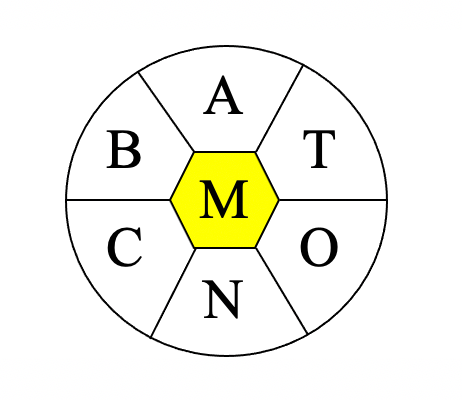
A, B, C, N, O, T, and center M (all words must include M)
Merriam-Webster says…
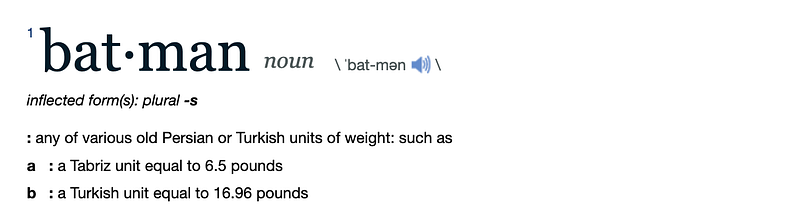
and…
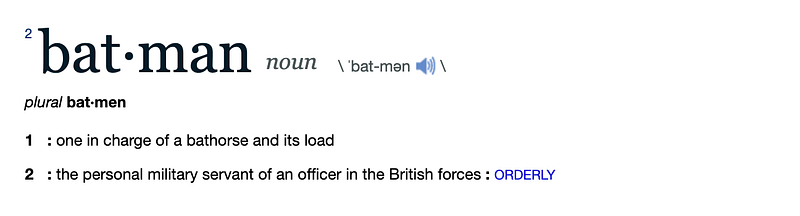
Silly little dictionary! Don’t you know that batman can’t possibly be a word if the New York Times says it ain’t?
For further fascinating facts, check out the Spelling Bee Master.
What’s your favorite dord* from today’s puzzle?
My Two Cents
I probably need to address the photo at the top of today’s column. I have no clue as to why an Adam-Westy Batman is hugging (and being kissed by?) Edson Arantes do Nascimento, but the photo caught my while I was skimming through options for “batman” on Unsplash. So I decided to use it. If you are reading this, the photo caught your eye, too.
So my whimsical choice worked.
This work of art, this collage, shows the greatest superhero and the greatest football player who ever lived. No, not Tom Brady — he’s not even the greatest American football player who ever lived. I’m talking about Pelé.
One day I’ll write about how I never met Pelé despite the fact that I should have.
I know many people consider Superman to be Número 1 when it comes to superheroes, but his near invincibility makes things too easy for him. Plus, he secretly looks down on the human race.
Spiderman was my favorite superhero growing up. Living in Venezuela, my access to the actual Marvel comic books was very limited. So my view of the character was shaped by the 1960s TV series reruns I watched dubbed into Spanish. Spiderman was strong, funny, sarcastic, smart, and very relatable — after all, Peter Parker was a “kid” when he got bit by that radioactive spider.
I also watched the 1960s Batman TV series as reruns (in Spanish), typically with my younger brother. Even as kids we realized the show was campy, but still, we were fascinated by it. Plus, it didn’t hurt to see Julie Newmar in a catsuit. (As an aside, did you know Newmar was an inventor and has patents for pantyhose and a brassiere?)
In my early twenties, I discovered what the real Batman was about and how the comics returned to the darker themes with Frank Miller in the 1980s. Batman was, of course, the incredible superhero without actual superpowers. Unless you count money, as Bruce Wayne points out to Barry Allen in Justice League.
About a dozen years or so, when I was visiting friends here in Spain, I had a conversation with their son Samuel, who was around six or seven years old at the time. At that tender age he amazed me by figuring out something I hadn’t realized until adulthood: in theory, anyone with money, dedication, sheer willpower, and technology could become Batman. Brilliant! Coincidentally, that same year this book came out:
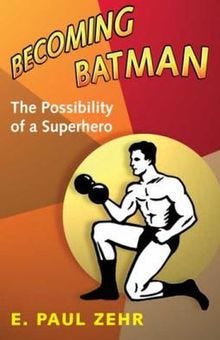
As the blurb explains:
Zehr discusses the physical training necessary to maintain bad-guy-fighting readiness while relating the science underlying this process, from strength conditioning to the cognitive changes a person would endure in undertaking such a regimen. In probing what a real-life Batman could achieve, Zehr considers the level of punishment a consummately fit and trained person could handle, how hard and fast such a person could punch and kick, and the number of adversaries that individual could dispatch. He also tells us what it would be like to fight while wearing a batsuit and the amount of food we’d need to consume each day to maintain vigilance as Gotham City’s guardian.
The book can get very technical, but is an interesting and recommended read. Not sure if you can use it as an actual step-by-step guide, so don’t go out and purchase that batsuit just yet.
Okay, I’ve spent enough time digressing over my personal taste in football players and superheroes. On to our daily dord*.
An officer and his gentleman
The dictionary shows two distinct meanings for the word batman. Let’s start with the second one. In this sense, the word comes from the French bât, meaning “packsaddle”. This, in turn, from the Old French bast, from Late Latin bastum.
In the military, batmen were soldiers assigned to serve officers. Before jeeps, batmen would also in charge of the bat-horse. Which is not nearly as cool as it sounds. That was simply the equine assigned to carry said packsaddle (bat) and other crap belonging to the above-mentioned officer.
In English the batman was also called orderly, a variation of which is used in other languages, too. In the U.S. they are known as aides-de-camp, a French term that translates roughly to “one who does grunt work all effin’ day”. In many countries the batmen were still being used as recently as World War II.
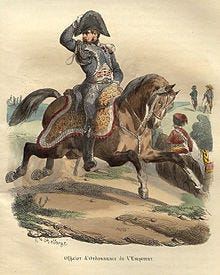
The above is an illustration of a French batman on a horse during the Napoleonic Wars. He is batting, which is the English term for doing batman-work. Weird. Aside from the bat-horse duties, the batman was expected to:
- run around between the officer and his subordinates to convey orders; during battle this represented a great peril to the batman’s life
- keep the officer’s uniform and personal equipment in tip-top shape
- drive the officer’s vehicle, sometimes during combat
- be the officer’s bodyguard in battle
- dig the officer’s foxhole, giving the officer time to direct his unit… and have a few drinks with fellow officers
- do anything else said officer didn’t feel like doing (not sure if this included the officer’s wife)
All this for minimum wage… or no wage. And you thought your job was crap!
Because officers in many armies came from the upper class, many batmen continued to work for them as errand boys after the officers returned to civilian life.
That brings us to Batman. And Alfred. And the oft-used phrase “Batman’s batman” to describe the tech-savvy octogenarian batcave manservant. Which segues us to this stirring existential question: If Alfred is Batman’s batman, who is Batman a batman of?
The weight of a bat
The English word for the Turkish unit of mass or weight — depending on your preference for kilos or pounds — was borrowed from… Turkish. Shocking, I know! Specifically, the Ottoman Turkish (Turkic) terms baṭman and baṭmān, of uncertain origin. Especially with regards to the prefix bat-, since the term man as a unit of weight goes back possibly to the Hebrew maneh (מנה) and the Ancient Greek mina (μνᾶ).
In ancient Persia, the two main commercial weights were the tabrézy man ( من تبریز ), or “man of Tabriz”, and the sháhy man ( من شاء ), or “the Shah’s man” which — of course — was twice as large. The man system was still used in Iran in the 20th century, and the term batman became synonymous with tabrézy man, with a value of approximately 2.969 kg in 1966.
The batman as a unit was first recorded in English in the late 16th century, in what is likely modern Baghdad, where it was equal to “7 pound and 5 ounces English weight”. In the central Ottoman system of weights, the batman was equal to six okas or 16.97 pounds in the avoirdupois system, about 7.698 kilograms. Later, when the metric system invaded Turkey, an oka was declared to be 1 kilo and the batman 10 okas.
Whew! Good thing we don’t need to use that batman weight very often.
But if the opportunity arises, you can just refer to this article for absolutely not much help at all.
So, where do we stand with batman and the Spelling Bee? Sure, the caped crusader doesn’t count, having a verboten capital “B”. But we’ve clearly demonstrated the existence of batman as very useful servant and much less useful unit of weight.
And yet, despite this mountain of evidence, the editors of the Spelling Bee decided that batman was a dord.*
You can check out my previous entry on another dord* here:
*What the heck is a dord, you ask? Here’s the answer: