
Barely Sahara
GiaB writing prompt #20: animalia
What it’s really like to ride a camel across the desert
Sahel is Arabic for coast. The Sahel refers to the region of Africa just south of the Sahara, thus, it is the coast of the Sahara Desert. It’s a bit unearthly to imagine the dry sands of the Sahel lapping gently onto the third largest desert in the world after the Antarctic and Arctic.
At the close of my Peace Corps service in Burkina Faso, a group of us decided to say goodbye to our home of over a year by doing the most touristy tour in the country.
From Ouagadougou, we banged around in the back of a truck for six hours. We had to wrap our heads in scarves and t-shirts to keep the dust out of our mouths. Once in Gorum-Gorum, our clothes were all brown, every wrinkle caked in sand. We each cleaned up with a bucket of water. It was not enough to remove the grains from my hair, my teeth and my ears.
There wouldn’t have been enough time to wash our clothes and have them dry by the next morning, so we all stood with our backs to the wind and waved our arms up and down in a line, whipping the sand out of our jeans, shirts and scarves.
A camel can drink fifty gallons of water in three minutes and then not need to drink for two weeks.
We ate millet with sauce and drank beer the way twenty-somethings drink beer — one after the other, hand over fist, until each of us found a bedtime.
We slept in small hotel pods made to look of clay. They were certainly concrete, but the twilight chill that fell over the town let us sleep well enough.
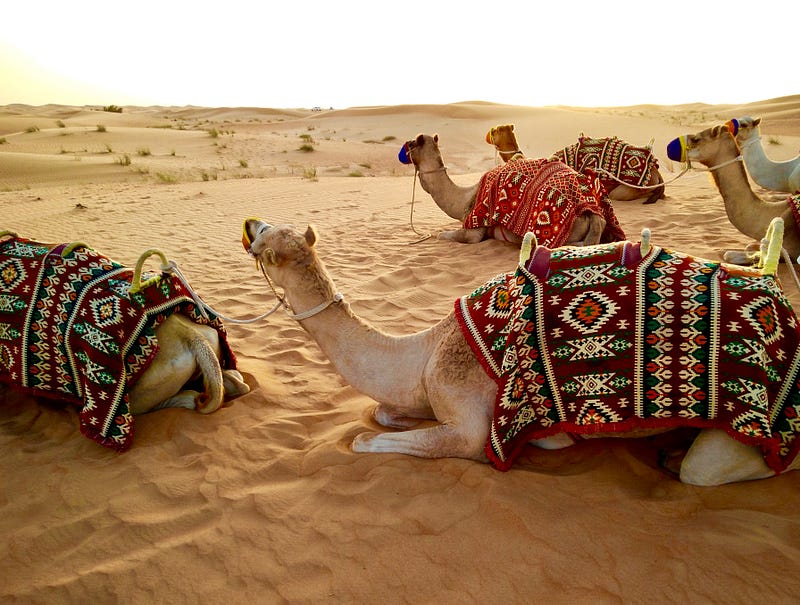
The morning brought a glorious sight. Dimly lit in a brown sunrise was a row of dromedaries parked on the ground. Their livery was of splendid reds, oranges, greens and blues. They lay contented in a row, spindly legs tucked under sandy, hairy bodies. Their necks swooped like gentle rope, and each head bobbed with huge, doe-like eyes draped in heavy lashes. Their keepers squatted in a circle nearby sipping hot tea.
Across a scape where Land Rovers have difficulty, camels are still the chosen mode of travel across desert plains. A camel can drink fifty gallons of water in three minutes and then not need to drink for two weeks. The hump is a big fat deposit. It does not store water. Since it is up and over the body (instead of around the body, as with most mammals), the camel does not need to spend much energy staying cool. This energy efficiency allows the camel to stay on the move for long distances.
If you are a romantic, then replicating part of a thousand-year-old trade trek has your heart fluttering no doubt. Still, there are some realities you’ll want to know before camel-ing.
- They don’t stand up the way you would think: Once nestled on our camels, one of the keepers waved his quip as a magic wand along the row, and we were a bit undone to discover that camels stand up on their back legs first. I did feel as if I would topple over the front.
- You don’t ride western-style: I was instructed to cross my feet in front of me, right onto the nape of my dromedary’s neck. The keepers were keen on telling us to not break from this position. It kept the camel aware that it had a rider.
- Maxi-pads will not help: We had been forewarned to wear extra padding of any sort. Stuff a shirt down your pants or wear a couple of maxi-pads, but on a twenty-four-kilometer trek, these strategies will not prevent the two inch strip of flesh above your butt crack from being inevitably skinned. Since it is bound to happen anyway, go ahead and gallop your camel here and there. Have fun!
- Bring gifts: We trekked twelve kilometers out into the desert, where we came upon the encampment of a chieftain. A thousand years ago, salt was likely the gift of choice. Nowadays (or at least when we were there), the chieftain wanted modern pain and fever relievers like Advil or Tylenol.
I can tell you that even with the small miseries, our trip out to the desert is still among my greatest memories. I wish you all safe travels.
Josie Elbiry, 2021
Many thanks to Victor Sarkin for his continued development of new content and for his support of the writers at Genius in a Bottle. Here is his original post for Prompt #20: “Animalia”.
Thank you to Carolyn Hastings for reaching out to invite me to write for Prompt #19 “Family”. I was too late to respond, but nonetheless her suggestion brought me to GiaB to write for prompt #20.
I would, in turn, like to invite Carolyn to write for prompt #20. Please also I encourage Arthur Ramirez, Alan Asnen, jenine bsharah baines and Alex Godley. Please follow the submission guidelines here.