
Bangladesh, Part 1 of 3
Arrival in Dhaka and an overnight paddleboat to Kulna
Thursday
The first thing that impressed me about Bangladesh is how green it is. I didn’t know what to expect, really, but all I knew about before I got here was the poverty. Maybe expecting the absolute worst of conditions helped me because things didn’t look that grim once I touched down at Zia International Airport.
Here in Bangladesh, I had the uncommon experience of being met at the airport. I made contact via Internet with Manik and he offered to meet my plane when it arrived. This meant the absence of looking for transport or a hotel, as he had also done that legwork for me.
Vehicular congestion in Dhaka is amazingly heavy. The worst I have ever seen has been Bangkok and Jakarta, where drivers turn three lanes of traffic into five or six by ignoring the delineated lanes, which they can do because there are so many small vehicles on the road. While Dhaka is not quite as bad, it certainly approaches those scenes. A simple trip turns into a bumper car relay, with drivers weaving, passing, honking, and creating chaos wherever they go.
Once I was settled in at the hotel, we went for a walk and then on to dinner. Dhaka is a fairly large city — a place where it would be very easy to be anonymous. Yet wherever we went, people were saying hello to Manik (not his real name). At the restaurant, one of the servers greeted him by saying, in English, “I remember you from the beginning.” I had thought that it meant that he knew Manik from the time that he was born.
While we were eating, Manik told me that he thought he should explain why he was getting all this attention. It is because he is a fairly famous entertainer. He went on to explain that he cannot easily meet gay men in Bangladesh because he has to maintain his privacy. So he tries to meet foreign visitors who will have no idea who he is and, therefore, not be a threat to his public image. He told me that he was able to confide in me because we had already been in email contact since January and he trusted me.
My first order of business was getting money. Lonely Planet lists an American Express office not too far from my hotel, but I could not find it. When I enquired at a bank, I found that it had been closed, and the bank referred me to another bank.
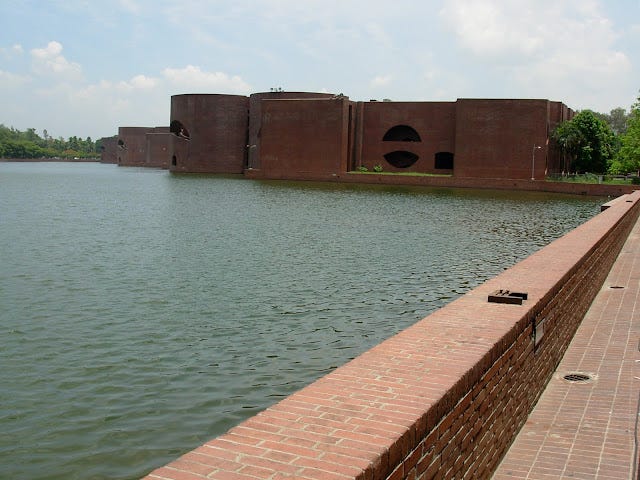
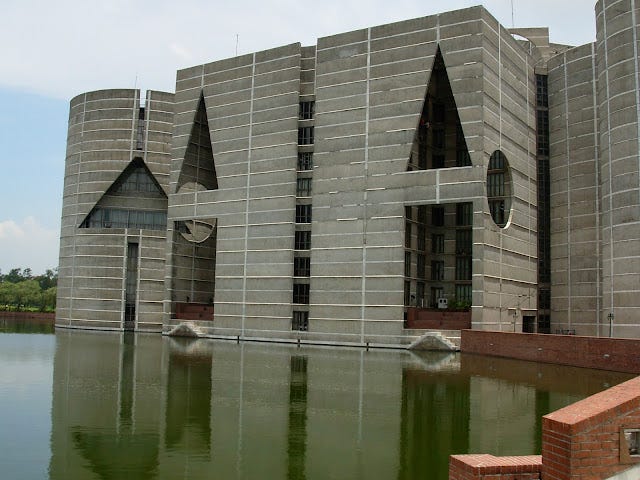
Now that I had some money in my pocket, I was off to see the sights. First on the list was the National Assembly, a modern building designed by American architect Louis Kahn. Not only is it a fascinating building by itself, but it is set in a lake and surrounded by a park.
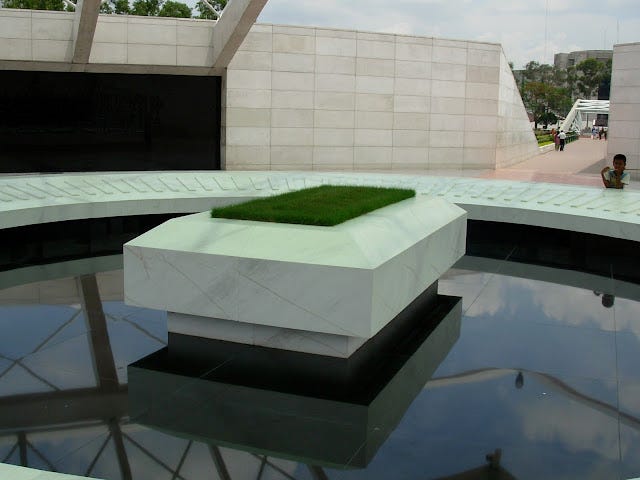
Across the street from the National Assembly is the Zia Uddyam, memorial to former President Zia. This, too, is an impressive sight — a mound that can be entered from two sides, with mausoleum under it, and carvings of black marble on four sides.
Getting away from this part of town proved to be difficult, which I had not anticipated. When the few vacant taxis or “baby taxis” (called “autorickshaws” in India and “tuk-tuks” in Thailand) slowed to pick me up, and I told them where I was going, the drivers shook their heads and drove off. After this happened four or five times and I had moved to a busier intersection in the hope of increasing my chances of seeing more taxis — and vacant vehicles were quite rare at that — a bystander approached me to ask if he could help. I told him my situation. He walked to a vacant taxi waiting at an intersection, negotiated with the driver, and arranged for me to get in. I offered to give him a ride if he were going in my direction, but he declined.
Wandering through the streets of Dhaka offers a bit of a surprise, as there are many more attractive buildings and parks than I would ever have imagined. There is construction everywhere. The city is dotted with factories where clothing is made for export to the USA and other countries. Manik rattled off a list of stores where one can find clothing made in Bangladesh, including Macy’s and The Gap. There are also lots of franchises, such as Baskin-Robbins, Pizza Hut, A & W Root Beer, and Price Club.
I met Manik at my hotel and we sat down to pore over my guidebook and map out a plan for me during my remaining eleven days in Bangladesh.
That accomplished, I asked Manik if it would be possible to get a beer, not knowing that he was going to take me halfway across town to do so. He later explained that it was cheaper that way, though I would have been happier paying more for the brew and not having to experience the Formula One action in order to do so.
On Wednesday, I was off to another “must see” monument: the Ahsan Manzil or “pink palace” of a former wealthy landowner, built in 1872. From there, I called Manik to see about his progress concerning booking me a ticket for a boat ride I wanted to take. (He had offered to help and I had accepted.) He informed me that I got a cabin on that evening’s passage, so off I went, back to my hotel to pack up an overnight bag and get ready to move on. Ironically, the dock was just meters away from the Ahsan Manzil, which meant that I had to make the congested round trip in order to leave that evening.
With a stop to check e-mail, I was back at the hotel, arranged to leave my larger backpack with the hotel staff, and then returned to the dock area for my overnight passage on the Padma River, my destination being Khulna, the third-largest city in Bangladesh.
Riding on “The Rocket” to Kulna
I don’t know how they came up with “The Rocket” as the name of this type of paddleboat service, but it has been plying these rivers for seventy years, and generally carrying upwards of twenty million passengers a year on the rivers. My vessel was called The Ostrich.
Manik had purchased a “VIP” ticket (Tk 2,000, about $30) for me, which entitled me to my own cabin with private bath, right off the first class dining room, where all such cabins were located. The room consisted of a twin-sized bed with clean linen, a small writing desk, and stained carpeting on which I would not want to step while barefooted or wearing white socks. It had two fans and a vent in the ceiling from which there was a slow but steady flow of air conditioning, to my great surprise!
All but one of the first class cabins were occupied when we left Dhaka, mostly taken by couples and small families, all very friendly, all Bangladeshi. I was the only Westerner on board.
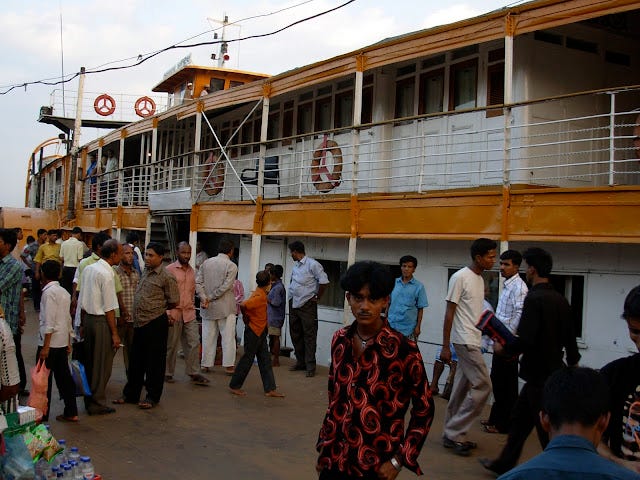
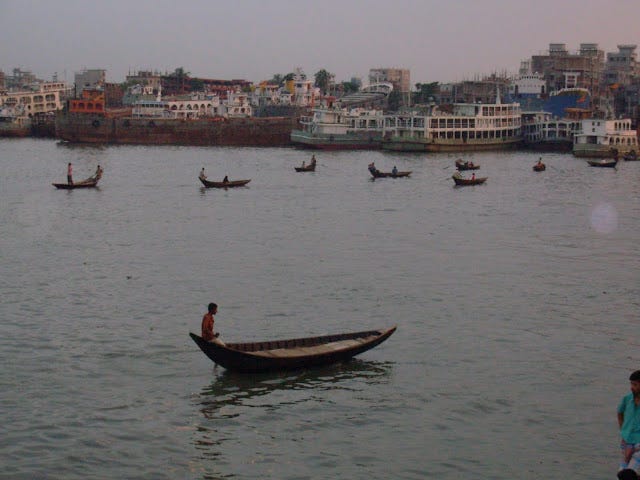
We left shortly after our 18:30 scheduled departure time. The crew asked me if I wanted to have dinner, and I said yes, as I had not purchased any food for the trip. They were a bit thrown off by my request for vegetarian food, but were able to supply me with fried rice, vegetables, and a few hard-boiled eggs for dinner. Dinner was served at a long and elegant table topped with stained white tablecloths, on china plates, all of which was an attempt at elegance, but which fairly well missed the mark because of the faded conditions.
My appearance on the ship was a curiosity to all — both the other passengers and those on the docks during the many stops that we made.
Talking of stops, here are the names of the ports of call during the voyage: Chandpur, Barisal, Jhalakati, Hularhat, Charkhali, Bara Machua, Morrel ganj, Mongla, and Khulna. As for the name of the rivers, we began on the Buriganga (a tributary of the Ganga — Ganges) and finished on the Rupsha. In the middle of the journey, it was anyone’s guess!
On Thursday morning’s first stop, at about 10:00, most of the first class passengers got off the boat, leaving me and one other passenger in our section. This freed up a lot of deck chairs, as the previous night there had been more people than the seven seats provided.
The view during the day was repetitive, but in a most enjoyable manner, as we viewed continuous habitation along the banks of the rivers where we traveled. The palette was limited but altogether pleasing: the khaki river, emerald foliage, and cottony clouds dotting the della Robbia blue sky. The breeze on board made the air tolerable, but when we stopped to pick up and discharge passengers, I was able to discern a definite change in the temperature, and that was not as enjoyable. In the morning on such stops, I retreated to my cabin where I was hoping that it would be cooler, but the air conditioning had been switched off. We had it again for a short time in the afternoon, but it did not last the remainder of the journey.
With mostly crew members to talk to during the afternoon, I had a little trouble understanding exactly what they meant with some of their questions. One kind gentleman told me that, “I am on stop.” I must have scrunched up my face because he realized that I didn’t understand what he had said. He then repeated it and, in perfect spelling bee manner, realizing the word where I needed the most help, said, “Stop. s-t-a-f-f. Stop.” I said, So, you are on the staff of the shipping company, and he said that yes, he was, for the last six months, before which he had worked for another company during fifteen years.
Further on downriver, the same man told me that we were looking at a “seem project.” Once again, I didn’t know what he meant by “seem,” but he spelled it, saying, “Seem. s-h-r-i-m-p. seem.”
Not only on the ship, but just about everywhere else, people’s first question to me — before many even say so much as “hello” — is, “Your country?” This has various versions, which include, “Hello your country?” “Hello mister country?” “You are from…?” and “What is your country name?”
Because I have been greeting people with “salam aleikum,” many ask me, “Are you Muslim?”
Anything I do causes attention and a stir. The simple act of buying two bananas has gathered a crowd of up to twenty curious people. They usually stick around for Act II, which consists of my eating the bananas.
One man on the boat asked me, when I told him I was from the USA, “Republican and Democratic Party? Which?” I told him that I had nothing to do with either one.
To continue reading, here is the link to Part 2: