
Bangladesh, Part 2 of 3
Bagerhat and bus ride from Kulna to Dhaka
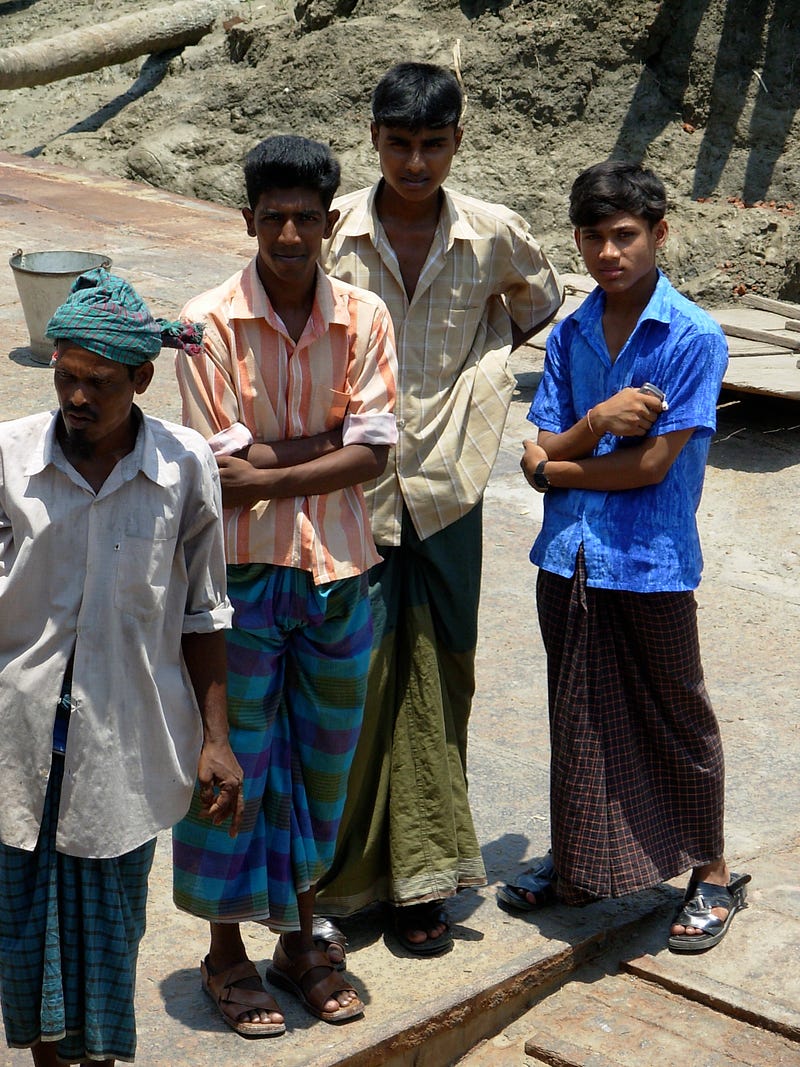
There were two main reasons for coming to Khulna. One, already accomplished, was the boat trip itself, as I wrote about in Part 1. The other, once here, was the visit to Bagerhat, which is said (by Lonely Planet) to have the greatest number of historical monuments in Bangladesh outside of Dhaka itself.
After a little Internet time in the hotel’s air-conditioned business center (with two computers), I was off to see the sights. A hotel employee helped to negotiate the rickshaw ride, and I was headed in the right direction! When I got to the bus stand, a bus was getting ready to depart for Bagerhat, but all the seats were taken so I waited for the next one, which took only about fifteen minutes before it filled up.
The sights en route were much like those that I had seen from the boat — mostly fields and trees. Since we were on a road rather than a river, though, I was able to see lots more vehicular traffic and store fronts.
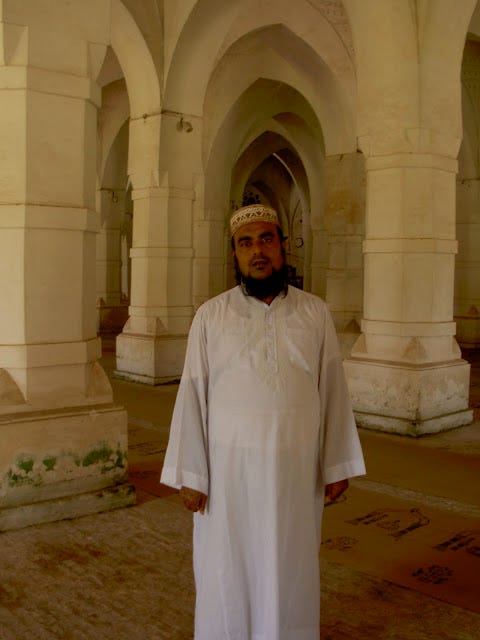
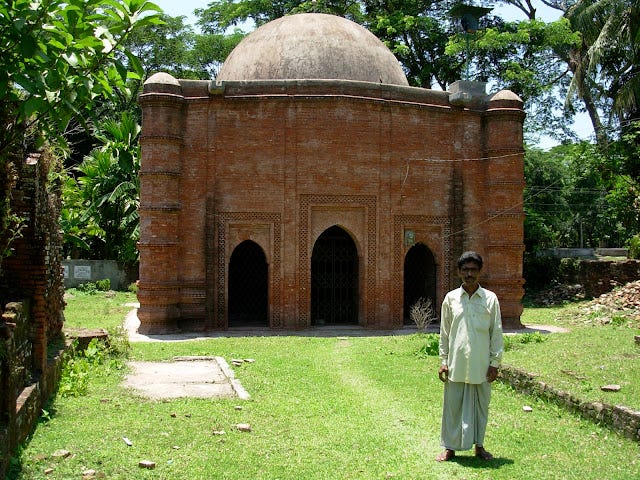
My first stop was about five kilometers from the center of town. Thank goodness for the comprehensive Lonely Planet guide, as I not only knew just where I was going, but how to get there. The people on the bus were very friendly, too, in as much as they all knew exactly where I wanted to get off. All I had to say was, “Shait Gumbad Mosque,” and they knew just what I needed to do. This mosque, located next to the small Bagerhat Museum, is said to be the largest and most traditional mosque in the country, made of bricks, and is held up inside by sixty stone columns. Only one of the columns is exposed so that we can see the stones; all others are covered with some sort of stucco.
In contrast to other countries in which “infidels” (non-Muslims) are not allowed inside mosques, I was not only welcomed, but invited in by the imam himself. This being Friday, I was in a bit of a hurry to see whatever mosques I could before the early afternoon prayers. One other difference here — especially in contrast to Mauritania, where I lived for two years — is that the calls to prayer are much more melodic and pleasant to listen to. I do not understand Arabic, but these calls are sung so softly and smoothly that I have the impression that they would be much easier to discern the actually words (if I knew what they were).
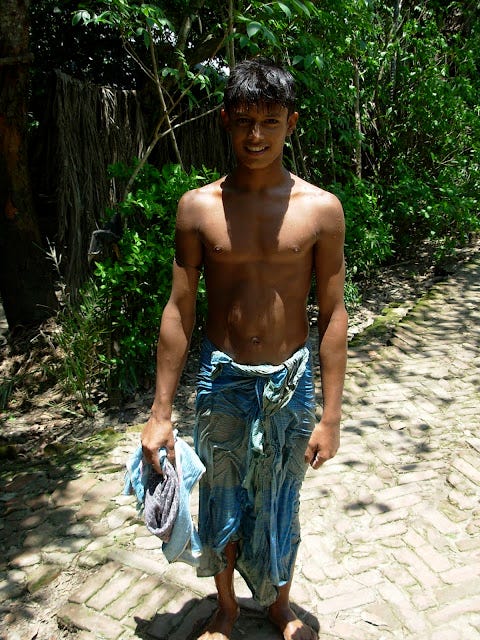
There were two other mosques nearby that I wanted to see. It was very easy to find my way around — not by any signposting with names of the mosques, but because I became a walking spectacle myself, and in no time I was gathering an impressive crowd of boys and young men who were more than willing to show me the way. In contrast to what I had thought was very typical Muslim modesty, many of the men were walking around shirtless, which added considerably to the delightful scenery.
My next stop was the Bibi Begni Mosque, and from there, another “guide” took me to the Chunakhola Mosque.
At each turn, of course, I answered the same questions: where I was from, what my profession is, and what I thought of Bangladesh. The walk to each mosque was on brick; most of the way was covered by lush greenery. It was hot, but I have experienced hotter weather in Africa, so it was not all that bad. (It was probably 95ºF/35ºC.)
After I saw those two mosques, I stopped for a banana break at a store that I had seen earlier. While I was eating, a rickshaw driver caught my eye and asked if I might want a ride. At this stage, with a bit of ground to cover so that I could see the other sights, I thought that that would be a good idea, so we negotiated a price and off we went. Correction: we really didn’t negotiate a price. He told me that it would cost Tk 20 (29 cents) and I didn’t see any reason for him to do it for any less.
As we rode around on the bumpy brick roads, me in the back of the rickshaw and the driver peddling furiously, it struck me that this was an excellent way to get a vigorous prostate massage — if that is one wants — but not what I was particularly thrilled to receive!
The next sights all looked remarkably similar in that they were old brick structures. First, there was the Zinda Pir Mosque, then the Nine Domed Mosque, which turned out to be the only place in days where I saw another foreigner (a man from Netherlands).
Finally the rickshaw driver took me to the mausoleum of Khan Jahan Ali, who lived in the fifteenth century in this area, during which time he led a huge building campaign, erecting mosques, bridges, palaces, and other buildings. He is continued to be revered by the people of the area.
It was at the mausoleum that I was enthusiastically invited in and asked for a donation — not only for the maintenance of the building but also “for tea” for the men who were gathered in front. When I offered Tk 100 to them for tea, at first one of them scorned the amount. But I pointed out that tea cost no more than Tk 2 per cup, which meant that there was enough for fifty glasses of it. He smiled, realizing that I may be a foreigner but at least I am not a fool.
My rickshaw driver was willing to take me into town to get the bus I needed, which was more than he had originally bargained for. I just asked him to name his price and I paid it, thinking that Tk 100 was more than reasonable.
Off I went for my return to Khulna on the bus.
“Exclusive” bus from Khulna to Dhaka
I opted for the “exclusive” bus trip for the return to Dhaka from Khulna. Yes, there was air conditioning. No, there were no torn seat covers. Inside, it was all very pleasant. There seems to be one incontrovertible fact about traveling in this part of the world: no matter how “exclusive” the bus, the drivers are madmen who slalom continuously on the two-lane roads so that they can bypass all the slower traffic — bicycles, bicycle-drawn carts, motorcycles, and other busses — lurching their vehicles into the oncoming traffic just in time to see that another madman is approaching, which means that they must lurch back behind the slow ones, usually applying the brakes, all the while keeping one hand on the horn, to alert the world around them with a message that says, “I want to pass you,” or “I am now passing you,” or “Move faster, you sonofabitch.” There were also lots of speed bumps. As we rode over them, the physics of the bus meant that I, in the back row (as far as I could get from the horn-blowing) was shot up into the air, literally out of my seat, as we passed over them!
One fascinating feature did impress me: all the way from Khulna to Dhaka, a trip that took a little more than six hours, there was continuous settlement of people. Never were we in a totally forested or unsettled place, even for as much as half a kilometer.
On Wednesday I am going to Chittagong. As a result of all this being thrown around my seat like a pinball, I decided that I am going to take the train for this journey. I hope it turns out to be a better strategy!
The passenger sitting next to me on the bus was very helpful, telling me which stop would be closest to where I was going (a train station to get my Chittagong ticket) and which train station was the best for me, considering that I would also need to go back to my hotel after I got the ticket.
He had introduced himself earlier by telling me, “I am a first officer.” Or that is what I thought he said. I asked him, “First officer of what? Army? Navy? Police?” He then did a spell-check for me, during which I found out that he was a forest officer at one of the national parks!
Dhaka days
Dhaka is a sprawling city that is clogged with traffic and also has lots of ongoing construction. There are several green areas, which was a surprise for me.
My plans for seeing other parts of Bangladesh, each of which was in a different direction from the capital, meant that my best strategy was to go one way, come back to Dhaka for a bit, and then head out the other way.
I met up with Y (whom I write about in the report about gay life here, in the post that immediately follows this one) and went out to dinner with him. In discussing what we would eat, Y asked me if I liked Mexican food. I said that I did, and he showed me how to find the only Mexican restaurant in Bangladesh: El Toro.
It was fun to order and eat a burrito! I imagine that the restaurant has a hard time getting ingredients. It was the sauce that was nothing like what I have tasted in the USA. I guess we Californians can be fussy about our burritos!
The next day, I took an hour-long ride, much of it in bumper-to-bumper traffic, in a “baby taxi” or “CNG” (named after the kind of fuel on which it runs, which is compressed natural gas) to meet Y at Lalbagh Fort. As it turned out, it was closed on Sunday, which is contrary to the information in Lonely Planet.
Y and I had lunch, walked through Old Dhaka, and then to the campus of Dhaka University.
On the way back to my hotel, it started to rain. At one point, a car passed me on the right. I was surprised to see the driver behind the wheel that was on the left of the car, just like at home. As the car sped past me, I was further shocked to see that the vehicle had a California license plate!
Drivers rule the roads here. Pedestrians take their lives in their hands crossing the streets, even at crosswalks, corners, and when they have the green lights.
Rickshaw wallahs, the slowest of the modes of transport, do not stick to the extreme left lane. You can find them anywhere, usually impeding traffic.
These rickshaw wallahs are also self-styled concierges. More than half of the ones with whom I rode, as well as some who began following me as I walked down the streets, asked me, “You need something?” If I told them that I didn’t need anything, they usually made their offerings more specific: “You need girl? Very pretty. Room, too. All ready for you.” And if I told them no, that I did not want a girl, their next line of questioning was often, “You want boy? You want me?”
The CNG drivers are also very strong-headed. If they do not want to go to your desired destination, they just shake their heads and drive away. At least half of the drivers with whom I rode saw fit to stop for gas while I was in the vehicle. Only on one occasion was I able to make myself clear that I wanted the driver to turn off the ticking meter while we waited. The others just kept it going, despite the pointing and gesturing I did. They do not want to rely exclusively on the meter for their fare, as they prefer that foreigners pay a higher and inflated price for their rides. I could usually get them to use the meter by saying that I would pay “meter plus baksheesh,” meaning that I would give them a tip, which is not something that the Bangladeshi riders would pay.
Now, back to the story. That afternoon, I met Z at a cafe not too far from my hotel. Called The New Yorker Cafe, its walls are an eclectic collection of Americana: a page from “The New Yorker Times,” photos of Elvis Presley, Marilyn Monroe, and James Dean; street signs proclaiming Elvis Presley Blvd, Marilyn Monroe Ave, a New York City subway map, and a framed poster of portraits of American presidents.
After the trip to Chittagong, I still had two more nights in Dhaka. I was able to see Y and Z again. X had left town for a trip. Y and I went to the memorial that was erected to those who lost their lives in the struggle to establish Bangla as the country’s “mother tongue.” (Up until that time, West Pakistan had been imposing Urdu on them.) Then we went to a Chinese and Thai restaurant called Midnight Sun.
After we walked around a bit, I met Z. We went together to the National Museum and saw their exhibits of art and life in Bangladesh. The weather outside was cloudy, then rainy, and was cooling down nicely. Inside the museum, however, it was stuffy and stifling. The museum is not climate-controlled; fans were whirling, but they were not offering much relief.
From there, we toured the campus of the art college.
To continue reading, here is the link to Part 3: