avatarGregory A. Austin

Free AI web copilot to create summaries, insights and extended knowledge, download it at here

3276

Abstract

possible to capture in a multi-sourced article devised by numerous editors.</p><p id="8f51">You’re probably familiar with the adage: “A picture tells a thousand words.” And while that sentiment itself is a load of rubbish, Wikipedia could do itself a favor by adding more photos of bands in their natural habitat — live and on stage. Instead, the reference guide shuffles through page upon page of notable dates, studio album tracks, and singles that climbed the US and UK billboard charts.</p><p id="0338">On top of all that, Wikipedia seems especially interested in the bands’ lineups. They’re obsessed with who played which instrument, when, and for how long. In almost every entry, for almost every band, they have a special “band timeline graph.” These colorful graphs give the chronological information of the band as well as where the members were and what they were doing when their band’s major studio albums dropped.</p><p id="14da">Check this one out:</p><figure id="9351"><img src="https://cdn-images-1.readmedium.com/v2/resize:fit:800/1*dppCttyvKBULguQ-3BYhDA.png"><figcaption>Picture from <a href="https://en.wikipedia.org/wiki/The_Regrettes">Wikipedia</a> (<a href="https://en.wikipedia.org/wiki/Wikipedia:Text_of_Creative_Commons_Attribution-ShareAlike_3.0_Unported_License">CC BY-SA 3.0 License</a>)</figcaption></figure><p id="12ab">The data shows a modern band with a high level of turnover in their five years of existence. Is this interesting? Does it help you understand the music or the general dynamic of the band? What does a reader gain from knowing this band burned through three drummers, two studio albums, and two “other releases?”</p><p id="502e">Now look at this one:</p><figure id="2342"><img src="https://cdn-images-1.readmedium.com/v2/resize:fit:800/1*kETppFl1lSLj6ll-AgTj6A.png"><figcaption>Picture from <a href="https://en.wikipedia.org/wiki/R.E.M.">Wikipedia</a> (<a href="https://en.wikipedia.org/wiki/Wikipedia:Text_of_Creative_Commons_Attribution-ShareAlike_3.0_Unported_License">CC BY-SA 3.0 License</a>)</figcaption></figure><p id="74e9">Based on the data, we can tell this band is older than the last, and they were around for more than three decades, but aren’t together now. But other than Peter Buck’s love/hate relationship with the rhythm guitar, how does either graph distinguish one band from the other, musically? For all the reader knows, the former could be a note-for-note cover band of the latter who picked up right where their predecessors left off. Maybe they even brunch together every Sunday to compare notes.</p><p id="6d4c">The only other takeaway from this graph is that Wikipedia is a bit flippant in their design. The first band’s graph puts the lead singer at top and cycles through the other instruments by a presumed level of “importance” (sorry, drummers). Contrarily, the second band lists the lead singer last and chronicles the members <i>alphabetically</i> from top to bottom. Now, without hearing any music, I’m already biased against the second band and their anal alphabetizing behavior — which is unfair since the band probably had no input in the making of their graph.</p><h1 id="82c0">Graphs are music’s white whale</h1><p id="faa3">Okay, here are two final graphs to compare side by side:</p><fi

Options

gure id="f4a2"><img src="https://cdn-images-1.readmedium.com/v2/resize:fit:800/1*RjyGOusr3UGYCdO2YPdHdg.png"><figcaption>Picture from <a href="https://en.wikipedia.org/wiki/Echo_%26_the_Bunnymen">Wikipedia</a> (<a href="https://en.wikipedia.org/wiki/Wikipedia:Text_of_Creative_Commons_Attribution-ShareAlike_3.0_Unported_License">CC BY-SA 3.0 License</a>)</figcaption></figure><figure id="231a"><img src="https://cdn-images-1.readmedium.com/v2/resize:fit:800/1*eH-2zaiYFD7kPdLdz4YO0g.png"><figcaption>Picture from <a href="https://en.wikipedia.org/wiki/List_of_the_Allman_Brothers_Band_members">Wikipedia</a> (<a href="https://en.wikipedia.org/wiki/Wikipedia:Text_of_Creative_Commons_Attribution-ShareAlike_3.0_Unported_License">CC BY-SA 3.0 License</a>)</figcaption></figure><p id="98f7">Here we have two bands that existed from the 1970s to the 2010s with a few breakups and reunions throughout their careers. From the data we see that despite releasing roughly the same amount of studio albums, the latter was more prolific in the early days while the former seems to have meticulously spread out their albums. We can also assume that the latter really got a kick out of recording their live shows — particularly in the early ’70s and (very specifically) in 1992.</p><p id="4a14">However, it’d be damn near impossible for a graph to depict how different these two bands are. Such musical cartography can’t show how they’re separated geographically by the Atlantic Ocean, or that their styles are at the opposite ends of the spectrum while the energy of their music is as different as ecstasy and opium.</p><p id="cdbb">The one thing these graphs do show — in sobering detail — is how the magic of music is as temporary as a wilting flower. The seamless way a piece of music can transport your consciousness to any time imaginable is no match for how short a time a band’s perfect lineup or their ideal period will last. If they’re lucky, the fruits of their labors will last far longer than their heyday. The latter ends too soon, often without warning.</p><p id="9dbd">Graphs might teach you that when stripped down, a band is nothing more than the sum of its parts. But they’ll never allow you to see the inner drama or the perfect alignments that allowed these bands to keep it together long enough to create something unique and memorable. The power associated with music is brief, poignant to some, and ancillary to others. For many, this true nature is indescribable.</p><p id="58fc">With that being said, you can’t blame Wikipedia for trying to figure out a question posed by so many.</p><div id="a993" class="link-block"> <a href="https://readmedium.com/a-lesson-in-italian-american-history-for-andrew-cuomo-e30380b89024"> <div> <div> <h2>A Lesson in Italian-American History for Andrew Cuomo</h2> <div><h3>It’s hard to believe, but the Sopranos were never meant to be the heroes</h3></div> <div><p>medium.com</p></div> </div> <div> <div style="background-image: url(https://miro.readmedium.com/v2/resize:fit:320/1*BTS3jj1KMu6FBV2Xl6l4hQ.jpeg)"></div> </div> </div> </a> </div></article></body>

MUSIC TO MY BLEEDING EARS

Band Timelines on Wikipedia Reinforce Music’s Fleeting Nature

All good things must end. But why so damn early?

Photo by Matthias Wagner on Unsplash

Wiki-Wonderland

I have a love/hate relationship with Wikipedia, and suspect you do too. That old online reference guide is a hard animal to love. It’s a lot like one of those friends who despite a brain brimming with knowledge, doesn’t quite understand how to control their social filter. And like Wikipedia, they’re always pandering for the smallest amount of sustenance to keep their services free for years to come.

Greetings, Gregory. I see you’re enjoying my winning presence on our barroom quiz team. However, as an independent hardware store cashier, coming to these weekly meetups is starting to take its toll. Since our (or any) quiz team doesn’t have a corporate sponsor, I must humble myself by asking you for a pint of beer. If everyone on this team could donate $5 for a pint — the price of one pint of beer — it will ensure my position on this team well into the future.

— That one friend we all have who thinks the world owes him a favor

Wikipedia’s constant bombardment can be annoying, but it’s a means to an end to ensure they’ll never have to put up ads. (With that being said, why don’t they just run ads like ninety percent of sites on the internet?) This aggressive method is a mere peccadillo, far from the website’s cardinal sin. Wikipedia’s true failure is similar to the shortcoming often expressed by Lieutenant Data from Star Trek: The Next Generation. Sometimes, they’re too robotic and cold for their own good.

Breaking up and mending together

One of the most glaring examples of Wikipedia’s unchecked roboticism can be seen in the way they cover music — particularly bands. For many, music is a feel-good escape that transcends time and space. Somebody’s favorite song can transport them to their high school prom in the 1980s, an outing they had a few months ago, or to an unknown location a thousand years into the future. Music has magical transformative properties that are impossible to capture in a multi-sourced article devised by numerous editors.

You’re probably familiar with the adage: “A picture tells a thousand words.” And while that sentiment itself is a load of rubbish, Wikipedia could do itself a favor by adding more photos of bands in their natural habitat — live and on stage. Instead, the reference guide shuffles through page upon page of notable dates, studio album tracks, and singles that climbed the US and UK billboard charts.

On top of all that, Wikipedia seems especially interested in the bands’ lineups. They’re obsessed with who played which instrument, when, and for how long. In almost every entry, for almost every band, they have a special “band timeline graph.” These colorful graphs give the chronological information of the band as well as where the members were and what they were doing when their band’s major studio albums dropped.

Check this one out:
Picture from Wikipedia (CC BY-SA 3.0 License)

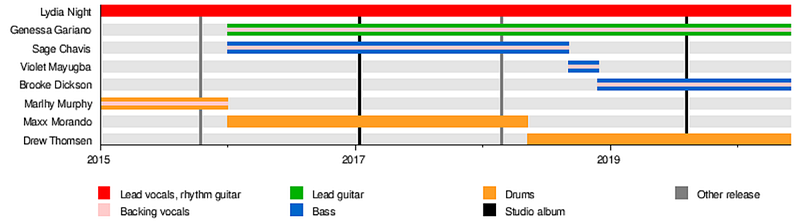
The data shows a modern band with a high level of turnover in their five years of existence. Is this interesting? Does it help you understand the music or the general dynamic of the band? What does a reader gain from knowing this band burned through three drummers, two studio albums, and two “other releases?”

Now look at this one:

Picture from Wikipedia (CC BY-SA 3.0 License)

Based on the data, we can tell this band is older than the last, and they were around for more than three decades, but aren’t together now. But other than Peter Buck’s love/hate relationship with the rhythm guitar, how does either graph distinguish one band from the other, musically? For all the reader knows, the former could be a note-for-note cover band of the latter who picked up right where their predecessors left off. Maybe they even brunch together every Sunday to compare notes.

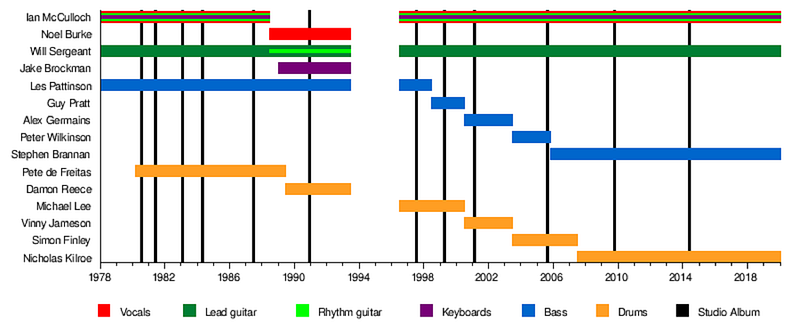
The only other takeaway from this graph is that Wikipedia is a bit flippant in their design. The first band’s graph puts the lead singer at top and cycles through the other instruments by a presumed level of “importance” (sorry, drummers). Contrarily, the second band lists the lead singer last and chronicles the members alphabetically from top to bottom. Now, without hearing any music, I’m already biased against the second band and their anal alphabetizing behavior — which is unfair since the band probably had no input in the making of their graph.

Graphs are music’s white whale

Okay, here are two final graphs to compare side by side:
Picture from Wikipedia (CC BY-SA 3.0 License)

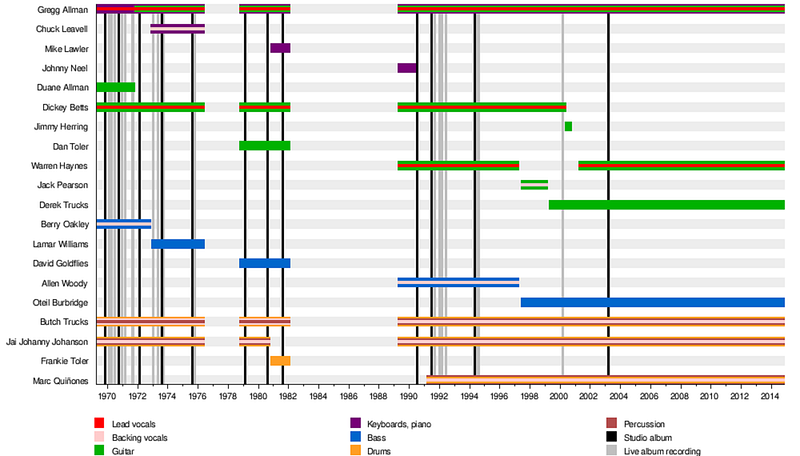
Here we have two bands that existed from the 1970s to the 2010s with a few breakups and reunions throughout their careers. From the data we see that despite releasing roughly the same amount of studio albums, the latter was more prolific in the early days while the former seems to have meticulously spread out their albums. We can also assume that the latter really got a kick out of recording their live shows — particularly in the early ’70s and (very specifically) in 1992.

However, it’d be damn near impossible for a graph to depict how different these two bands are. Such musical cartography can’t show how they’re separated geographically by the Atlantic Ocean, or that their styles are at the opposite ends of the spectrum while the energy of their music is as different as ecstasy and opium.

The one thing these graphs do show — in sobering detail — is how the magic of music is as temporary as a wilting flower. The seamless way a piece of music can transport your consciousness to any time imaginable is no match for how short a time a band’s perfect lineup or their ideal period will last. If they’re lucky, the fruits of their labors will last far longer than their heyday. The latter ends too soon, often without warning.

Graphs might teach you that when stripped down, a band is nothing more than the sum of its parts. But they’ll never allow you to see the inner drama or the perfect alignments that allowed these bands to keep it together long enough to create something unique and memorable. The power associated with music is brief, poignant to some, and ancillary to others. For many, this true nature is indescribable.

With that being said, you can’t blame Wikipedia for trying to figure out a question posed by so many.

Music
Wikipedia
Internet
Charts
Self Reflection
Recommended from ReadMedium