
Balancing Your Energy for Success
Like riding a bike
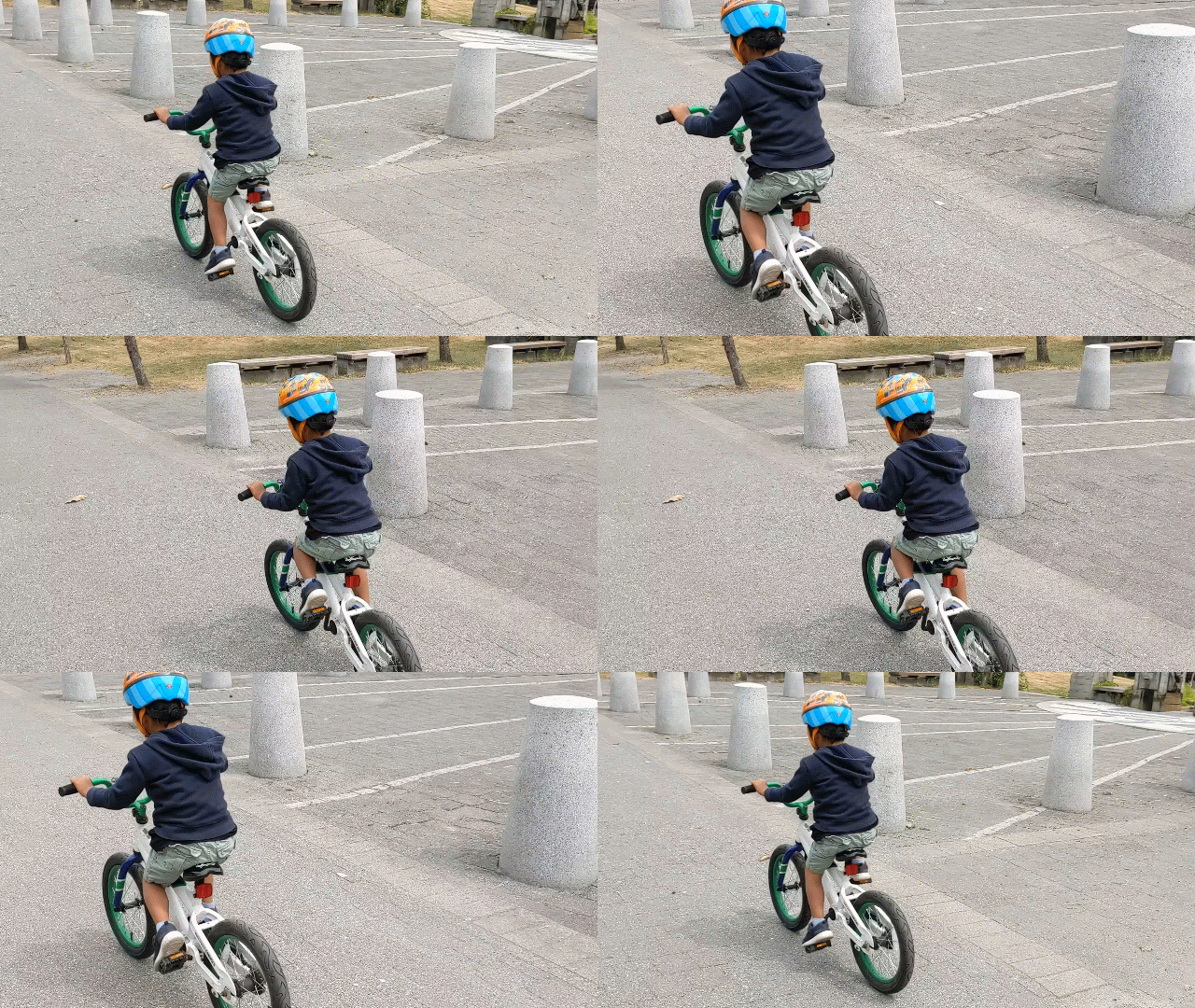
“It is the same with people as it is with riding a bike. Only when moving can one comfortably maintain one’s balance.” — Albert Einstein
Have you ever found yourself acting against your own long-term interest because you were tired or worn out? Maybe you ate that extra piece of pie, or you procrastinated another day on that project you needed to get done? Maybe you started an argument over something small and said things you later regretted or you acted impulsively in a way that might have felt good at the moment but that act had negative consequences for yourself and/or other people in your life?
A common example that many people have faced is the fight they have with family members when they are hungry. In popular culture, we call it being “hangry.” There was even a popular award-winning chocolate bar commercial that played off this theme with the tag line, “you’re not yourself when you’re hungry.”
Hangry in Greece
I know that I have experienced this with both family and friends. One memorable event happened with my parents and brother while on a trip to Greece. Although all of us had been to Greece many times in the past, this was the first time since childhood that all four of us were there at the same time. My parents, therefore, wanted to take me and my brother on an extensive tour of the country of their birth since we were now at an age where we could appreciate the history and beauty that they saw.
On road trips, my father likes to start early and drive as long as he can until we get to our destination. I remember fondly, as a child living in Montreal when in the summers, my parents would pack us in the car at two in the morning while half asleep. We would then drive down south for 6–8 hours going to Cape Cod or some other beach destination. My brother and I would fall asleep again for most of the journey and wake up with excitement as we were just arriving at our vacation spot.
In Greece, however, we were not children sleeping in the back seat but adults and the tour they had planned was a 5500-kilometer journey over seven days. Things were great when we arrived at our destinations but tensions in the automobile had built up. By the third day, bickering in the vehicle was common. As a newly trained psychologist, I took it upon myself to try to get my family members to calm down and breathe. I must have told them to stop and take a breath about 10 times a day while driving.
By the end of the sixth day, I didn’t realize how hungry and exhausted I was when we finally stopped for a late lunch. We had ordered and a small disagreement occurred between my parents where they had a different opinion about a historical event. I should note that these types of arguments are a bit of national past-time for Greeks and I have been known to partake in them myself from time to time.
On this day, however, I must admit that being tired, hungry, and spending too much time trying to care for everyone else’s emotional needs but my own, I had little energy left for my own emotional regulation. I reacted with a verbal outburst stating among other things that I have had enough of the bickering (using more colourful language).
I then stood up with such a flourish that my chair fell backwards. The chair landed on the ground with a noticeably loud thud capturing the other patrons’ attention. Finally, as everyone in the restaurant stared, I stormed out and started walking quickly down the street.
After 10 minutes, I finally stopped and realized what I had done. By that time my family had left the restaurant and drove by to pick me up (I must have walked about one kilometer). I apologized for my behaviour and my father, with a impish grin, reminded me that breathing was important.
Life Takes Energy
You see life takes energy. Overcoming challenges takes energy. Learning takes energy. Sticking with our long-term goals takes energy. Anytime we have to make a decision, filter out distractions, focus attention, or fight an impulse we use up energy. If we do not pay attention to our energy, we may find ourselves burned out or acting in ways that don’t support our life.
Energy depletion does not mean that we lose control and it is not an excuse to avoid taking responsibility for our actions. When my clients offer these types of excuses or justifications I challenge them immediately. For example, regardless of how tired, hungry, or angry we might be, we are still less likely to yell at some people (e.g., our boss or a police officer) and more likely to react with others (e.g., family members). So, we control ourselves with bosses because they can fire us but we may give ourselves permission to react with family and friends because we don’t expect to get fired.
Looking at my own situation, you could see that I demonstrated control. I did not, for example, hit anyone nor did I break anything. I was still responsible for my actions both in terms of allowing myself to reach that level of energy depletion and in how I chose to react in that state. Energy depletion has very real neurological and psychological effects on us but it does not mean we lose control. We remain responsible for our actions.

Burnout: Energy Depletion
Nevertheless, it is important to pay attention to our energy level because otherwise we risk burning out. In states of energy depletion, we are not at our best. Below is a list of symptoms of burnout or compassion fatigue. Look and see if any of them sound familiar.
· Irritation and dissatisfaction
· Increased negativity and pessimism
· Sleep and appetite disruption
· Preoccupation & difficulty concentrating
· Physical, emotional & mental exhaustion
· Feelings of hopelessness & helplessness in work & life
· Depression may occur — we become detached
· Personal and professional relationships begin to collapse
To understand burnout, we need to understand our brain. Our brain requires energy to operate properly. Additionally, our brain uses almost a quarter of the energy of the whole body. A large portion of that is in our frontal cortex, the area of our brain that we often refer to as our executive functioning.
As Kelly McGonagall describes in her book The Willpower Instinct, that is the part of the brain that can help us say yes to what supports our lives, to say no to what will interfere with our lives and to keep our long-term interests in mind when faced with immediate gratification.
Energy depletion will have an impact on our frontal cortex and consequently our resourcefulness. All of a sudden, our capacity to stay focused on our long-term goals goes down, as does our capacity to say no to choices that may interfere with our long-term good (but may feel good right now).
We are now more likely to be reactive to our environment rather than responsive. We are more likely to give ourselves permission to follow base impulses (e.g., eat too much of the wrong thing, have an adult tantrum, etc.) than consider the consequences of those actions for our long-term good.
The Solution
The good news is that we can address this problem quite simply by being more aware of our energy levels and rebalancing our system as is necessary throughout the day. There are five key factors associated with energy balance: good sleep, exercise, proper nutrition, periodic recharging, and creating healthy boundaries so that we do not overextend ourselves.
This rebalancing is a dynamic experience. Because life can be unpredictable in its demands, it is important that we pay attention and adjust each of these five areas on an ongoing basis. In a future post, I will go into details regarding how we can utilize these 5 areas to support our energy system.
Check out some of my previous articles in The Orange Journal here:


