
Lemonade, Fertilizer, and the Art of Reframing
The alchemy of perspective
“Just when the caterpillar thought that the world was over it became a butterfly.” English Proverb
Alchemy is the art of turning one thing into another. In ancient times, there was a belief that you can transmute a common substance of little value (for example, lead), into something of great value (for example, gold). In his famous book the Alchemist, Paulo Coelho, speaks to the psychological elements of alchemy as involving the transformation of the person.
Similarly, Tara Bennet-Goleman in her book Emotional Alchemy suggests that the true meaning of alchemy is that we all have the natural ability to turn our moments of confusion into insight and clarity.
One of the most powerful psychological experiences we can engage in is the act of transforming our moments of pain and difficulty into resources or opportunities. Through this transformation, we can then engage in the world in a different and more effective way. In psychology, we often refer to this alchemy as reframing. In everyday language, we talk about turning lemons into lemonade or the crasser metaphor of turning manure into fertilizer so that out of something negative, growth and beauty is possible.
This is more common than you might think. Research in psychology has shown that between 30% and 70% of people report positive changes after encountering personal suffering. Positive psychology practitioners and researchers refer to this as post-traumatic growth in recognition of the fact that we can also grow in significant ways from pain, trauma, and other life challenges.
Reframing is not easy and it can take time. It can, however, be powerful. One of my clients experienced a wonderful reframe that shifted his focus from suffering to renewal. It did not change his circumstances but it relieved him of some significant suffering and consequently, he could put more energy into his healing.
A Doctor’s Journey Through Resentment
He is a medical doctor from an African country who immigrated to Canada to begin a new life. He was a well-established medical practitioner in Africa and held some prestigious positions. Nevertheless, like many professional immigrants into North America, he needed to prove his credentials to our College of Physicians and Surgeons and this required him to take courses and exams. Consequently, he was working in menial positions while getting his equivalency.
Unfortunately, one evening while driving home, he was rear-ended by another vehicle whose driver was distracted by being on her phone. The accident happened as he was waiting to merge on the highway and his vehicle was hit so hard it almost pushed him onto oncoming traffic just as an eighteen-wheel truck was speeding by. At that moment, he believed that he might die.
In addition to the psychological trauma, he also suffered physical injuries including migraines and other pain in his neck and shoulders. This affected his ability to read and concentrate which of course affected his ability to complete his equivalency. He began to wonder if he would ever be able to return to medicine and he began to feel great sadness at this potential loss and great anger towards the distracted driver.
Reframing Resentment
In our work together, several things became clear. First, he strongly identified with being a medical doctor. For him, this meant being a caring person who attempts to save or improve people’s lives. He was also carrying a lot of resentment and anger towards the distracted driver.
His resentment also took a lot of his energy and he reported that he thought about that person daily. Finally, his thoughts were also consumed by the fact that he could have died. He had flashbacks of the truck speeding by so close to his vehicle as he was pushed forward. These thoughts and images disturbed his sleep further diminishing his concentration and increasing his tension and pain.
One session it dawned on me that he saved her life. I asked him what would have happened to her if he was not in front of her at the entrance to the highway? He realized that distracted as she was, she would have driven straight into the oncoming traffic and likely been killed by the truck. We discussed how he in fact saved her life. That his presence saved her life. Therefore, even though he wasn’t practicing medicine yet in Canada, he was still saving lives.
This reframe shifted something for him. His body became lighter and he could let go of his resentment and anger. This didn’t mean he was letting go of his legal claim against her, there were still consequences for her distracted driving. Nevertheless, he could release his resentment and some of his trauma for his own safety. You see in his medical practice in Africa he would occasionally put himself in danger in the performance of his duties. The risk he experienced in this context was, therefore, also reframed as part of saving a life.
Having freed up energy from resentment and trauma he could focus more on his physical recovery and his future. He regained momentum for moving forward with his goals once more. The path ahead was still full of challenges but he was no longer contributing to those challenges by being stuck mentally and emotionally. This renewed understanding was a pivotal moment in his healing. Keep in mind that post-traumatic growth does not mean that we do not suffer after reframing or that the trauma isn’t harmful and distressing. It does, however, allow us to find the resources and strength to move through the struggle more effectively.
Understanding Frames
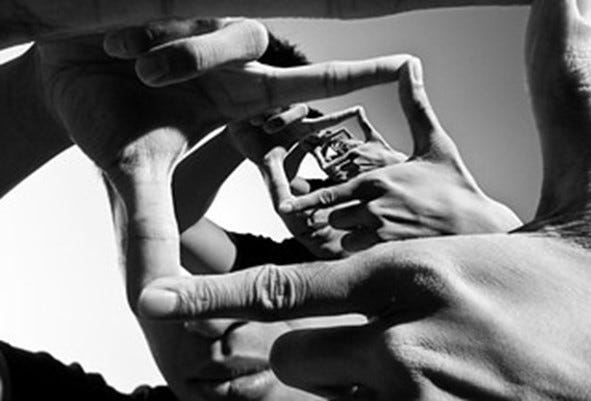
Frames are, therefore, very important. A frame is a way in which we see the world. You can think of it as a belief or a perspective that we use to understand the world. It sets the boundaries of how we see the world much in the same way that a picture frame sets the boundaries of the picture. What is outside of the frame is not visible to us. Having a specific frame is not a problem in and of itself. It is only when the frame we are using is not working for us or when we are so inflexible that we do not see other ways of looking at the world.
Perhaps you have heard of the story of the three blind men and the elephant. One man felt the leg of the elephant and believed the elephant was a sturdy tree. Another man felt the elephant’s trunk and believed it was a snake, while the third man felt the ear and believed it was a rug. By examining only one part of the elephant they could not understand the true nature of an elephant. In the same way, when we do not examine our perspectives we may be blind to important aspects of our reality.
Reframing involves stepping back and considering alternative frames and perspectives. Take for example the perspective that my friend and colleague Peter Levesque, founder of the Institute for Knowledge Mobilization, has created around competition. Peter observed how the typical framing of competition can become a race to the bottom because people are trying to step over each other to “win.” He noted many people stuck in this frame think and act with the perspective of “I want what you have” and a win/lose mindset.

Reframing Competition
Peter prefers to view life from a different perspective. Instead of “I want what you have” he thinks, “I want to know how you got there so I can achieve what I want as well.” This different frame changes the focus from envy to curiosity, from judgment to learning, and from hopelessness to action. It is a shift from “what” to “how” and a change in energy from a defeating win/lose mentality to a creative and energized win/win mentality.
Reframing can be extremely difficult but it can also be quite simple and even small reframes can have profound impacts. One client, who was working towards reconciliation with his wife, noted that thinking about “getting back together” created anxiety for both him and his wife. They both had visions that the old patterns would resurface. I suggested that instead they think about how to “move forward together.” This change opened their perspective to what was possible and what they wanted to create rather than what they were afraid might happen.
The process of reframing can be difficult, especially when people are dealing with significant suffering from a serious medical (e.g., illness or disease) or social issue (e.g., abuse and trauma). Be patient with yourself and be willing to seek help.
Journaling can help. Explore and respond to questions that seek to open your view regarding how you are seeing your current circumstances.
Try This: Journaling for Reframing
· How have you become sensitized to the pain of others through this problem?
· Is there anything you could do to make the world a better place or reduce the likelihood of others will suffer as you have?
· How do you think this might fit into the bigger picture of your life?
· Can you think of past traumas or problems that led you to a better place and that seem like necessary experiences when you look back on them now?
· Do you think what you are going through right now could be one of those experiences?
· Without being dismissive of your suffering, I was wondering if you think there was any lesson you have learned from this experience?
· How do you think your life is better because of this problem even though you would not have chosen it?
· What do you think you could contribute to the world or other people now that you have gone through this difficult time?
This is an excerpt from my book CORE Living: 8 Choices for Living Well available at Amazon
See also


