
Balancing Act: Harnessing AI Tools for Better Writing
Believe in human-created writing AND benefit from technology.

Readers want human-crafted stories.
More and more, editors read submissions written with too much help from artificial intelligence. AI, including ChatGPT, Jasper, Bard, or another option, can be valuable when used for specific tasks, not to write your article.
New writers and those with English as a second language may think using AI will help them write effectively. Yes, AI has uses, but not to write your article.
It would be impossible to discuss every type of writing in one article. So, here, we’re looking at typical blog posts and articles that combine personal experience, opinions, and information.
You may think all writing is the same, whether created by humans or machines. Not true.
Google, the search giant, worded it well in their Google Search’s guidance about AI-generated content.
“… however content is produced, those seeking success in Google Search should be looking to produce original, high-quality, people-first content demonstrating qualities E-E-A-T.”
What is E-E-A-T? Expertise, experience, authoritativeness, and trustworthiness; the goals of good content. And this is what Google and readers want to read.
To compare AI-created and human-created writing, I asked ChatGPT what makes a good blog post. In its favor, it got the answer right:
In the dynamic realm of online content, crafting an engaging and captivating blog post is both an art and a strategic endeavor. Begin by hooking your audience with a compelling introduction that sparks curiosity and resonates with their interests.
Yes! A writer definitely wants to engage and captivate.
So next, as a test, I asked ChatGPT to write.
“Please provide a 50-word opening paragraph for an article about the guilt parents feel when they worry about making mistakes with their children.”
It returned: Parenting is a delicate dance, and in the intricate choreography of raising children, missteps are inevitable. As the music plays, guilt often takes center stage, a relentless partner for parents who falter. The weight of mistakes, no matter how small, can be a heavy burden, casting shadows on the uncharted path of parenthood.
Yikes. Accurate, perhaps. Boring and oddly worded, yes.
No parent I know would call parenting an intricate choreography. AI has no human experience, so it cannot convey real emotion.
On the other hand, I have five children. Lots of experience and all kinds of emotions in my life. So, I let my mind wander back and consider how I might begin an article about Parental Guilt.
Being woken by the phone in the middle of the night is never good news. And as the mother of four sons, I know this all too well.
I looked at the time. 1:00 a.m.
“Hello? Yes, this is the mother of Sam. Who are you?”
The voice on the other end answered, “Officer Johnson from APD. We picked up your son at the scene of a suspected vandalism incident an hour ago.”
“I’m sorry. That can’t be. He went to bed hours ago.” I jumped out of bed and headed to his room. I knocked; no answer. Pushing the door open, I saw the room was empty.
“Well, that’s the name this young man gave me. Can I bring him home?”
An hour later, my sheepish son opened the front door. A uniformed officer stood behind.
Indeed, Sam had climbed out his bedroom window and joined some friends in throwing eggs at a classmate’s house.
The next day, after I had time to process my anger along with relief the incident was not more serious, I spiraled into Parent Guilt. All parents know what I’m talking about.
Oh my. What kind of mother doesn’t know their son has a ladder propped up outside their second-story bedroom window? Have I been so busy working that I’ve lost touch? Sam’s probably acting out because his father and I have been arguing.
Yes, that sounds like the nagging voice of Parental Guilt.
A story can open with a startling statistic, a personal anecdote, or a compelling question—but make it relatable.
For example, I could have said, Do you know what most parents fear most? It’s not worrying whether their child will be abducted, contract a terrible disease, or fail at school. I spoke to twenty parents, and most told me, “We are scared that we make mistakes and mess up our kids.”
Or, “What is your greatest fear as a parent?”
Nearly any opening would be better than, “Parenting is a delicate dance, and in the intricate choreography of raising children, missteps are inevitable.”
Think about articles that attract your interest. Ask yourself why?
I want a clear, compelling title and an opening that grabs me.
Eight years ago, I began working as a content writer and had little confidence in my writing ability. My words were lifeless and uninspiring. Learning to infuse our writing with voice and humanity takes time while remembering the rules of structure and grammar.
What? Twenty-seven uses for the comma?! I felt overwhelmed.
I gradually learned that writing can educate, inspire, and establish expertise. Well-written informative articles can also contribute to search engine optimization (SEO).
Only humans can genuinely integrate these purposes successfully.
Yes, humans can write boring, insipid articles, too.
Not all online writing was good before the availability of AI. It takes practice and experience to communicate clearly and effectively. But only humans have the advantage of personal experience.
My advice: be willing to be authentically you. Own your voice and believe in yourself and your wisdom. Readers respect honesty and are attracted to passion and vulnerability. Those traits are far more critical than perfect structure, punctuation, or grammar.
AI excels at structure.
Structure and organization are complicated for most writers. We have an idea in mind, and we start writing, but soon we veer off-topic, confusing the reader. Structure is easy for AI because it’s never distracted by ideas or emotions.
So, you can use ChatGPT or other AI tools to provide an outline, the bones of your article.
Here, I asked AI for an outline on the topic of parental guilt with this prompt:
Please provide an outline for an engaging blog post of 1,000 words about the guilt parents feel when they make mistakes with their children. Provide five key points.
Here’s the outline. Notice that it builds on its previous suggestion that Parenting is a delicate dance.
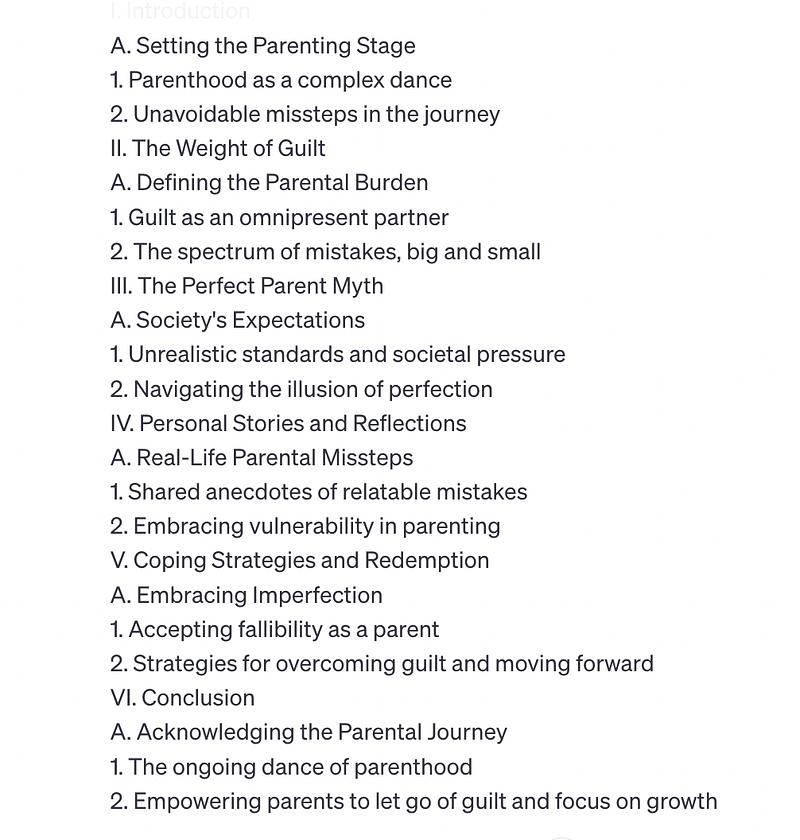
Its main points are good, indicated with Roman numerals and capital letters. I could use this outline to provide a guideline for an article.
But at this point, I’d write the article myself.
Use AI to proofread your work.
I prefer Grammarly, the paid version, to help with this stage of the writing process. This screenshot illustrates its suggestions for the original draft of this article:
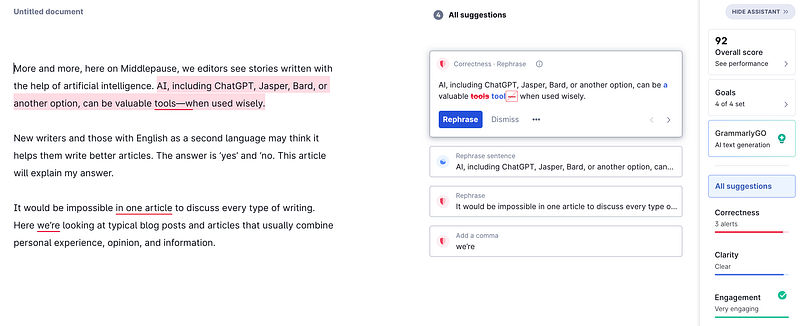
I slowly read my work; all of its suggestions are valid and helpful, so I ‘accept’ them all. My article now has correct usage, grammar, and punctuation, but the thoughts remain mine.
Warning: do not accept all the suggestions without consideration. Sometimes, you prefer your own version, and the decision is yours. It saves me a lot of time, and I make fewer mistakes since I’m always learning from my helpful AI Tutor.
As a new writer, I tried several free proofreading programs, including PaperRater, Hemingway, ProWritingAid, and the free version of Grammarly. I’ve settled on ProWritingAid and Grammarly as the most useful to me.
If you have yet to try these tools, check them out. The right choice for you will depend on your budget, skill, and the writing you do.
AI excels at making headline suggestions.
After you’ve finished your article, proofread it with the help of AI, read it aloud to yourself, edit it, and revise it. Then you can copy your text and ask your AI to provide ideas for headlines.
I gave ChatGPT this prompt: Please provide three suggestions for this article.
It returned these ideas:
- “Navigating the AI Writing Landscape: A Guide for Writers”
- “Balancing Act: Harnessing AI Tools for Better Writing”
- “Beyond the Code: Unraveling the Impact of AI on Personal Writing”
After looking at the suggestions, I decided on:
Balancing Act: Harnessing AI Tools for Better Writing and the subtitle: Trust yourself while you benefit from technology.
So, there you have it: some appropriate uses of modern AI.
I love experimenting with new technologies to make my work faster, easier, and better.
You can use tools for keywords, SEO, and many more purposes. Read Basic Keyword Tools and Techniques You Can Use to Write Better Every Day to learn more.
Writers: trust yourself and use AI to help you become better at your craft. But also study and use platforms like Udemy to take affordable classes, read books, and practice.
Whether you write for a hobby or hope to make writing your career, appropriate technology can make your writing more effective.
But make your words your own. We look forward to reading what you have to say.