
Backspin: Wu-Tang Clan — Enter the Wu-Tang (36 Chambers) (1993)
When pop success threatened to smooth out rap’s rough edges, Wu-Tang Clan brought back the ruckus. (97/100)
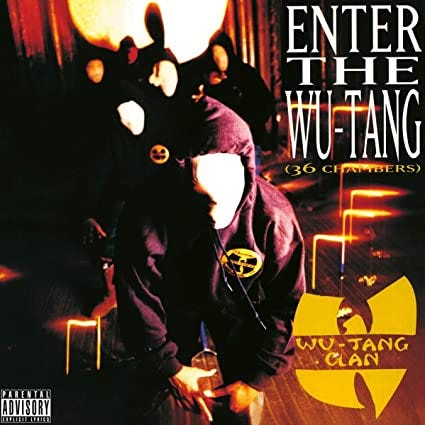
Enter the Wu-Tang (36 Chambers) is the hip-hop embodiment of Newton’s third law of physics: for every action, there is an equal and opposite reaction.
As the late ’80s golden era gave way to early 90s corporatization, hip-hop, having felt the first glimmers of previously unimaginable commercial success, was growing progressively polished. The warm sun rays of Southern California were reflected in the pristine synthesizers of Dr. Dre’s G-Funk. The increasingly sophisticated production of the Native Tongue collective and their growing cadre of acolytes was adding jazzily melodic texture to New York’s vintage boom-bap sound. Naughty by Nature had mastered the formula for sanding down their rough East Orange edges just enough to highlight irresistible call-and-response choruses.
Just as it appeared as though hip-hop’s rawness might soon be relegated to ’80s nostalgia, the Wu-Tang Clan entered with an album that was the antithesis of MTV, daytime radio, soda commercials, and everything that the once rebellious counter culture appeared to be evolving into. Enter the Wu-Tang is dense, murky, and often abrasive. At times, it’s impenetrable, particularly to listeners unversed in the kung fu mythology in which the group’s lyrics and philosophy are so deeply steeped. It was also riveting, washing through hip-hop’s collective respiratory system like a breath of fresh air, despite (or perhaps because of) the unmistakable taint of weed smoke and gun powder. The album’s controlled chaos instantly reinvigorated New York street rap, while simultaneously distinguishing Wu-Tang as a breed unto itself.
Like Public Enemy’s seminal It Takes a Nation of Millions to Hold Us Back, Enter the Wu-Tang exists in its own sonic universe. Just as Nation’s wailing air raid sirens yank the listener into that PE’s orbit from the first note, RZA, Wu-Tang’s resident production sensei, masterfully sets the tone here with a deftly deployed clip from the 1981 movie, Shaolin and Wu Tang. After nearly 20 seconds of tense dialogue, the mystical strings of the film’s score seamlessly give way to the brooding baseline and dusty drum loop of “Bring Da Ruckus.” RZA’s primal scream of a hook offers a jarring contrast to the disciplined combat of the intro. When Ghostface Killah bludgeons the mic with his opening verse, it’s quickly clear that despite the kung fu aesthetic, this clan is just as likely to stomp you out as delver a crescent kick.
The track is sonically dissonant, at times atonal, even. The rhymes are pure aggression, a jarring departure from the liltingly melodic forays of the G-Funk anthems of the day, and the tongue twisting high wire act of Das EFX. Yet, the track is as hypnotic as the era’s most polished offerings. It’s a fitting opener in that it invites listeners to self-select. Some will be (and were) repelled, but if you stick through til the end, you’re hooked, a humble student now eager to follow the Wu-Tang masters wherever they lead for the next 55 minutes. And what a journey it is.
The brooding of “Bring Da Ruckus” abruptly gives way to the raucous free-for-all that is “Shame on a N***a,” which erupts like a PCP-fueled bar room brawl. It’s the first of several tracks on the album that deftly showcase individual members, building out the distinctive personas of each clansman without sacrificing the collective framework. Here, the group’s two most charismatic swordsmen, Ol’ Dirty Bastard and Method Man, kick off the proceedings with pure star power. While Meth, and later Raekwon, both deliver inspired turns, this is Dirty’s show. The Wu’s resident wild card howls the track’s head banging hook and proceeds to maraud his way through open and closing verses peppered with growls, exclamations, and onomatopoeias. In a clan of kung fu masters, Dirty is the drunken brawler with just enough marshal arts knowledge to be dangerous. His manic energy injects the otherwise meticulously disciplined crew with a much needed unpredictability.
“Clan In Da Front” follows as a potent counterpoint, showcasing the group’s most precise technician, The GZA, in a pulsating tour de force. RZA presents a minimalistic canvas consisting of a slapping drum track and a pensive piano loop, as GZA crafts a tapestry of clever boasts, extended metaphors, elusive mysticism, and cannily placed pop cultural references that personifies the group’s unique style.
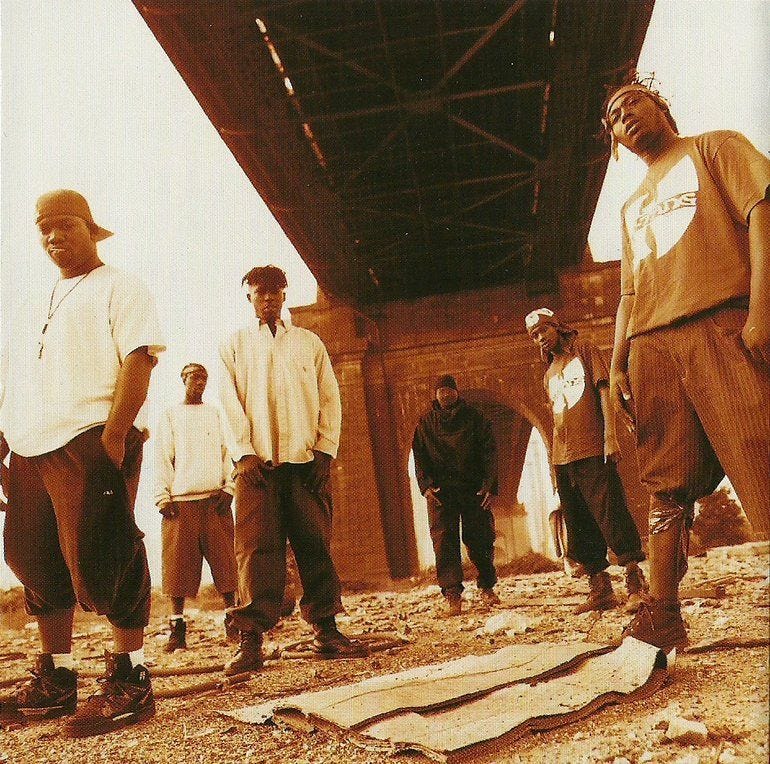
The similarly measured “Can It All Be So Simple” introduces the Clan’s most potent pairing, Raekwon and Ghostface, in the first of what would be many riveting collaborations. Over a slow burning Gladys Knight sample, Rae and Ghost strip away the Clan’s mythology and mystique, delivering poignant and relatable narratives of struggle and ambition. Rae laments past pain, and Ghost grounds day-to-day struggles in visions of a brighter future. The iconic “C.R.E.A.M” follows a similar template, with Raekwon again proving near peerless at painting vivid vignettes, and Inspectah Deck taking the track to the stratosphere with his perennially underrated gift for pairing powerfully constructed bars with an unrelenting delivery.
Method Man lightens the mood with his eponymously titled star turn. The rollicking track is the perfect showcase for one of rap’s most naturally gifted leading men, his elastic flow weaving in and out of the unyielding beat, the raw grit of his voice adding a layer of menace beneath the whimsy of the sing-song delivery. The track is at once a showcase for everything that enabled Meth to grow into one of the genre’s biggest stars, and a frustrating reminder that had he been able to match the musical serendipity of this track more regularly, he could actually have built a solo catalogue equal to his star status.
While the solo and duo tracks tend to be measured affairs, carefully tailored to highlight the strengths of the featured MCs, the posse cuts are pure bloodsport. There’s a saying among swordsmen that steel sharpens steel. Perhaps it explains the palpable sense that while these tracks are unmistakably family affairs, if your blade game is slipping, your head will get sliced by your brother.
“Protect Ya Neck” is a masterclass in cipher demolition, the intensity ratcheting up a notch every time the mic is passed. As the first single released, it was the track that introduced the group to the world, fully formed as Voltron, while also allowing each of the 7 featured members to shine individually. But it has always been “Da Art of Chessboxin’” that makes me want to find an arch enemy with whom to engage in a chemically enhanced steel cage death match. The tension bubbling through the background chant and haunting keys is brought to a boil by the throbbing drums, and Deck, Rae, ODB, and Ghostface hurl ferociously focused lyrics of fury. Yet, it’s Masta Killa, making his only appearance on the album, who delivers the verse that perhaps best encompasses all the elements that define the Wu, from the meticulous metaphors and off kilter-imagery to the brazen bravado:
Homicide’s illegal and death is the penalty What justifies the homicide, when he dies in his own iniquity? It’s the master of the mantis rapture comin’ at ya We have an APB on an MC Killer Looks like the work of a master Evidence indicates that his stature Merciless like a terrorist, hard to capture The flow changes like a chameleon Plays like a friend and stabs you like a dagger This technique attacks the immune system Disguised like a lie, paralyzin’ the victim You scream as it enters your bloodstream Erupts your brain from the pain these thoughts contain Movin’ on a n**** with the speed of a centipede And injure any motherf***in’ contender
For all its aggressive rawness and unpolished affectations, Enter the Wu-Tang actually applies many of the lessons learned from hip-hop’s mainstreaming to great affect. Most of the tracks are bolstered by instantly memorable hooks, be they crowd inciting chants (“Wu-Tang Clan ain’t nothin’ to f*** wit!”), or melodic earworms courtesy of soulful samples (“After the laughter, comes tears”). RZA’s sampling acumen also provided many of the tracks with a melodic undergirding. It made for a sonic layering that gave Wu-Tang a catchiness absent in other ’90s Timbo and hoodie bangers that made fitting soundtracks to a New York winter, but failed to resonate much outside the Tri-state area.
Even within the canon of great hip-hop albums, Enter the Wu-Tang (36 Chambers) sits in rarified air. Not only was it one of the albums responsible for putting New York back on the national map, it simultaneously established the Wu as its own subgenre and subculture. In the mid to late ’90s, there were hip-hop heads who listened to Wu-Tang, there were rock fans who listened to Wu-Tang, and there were Wu-Tang fans whose CD stacks consisted almost entirely of Clan projects (group and solo) and those of its subsequent affiliates. The group is still evident in the design of current rap collectives like Griselda. Most importantly, more than a quarter century after its initial release, Wu-Tang Clan’s unique brand of refined rawness plays as every bit the breath of fresh air juxtaposed against today’s trap sounds as it did against the G-Funk grooves of its day.
By the Numbers
Production: 10 Lyrics (how the words are put together): 9.5 Delivery & Flow: 9 Content (Substance): 9.5 Cohesiveness: 10 Consistency: 9.5 Originality: 10 Listenability: 9.5 Impact/Influence: 10 Longevity: 10
Total — 97
Next
Previous
Backspin is a look back at the albums that shaped and defined hip-hop. It explores what made them resonate, the impact they had on the culture, and where they fit in today’s ever-expanding hip-hop canon.