
Backspin: Queen Latifah — All Hail the Queen (1989)
Queen Latifah assumed her throne with an album that embodied the Golden Era. (86/100)
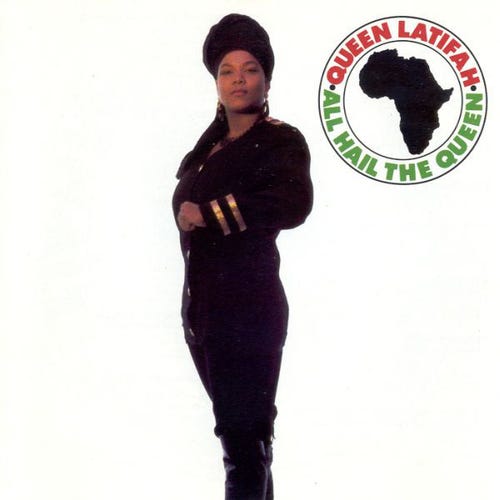
It seems counter intuitive that one of the most enduring superstars to emerge from hip-hop’s Golden Era would have one of its most overlooked albums. Yet, that’s precisely the paradox of Queen Latifah’s rap career. Hip-hop was the catapult that propelled her into the stratosphere of popular entertainment, but unlike her fellow (male) rappers turned cultural icons, her hip-hop bonafides have largely gotten lost in the shadows of her mass market accomplishments.
It’s perplexing (less so if you’re familiar with Tommy Boy Records’ general malfeasance in the handling of its legacy catalog), because Queen Latifah’s resounding debut cut through 1989’s crowded field, immediately positioning the Newark, NJ mic commander as one of the culture’s most respected figures. More than three decades later, All Hail the Queen remains as invigorating a listen as the day it dropped, thanks in part to the assuredly eclectic production, but mostly to Latifah herself. Her formidable mic skills consistently impress, but it’s her essence — by turns commanding, accessible, and charismatic, but always reassuringly at ease with herself — that truly captivates.
From the moment it emerged on mix shows at the close of hip-hop’s coming of age year, 1988, Latifah’s debut single “Wrath of My Madness” (original pressings of the 12-inch had yet to adopt the royal moniker) stood out from the star-studded crowd. Where the frenetically paced James Brown loops that embodied the sonic prototype of the day hit the blood stream like a shot of adrenaline, “Wrath of My Madness”’s bass heavy mid-tempo groove burrows into your spine, causing involuntarily head nods and screw faces.
Latifah’s stutter-step flow carries shades of the Native Tongue camp’s avant-garde stylings, landing somewhere between the Jungle Brothers and De La Soul, but with the bare-knuckled force of a war-tested cypher vet. Lyrically, she places herself on the battle field, but above the fray. In mocking the futility of rap beef, she slyly positions herself as the vanquishing victor.
Some MCs act bold and arrogant Vain and using each other to compete with These subjects I pity Cause their rhymes are not witty Like mine To write a rhyme that’s so delicious you can eat it Now there are those who like my taste, but don’t consider bitin’ There’s penalties for those who don’t do writin’ And just be reciting Everyone else’s word that took a lot of thinking It’s not our fault your thoughts are shrinking Well, mine are growing Yes, you know, like all the woman inside of me Despite what you do or say And even in spite of me
Latifah’s call out of the preponderance of early female MC known to rely heavily on (male) ghostwriters may be a less than subtle gambit to position herself outside of gender stereotypes. Still it’s fair to say no female MC had been more comfortable in their skin. She doesn’t run from her womanhood like the cadre of tomboy styled MCs who showed little lyrical differentiation from the boys. She firmly embraces it, not as a gimmick or crutch, but as a fundamental component of the worldview that informs her rhymes.
On the flip side, she’s not afraid to flirt. Yet there’s nothing demure about it. She lays down the same gauntlet to potential suitors as to lyrical opponents: acknowledge her royalty or keep steppin’.
Brothers catch my eye with little hijinks like eye winks Dying to have a lover of my likeness So release all your shyness Just call me “Your highness” And dare to feel the wrath of my madness
Delivered nearly a year after “Wrath of My Madness,” All Hail the Queen lived up to the long simmering expectations, effortlessly building out the rich personality and worldview introduced on the single. Latifah nimbly maneuvers nearly every box in the increasingly niche driven late ’80s hip-hop scene without ever seeming to pander or lose her essence.
“Dance for Me” epitomizes the ethos of “party with a purpose.” The uptempo opener balances enough bounce to ignite a dance floor with sufficient bump to boom in a jeep. Despite the whimsy infused by the Sly Stone vocal sample cleverly deployed as a bass line by producer DJ Mark the 45 King, Latifah resists the temptation to water down her technique. Flows, cadences, and rhyme schemes cascade with a fluidity equal to the beat. Despite the sonic density of the production, her commanding delivery wrestles its way to the forefront.
“Come Into My House” follows the footprints of The Jungle Brothers “I’ll House You,” pairing hip-hop swagger with the electronic escapism of house music for a genre-bending burner capable of igniting party goers of any and all ilks. While Latifah’s take doesn’t feel quite as sonically organic as the JBs’, the sheer charisma of her playfully delivered verses paired with the understated sensuality of her gently crooned chorus are enough to win over party goers and even a few begrudging purists.
More than enough red meat is served up to keep heads nodding, with “Latifah’s Law” and “Queen of Royal Badness” offering hypnotic compositions over which Latifah can flex her MC prowess at mid and high tempos respectively. A precursor to the template that many left-of-center “alternative” MCs would follow in the early ’90s, Latifah’s braggadocio is infused with nuggets of consciousness. But it’s largely subtext as opposed to the full frontal knowledge bombs often favored by righteous rappers of the late ‘80s.
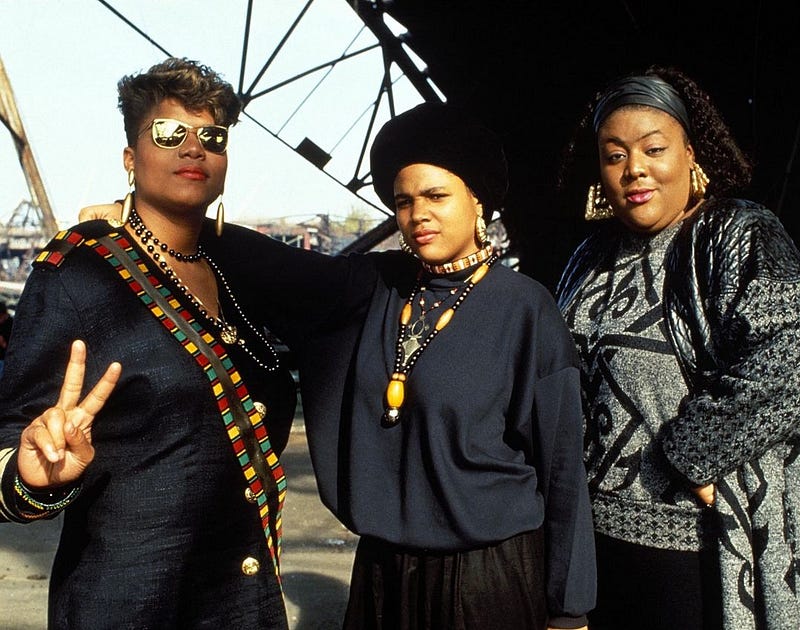
All Hail the Queen may be the first hip-hop album to tout a preponderance of bluechip guest appearances from high profile members of disparate crews. It’s a tribute to Latifah’s command of her space that it all feels of-a-piece, further solidifying her position as a burgeoning matriarch presiding over the culture in all of its diversity.
The 45 King, the album’s primary producer, steps from behind the boards to trade bars with his fellow Flavor Unit co-founder on “A King & Queen Creation”. The tag team effort positions The Unit as an up and coming crew for a ’90s kinda world, pairing hip-hop’s fundamentals of funky beats and furified rhymes with a burgeoning ethos of social awareness and unity.
De La Soul’s Posdnuos and Trugoy the Dove, fresh off the breakout success of 3 Feet High and Rising, make Latifah’s Native Tongue affiliation official on “Mama Gave Birth to the Soul Children”. Prince Paul’s playfully eclectic sonic canvas allows Latifah to lean into her avant-garde tendencies, while fleshing out the native tongue ethos. While Latifah’s mature lyrical focus adds direction to De La’s stylistic excursions, their embrace of her as matriarch positions the Tongues as an outgrowth of a woman’s soul. The conceit undergirds the feeling that the crew is inherently more in touch with the natural world than their more machismo-driven peers.
On “The Pros,” Stetsasonic’s Daddy-O lays down a wicked riddim, over which he and Latifah go all in on the island influence hinted at throughout the album, while KRS-One pulls the conscious subtext to the surface on “Evil That Men Do”. The Boogie Down Productions chief is credited with production and delivers a brief cameo, but if he didn’t contribute his potent pen, at the very least as an uncredited co-writer, then Latifah succeeded in channeling the Blastmaster’s professorially modulated style to a tee.
Most memorable of all is “Ladies First,” a buoyant female rallying call with a fiercely focused Monie Love. The British-born Native Tongue spitter’s tongue-twisting flow never sacrifices substance for style, and proves the perfect counterpoint to Latifah’s regal deliberateness.
The first high profile collaboration between female MCs, the song embodies the empowerment ethos its lyrics champion. The two women commandeer the 45 King’s galvanic drums with every bit the confidence and competency of their most decorated male counterparts. As Latifah illustrates, the record celebrates not only the womanhood of the two MCs, but its power to motivate and inspire:
Who said the ladies couldn’t make it, you must be blind If you don’t believe, well here, listen to this rhyme Ladies first, there’s no time to rehearse I’m divine and my mind expands throughout the universe A female rapper with a message to send them Queen Latifah is a perfect specimen
Released as the album’s third single, “Ladies First” quickly became a staple on rap video outlets as well as an anthem for young women from elementary school playgrounds to college quads.
While the album’s eclecticism might look scattershot on paper, it all comes together seamlessly, thanks largely to the sheer force of Queen Latifah’s personality. She’s the connective tissue, her magnetic warmth and majestic confidence corals the disparate elements, making them all feel like pieces of carefully crafted whole. Not so much an album but a person.
Paradoxically, it’s likely that same force of personality that ultimately led to Latifah’s rap career getting short shrift in today’s popular perception of her. In the ensuing decades, she has leveraged her larger than life personality to equally outsized success on screen and mass media. To those who weren’t there, a genre record (she never had culturally transcendent crossover staple matching the magnitude of her eventual celebrity like Will Smith’s “Summertime” or Ice Cube’s “It Was a Good Day”) likely feels small — almost unworthy — by comparison.
While All Hail the Queen certainly deserves all the accolades lavished upon the more sexualized takes on empowerment by the top female rappers of the ’90s Renaissance era, it’s relative obscurity has helped it forge a special connection with true hip-hop heads. No matter how high Latifah’s star rises and how bright it shines, the album represents a piece of her that will forever remain ours.
It’s a reminder that her ascension started with hip-hop, and that every time she graces the screen she’s representing the culture with the same confidence, consciousness, and humanity that rocked our boomboxes in ’89. Now, he’s reacing generations, demographics and parts of the world we never could have imagined.
Just as she predicted on “Ladies First,” Queen Latifah truly has expanded throughout the universe.
All hail, indeed.
By the Numbers
Production: 9 Lyrics (how the words are put together): 9 Delivery & Flow: 9.5 Content (Substance): 8 Cohesiveness: 9 Consistency: 9 Originality: 9 Listenability: 9 Impact/Influence: 8.5 Longevity: 6
Total — 86
Next
Previous
SEE ALL
Backspin is a look back at the albums that shaped and defined hip-hop. It explores what made them resonate, the impact they had on the culture, and where they fit in today’s ever-expanding hip-hop canon.


