
Backspin: Ice Cube — The Predator (1992)
A fire this time. (82/100)
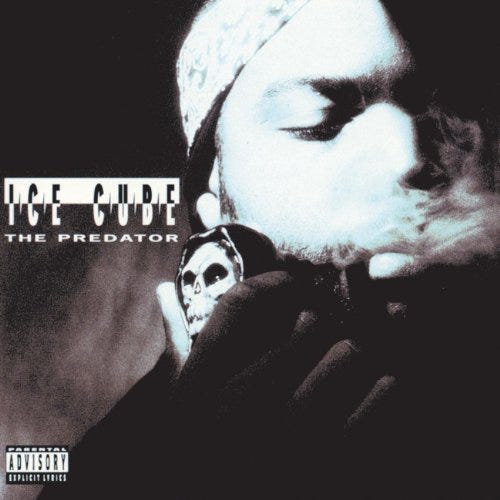
1992 was a year of American reckoning. On April 29th, a Simi Valley, CA jury acquitted the four police officers charged with assaulting Black motorist Rodney King. The attack was captured on video and viewed the world over. In the eyes of the jury and millions of Americans like them, King was still the predator.
The streets of Los Angeles erupted, the verdict triggering centuries of latent rage in communities haunted by a still-active legacy of similar injustices. The city burned for 6 days — largely the poor neighborhoods to which its Black and brown residents were confined by infrastructure and sociology. The rebellion was widely documented as a “riot,” casting the city’s least powerful as the predator.
Into the chaos emerged Ice Cube, in the midst of his own reckoning, to give voice to the emotions and experiences that had exploded on those LA streets. By turns exhilarating and messy; cathartic and confounding, The Predator viscerally captures one of its generation’s most tumultuous moments.
In Ice Cube’s grand tradition of ferocious album openers, “When Will They Shoot?” throws us right into the fire with a relentless burst of sonic and lyrical armageddon. Over a cacophonous beat from DJ Pooh and Bobcat, Cube raps from the eye of the storm in his mind. Like so many of his peers who stormed the streets, he’s got his own beefs that converge with the communal outrage sparked by the verdict to form a psychological tsunami.
As his community burned, Ice Cube saw his own star rise as a bankable movie lead and multi-media raconteur. After spurning him as a pariah a few years earlier, corporate America was suddenly eager to leverage him as a cash cow. Yet, even as they expanded his platform, the box in which they sought to confine him grew ever tighter.
His two previous projects, 1990’s AmeriKKKa’s Most Wanted and 1991’s Death Certificate, spoke emphatically to the conditions that ignited the violence of April 29th. Instead of heeding his warnings, institutions from media to politics castigated him as a catalyst. Exhuming the metaphor of predator and prey that girded AmeriKKKa’s Most Wanted, Cube presents the targets on his back, front, and sides as only growing larger and more numerous with fame:
God damn, another f***in’ payback with a twist The motherf*****s shot, but the punks missed Ice Cube is outgunned, what is the outcome? Will they do me like Malcolm? ’Cause I bust styles, new styles Standin’ strong, while others run a hundred miles But I never run, never will Deal with the devil with my motherf***in’ steel — Boom! Media tried to do me But I was a boy in the hood before the movie, yeah Call me n****, bigot, and a spook But you the one that voted for Duke, motherf***er White man is somethin’ I tried to study But I got my hands bloody, yeah They said I could sing like a jaybird But n****, don’t say the J-word I thought they was buggin’ ’Cause to us, Uncle Sam is Hitler without an oven Burnin’ our black skin Buy my neighborhood, then push the crack in Doin’ us wrong from the first day And don’t understand why a n**** got an AK Callin’ me an African-American Like everything is fair again, s***
If Cube is calling out America for trying to shoot the messenger, he’s also making it clear this messenger is shooting back.
Now if I say “no violence,” devil, you won’t respect mine F*** the dumb s*** and get my TEC-9
It’s Ice Cube proclamation that he’s turning the tables, or at least doing his damndest to. The remainder of the album finds him clawing for agency, shedding the crippling cocoon of “prey” and embracing the role of “predator” with which America seemed intent upon saddling him.
Bare-knuckled lead single “Wicked” tempers braggadocio with well warranted skepticism towards LA’s newly appointed Black police chief, Willie Williams, whom Cube suspects is “just a super slave.” The new chief is summarily put on notice that he will be held accountable by any means necessary.
“Now I Gotta Wet ‘Cha” embodies Ice Cube’s high-wire balancing act between his roles as hip-hop’s boldest truth teller and corporate America’s burgeoning commercial entity. Over DJ Muggs’ gut bucket blues-drenched banger, Cube launches a frontal assault on perceived enemies of Black liberation, both from outside the community and within. While his second verse missive to the Simi Valley jury is particularly blistering, the song’s meticulous construction around a sing-songy Cypress Hill-esque chorus undercuts the vitriol, making it feel too calculated by half. Cube’s post-chorus coda, “the n**** with the big fat trigga,” plays more silly than menacing.
“We Had to Tear This Mothaf***a Up” is more focused. Dispensing with the commercial bells and whistles, Cube takes us back to the April 29th acquittal and its aftermath from the perspective of the hood:
Not guilty, the filthy, devils tried to kill me When the news get to the hood, the n****s will be Hotter than cayenne pepper, cuss, bust Kickin’ up dust is a must
As the song progresses, Cube takes us from Tarantino-worthy revenge fantasy, in which the acquitted officers are called out by name and dealt vigilante justice, into the heart of the uprising itself. He positions the eruption as seized empowerment; an overdue predator moment in a system that has long preyed on Black submissiveness. Muggs’ menacingly minimalistic drum and bass heavy production gives the track a fitting balance of urgency and deliberateness.
On the polar opposite end of the spectrum stand The Predator’s two smash singles, easily the biggest commercial hits of Cube’s career. On the surface, “It Was a Good Day” is everything Cube railed against on AmeriKKKa’s Most Wanted’s “Turn Off the Radio”. Atop the suede-smooth melodies of the Isley Brothers’ summer soft slow jam, “For the Love of You,” a carefree Cube waxes poetic on Los Angeles’ most idyllic day (eventually identified by internet sleuths as January 20, 1992). He enjoys a pork-free breakfast, notches a triple double in a park pick-up game, and still has enough energy left to satisfy a seemingly insatiable conquest into post-coital slumber.
It works to perfection, not just as a radio single — of which its one of hip-hop’s all-time greats — but within the context of the album. Below the tranquil surface bubbles an undercurrent of foreboding. Cube repeatedly defines the goodness of the day by what doesn’t happen — police harassment, shootouts, and the murder of peers. The sample’s ethereal haze gives the whole vignette a dreamy quality. The escapism slams to an abrupt end when Cube is jarred back to reality, instructing DJ Pooh to “stop this s***,” and chastising himself with a brusque “what the f*** I’m thinkin’ about?”
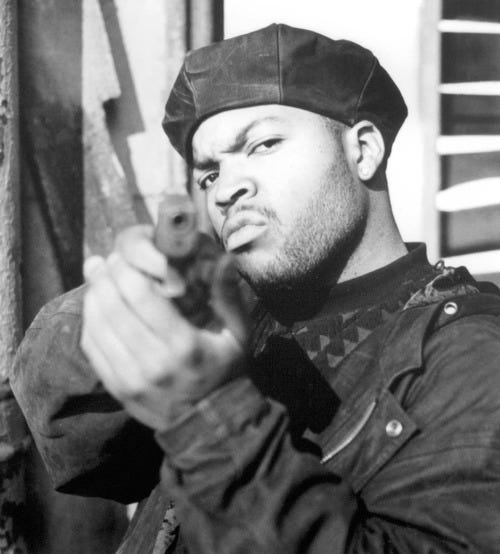
“Check Yo Self,” — appearing here in its House of Pain-esque original form, decidedly rowdier than the Grandmaster Flash-sampling remix that dominated airwaves — comes out swinging like a back alley brawler. However, the free-association braggadocio of the lyrics feels out of place within the framework of the album.
Cohesiveness is a recurring struggle across the album’s back half. “Dirty Mack” and “Don’t Trust ‘Em” seek to expand the scope of the album’s premise by painting a world defined by predators and prey in myriad forms. While Cube riding a nasty funk groove is always a treat, the synth-fueled bounce of the former feels out of place among the rawer sonics most prevalent on the album. And juxtaposed against the revolutionary fervor that defines The Predator, the latter’s call out of predatory women feels trite and reductive.
Despite the detours, the album regains its focus en route to a jarring conclusion. Having spent the bulk of The Predator embodying the aftermath of the King verdict, Cube uses the final two tracks to bring the album full circle. Neither song pulls any punches in tackling the root cause of the trial and subsequent rebellion: the racially motivated police brutality routinely visited upon Black men. In tandem, the tracks tease out the duality of the album’s title and central theme.
“Who Got the Camera” positions the police as the predators, using a “routine traffic stop” as pretext to brutalize Ice Cube and vandalize his car. After 45 minute of Cube going full Django on any and all adversaries, it’s sobering to find him suddenly as powerless as King and every other Black man who has felt the weight of the law on his neck:
Found an empty can of Old Gold Came around and put my ass in a choke hold F***ed around and broke my pager Then they hit a n**** with a Taser The motherf***in’ pigs was tryin’ to hurt me I fell to the ground and said, “Lord, have mercy!”
The chorus offers a juxtaposition of the cops fiending for blood (“just give me just one more hit”) and Cube’s repeated pleas to the bystanders of “who got the camera?” It’s a clear nod to the King tape. It also foreshadows a 21st Century when the answer would be “everybody,” with videos of Black men brutalized by police becoming commonplace. Cube is also prescient enough to foresee the ultimate futility of the videos:
F***in’ police gettin’ badder ’Cause if I had a camera, the s*** wouldn’t matter
Resigned to the sad truth that legal remedies are insufficient when the legal system itself is predatory, Cube turns to vigilante justice in its deadliest form on “Say Hi to the Bad Guy.” The album closer actively takes the fight to the police, with Cube completing his transition from the prey of AmeriKKKa’s Most Wanted to the ultimate “super predator.” At a time when the King video and verdict had left many feeling powerless, the track’s closing gun shots offer a moment of agency, however ill-gotten or fleeting.
It works emotionally, and even as metaphor: the efficacy of fighting fire with fire. As a viable course of action, it falls short. Against the outsized machinations of systemic oppression, armed rebellion has repeatedly proven little more than a righteous suicide pact. Ask Nat Turner and John Brown. “When Will They Shoot?” seems to acknowledge as much.
Ice Cube himself was hardly popping killer cops and bigoted jurors in between Hollywood film sets and corporate boardrooms. His “fire” came through the weaponry of economic empowerment; a remedy conspicuously absent from The Predator.
Therein lies the album’s frustrating contradiction. It captures the raw feeling of the moment, providing catharsis to communities still reeling, and insight into the rebellion’s seemingly sudden eruption for allies able to see past the fire and brimstone.
Yet, it falls short of offering the level of conceptual and intellectual sophistication that made Death Certificate a generational work. Perhaps Cube was working on a tight timeframe between movie shoots. Maybe the intensity of his rage simply burned too hot in the moment to be rationalized. It would certainly be understandable.
Still, The Predator feels like a slightly missed opportunity. It’s unmistakably of its moment. But its continued relevance 3 decades later speaks less to it transcending that moment than to America’s recurring failures of reckoning causing the moment to repeat on a seemingly endless loop.
By the Numbers
Production: 8.5 Lyrics (how the words are put together): 9 Delivery & Flow: 9 Content (Substance): 9 Cohesiveness: 7 Consistency: 7.5 Originality: 7.5 Listenability: 8 Impact/Influence: 8.5 Longevity: 8
Total — 82
Related
Next
SEE ALL
Backspin is a look back at the albums that shaped and defined hip-hop. It explores what made them resonate, the impact they had on the culture, and where they fit in today’s ever-expanding hip-hop canon.