
Backspin: Public Enemy — It Takes a Nation of Millions to Hold Us Back (1988)
Public Enemy’s sophomore album embodied the Armageddon of 1988 and helped solidify hip hop as a statement, a culture, and a movement. (97/100)
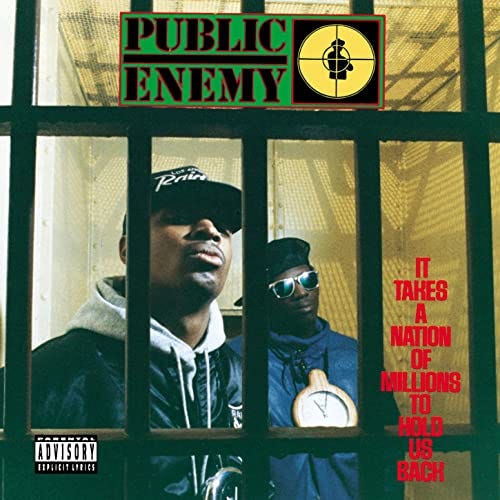
1988 was a hell of a year for hip-hop. But for urban America more broadly, it was a year of hell. The culmination of Reaganomics and the crack epidemic collided to unleash a torrent of violence, addiction, incarceration and despair. Being uniquely of the American inner city experience, hip-hop had never shied away from difficult topics, but Public Enemy’s It Takes a Nation of Millions to Hold Us Back was different. It didn’t just talk about the struggles of the day like Grandmaster Flash & the Furious 5’s “The Message,” or decry injustice like Run-DMC’s “It’s Like That.” It embodied the Armageddon through a barrage of frenetic beats, abrasive sonic dissonance, and urgent rhyming, all the while galvanizing resistance and laying a blueprint for the fight.
Against a backdrop of wailing air raid sirens, the simmering intro, “Countdown to Armageddon,” informs listeners that “you’ve been warned.” It’s little preparation for the full bodied assault that “Brings the Noise” unleashes upon the speakers. If the traditional album opener is a table-setter, “Bring the Noise” flips the table clean over. Chuck D, propelled by the sonic tsunami of breakbeats and sampled horn stabs, and egged on by the irrepressible Flavor Flav, unfurls his modus operandi — challenging systemic racism and the war industrial complex, while calling out his critics and tepid radio programmers:
Never badder than bad Cause the brother is madder than mad At the fact that’s corrupt as a senator Soul on a roll, but you treat it like soap on a rope Cause the beats and the lines are so dope Listen for lessons I’m saying inside Music that the critics are all blasting me for They’ll never care for the brothers and sisters Now, cause the country has us up for the war We got to demonstrate (come on now!) They’re gonna have to wait ’Til we get it right Radio stations, I question their blackness They call themselves black, but we’ll see if they’ll play this
The album refuses to let up from there, simultaneously embodying the chaos of the moment and cutting through it with piercing sirens, scratches, and squeals. Most MCs would get lost in the cacophony, but Chuck D’s booming baritone - equal parts radio announcer, Baptist preacher, and gutbucket soul shouter — provides the sonic anchor. Flavor Flav’s piercing adlibs add the flamboyant color. Brick by brick, PE is solidifying hip-hop as a culture, laying bare a political ideology rooted in revolutions not only of past records, but past movements, with speeches from Malcolm X, Ava Muhammed, and others interspersed.
The album is best known for the broad stroke call-to-arms anthems with which PE would score some of its biggest hits. The aforementioned “Bring the Noise” remains an adrenaline booster in any late ’80s hip-hop set. “Rebel Without a Pause” is quite simply one of the greatest and most distinctive rap singles ever pressed to wax. With its driving drums (played live on the drum machine by Flavor Flav for the duration of the recording) topped with a piercing alto sax sample from The J.B.’s, the track simmers with sonic tension. Chuck’s righteous bravado provides the release. It’s far from PE’s most incisive social critique, and isn’t meant to be. It feels more like a defiant display of a bold black masculinity at the tail end of a champagne soul decade in which urban music had been largely neutered. (“Smooth, not what I am/Rough, cause I’m a man/No matter what the name, we’re all the same/Pieces in one big chess game”)
But it’s the micro-focused critiques and narratives that give the album a conceptual depth to match its layers of sonic revolution. “Don’t Believe the Hype” dismantles the simplistic stereotypes used to dismiss rap at the time, as well as visionary black artists of eras past. (“Writers treat me like Coltrane, insane/Yes to them, but to me I’m a different kind/We’re brothers of the same mind, unblind”). “Night of the Living Baseheads” attacks the crack epidemic head-on, beginning with a big picture diagnosis of the disease. From there it drills its way down like a 105 BPM jackhammer, closing with a powerful vignette about an MC undone by moving from one form of “bass” to a more destructive variety.
Perhaps best of all is “Black Steel In the Hour of Chaos,” a vivid first-person narrative of a political prisoner who ignites a prison riot, leading an entire cellblock to freedom. It’s at once a pointed critique of the prison industrial complex, a nod to the long history of imprisoned black revolutionaries, and ultimately a visceral catharsis, much needed over 50 minutes into such an intense listening experience. It’s also the pinnacle of Chuck’s underrated ability as a storyteller. Few MC’s not named Christopher Wallace or Brad Jordan have spun a more vivid tale on wax than “Black Steel.”

In fact, It Takes a Nation of Millions to Hold Us Back, in its entirety would be Exhibit A in the case against the revisionist argument that has cropped up in the 21st Century that Chuck was not an elite MC. Chuck D, is in fact, one of the greatest vocal practitioners the genre has seen, using his voice as an instrument to anchor the mayhem of the Bomb Squad’s aural assaults. More than a few MCs routinely rated ahead of Chuck would simply get lost or drowned out by such a thickly layered wall of sound. Not only does Chuck match the raw power of the tracks, he somehow manages to bring nuance to the brawl, inflecting, deflecting, and pausing to build momentum and punch home key points.
It was Chuck’s command of the microphone that first drew me into Public Enemy as a (probably too) young child, who otherwise would have been overwhelmed by shear magnitude of the soundscapes. I am infinitely grateful that it did. I have listened to hundreds, if not thousands of albums spanning numerous genres, many of them intrinsically interwoven with particular periods or experiences in my life. Yet, I can count on one hand the ones that profoundly changed me on first listen. It Takes a Nation of Millions to Hold Us Back is one of them.
While I didn’t get all of the references or fully comprehend all the concepts as a kid, everything from the controlled chaos of the production to the militant spirit of the rhymes made it my portal into a whole new world, where music has the power to move not only asses, but masses. All of the potential that the genre had flashed up to that moment synthesized into a fever pitched treatise, solidifying hip-hop as a statement, a culture, and a movement that embodied the historic year of its release. If Eric B. and Rakim’s Paid In Full upped the ante on lyrical intricacy, and Boogie Down Productions’ Criminal Minded on gritty realism, Nation of Millions raised the bar on visceral immediacy.
A few short months later, a group on the opposite side of the country would take that uncompromising intensity in a direction that Public Enemy may not have anticipated, and one that ultimately had an even greater impact on the next generation of rap. But that doesn’t diminish the artistry or impact of Public Enemy’s magnum opus. In today’s climate of discord, in which black, brown, and urban youth are aggressively vilified as public enemies, It Takes a Nation of Millions to Hold Us Back hits just as hard as it did ’88, feeling every bit as timely and every bit as necessary.
By the Numbers
Production: 10 Lyrics (how the words are put together): 9 Delivery & Flow: 9.5 Content (Substance): 10 Cohesiveness: 10 Consistency: 10 Originality: 10 Listenability: 9 Impact/Influence: 9.5 Longevity: 10
Total — 97
Backspin is a look back at the albums that shaped and defined hip-hop. It explores what made them resonate, the impact they had on the culture, and where they fit in today’s ever-expanding hip-hop canon.