avatarAvi Kotzer

Free AI web copilot to create summaries, insights and extended knowledge, download it at here

3309

Abstract

</i>, but rather filed a patent for a “Mode of making boxes for axles and gudgeons”. If the word <b>gudgeon</b> sounds familiar, that’s because you read the <a href="https://readmedium.com/pintle-7b6890cad43">article</a> I wrote yesterday. (Thank you, by the way.)</p><figure id="b4d6"><img src="https://cdn-images-1.readmedium.com/v2/resize:fit:800/1*g20j3nu84kusBWbwafWPqg.png"><figcaption>Screenshotted by Iva Reztok</figcaption></figure><p id="012e">In the patent description, Babbitt wrote:</p><blockquote id="cabe"><p>“The inner parts of the boxes are to be lined with any of the harder kinds of composition known under the names of britannia metal or pewter, of which block tin is the basis. An excellent compound for this purpose I have prepared by taking about 50 parts of tin, five of antimony, and one of copper, but I do not intend to confine myself to this particular composition.”</p></blockquote><p id="5fd9">Seventy-two years later, the 1911 Encyclopedia Britannica had this brief mention about the alloy’s formula: “…it originally consisted of 24 parts of tin, 8 parts of antimony and 4 parts of copper, but in later compositions for the same purpose the proportion of tin is often considerably higher.”</p><p id="89b0">Today’s online edition of the Britannica, however, mentions these combinations:</p><ol><li>high-tin alloys with small quantities of antimony and copper</li><li>high-lead alloys containing antimony, arsenic, and tin</li><li>intermediate tin-lead alloys with antimony and copper</li></ol><p id="cfbc">Wikipedia has the different alloys listed in a table that includes such terms as <b>ASTM grade</b>, <b>Yield Point psiD (MPa)</b>, and <b>Johnson’s Apparent Elastic Limit psi (MPa)E</b>.</p><p id="023b">Yeah… my thoughts exactly.</p><p id="0711">What’s important is the use of <i>babbitt</i> in bearings and internal combustion engines. Why? The alloy is quite resistant to galling, a form of metal wear that occurs due to adhesion between surfaces that slide against each other. Galling is caused by a combination of friction and adhesion between surfaces, followed by slipping and tearing of crystal structure beneath the surface.</p><p id="fde9">Because <i>babbitt</i> has small hard crystals in soft metal, this softer part erodes a bit, creating paths for a lubricant to appear between the hard spots that provide the actual bearing surface. When tin is used in the alloy, that friction causes the tin to melt and <i>become</i> the actual lubricant, protecting the bearing from wear when other lubricants are absent.</p><p id="7ee9">However, today most <i>babbitts</i> cannot endure prolonged use in high-performance internal combustion engines, which is why bearings are now made with linings of copper and aluminum alloys.</p><h2 id="20ff">A Babbitt named George</h2><p id="ad84">There is a Babbitt in the dictionary that’s <i>always</i> spelled with a capital “B”:</p><figure id="ff16"><img src="https://cdn-images-1.readmedium.com/v2/resize:fit:800/1*p5XXFG26UZziOTlyJvYh6g.png"><figcaption>Credit: merriam-webster.com</figcaption></figure><p id="b579">The origin of this term comes from a novel by <a href="http://english.illinoisstate.edu/sinclairlewis/">Sinclair Lewis</a>, the first American writer to win the Nobel Prize in Literature, awarded to him “for his

Options

vigorous and graphic art of description and his ability to create, with wit and humor, new types of characters.”</p><p id="8364">Henry Louis Mencken (known as Aitch Ell to his friends) described him as a “red-haired tornado from the Minnesota wilds.” You can clearly see the bright red hair and tornado-like attitude in this photo:</p><figure id="af17"><img src="https://cdn-images-1.readmedium.com/v2/resize:fit:800/0*CDvVht-EQMfs8Ole.jpg"><figcaption>Photo by Nobel Foundation</figcaption></figure><p id="50c1">The book written by Sinclair is titled— shockingly —<i> Babbitt</i>, and its protagonist is named — are you ready for this? — Babbitt. George F. Babbitt to be precise. In his satirical novel, Lewis critiques the emptiness of middle-class American life and its social pressure toward conformity.</p><p id="64d8">In his review, Mencken had this to say: “There is no plot whatever… Babbitt simply grows two years older as the tale unfolds”. Which apparently was part of what Lewis was trying to do in order to make his point.</p><p id="aa22"><i>Babbitt</i> was published in 1922 and many people think the controversy it provoked was a key element in the Nobel Committee’s decision to award him the prize eight years later.</p><figure id="1bbc"><img src="https://cdn-images-1.readmedium.com/v2/resize:fit:800/0*Up9azaLgd9n0HTWY.jpg"><figcaption>Photo by Publy K’domein</figcaption></figure><p id="7fc1">I have not read the book, and although I’m usually loath to reading plot-less novels, I think I’ll have to check this one out. Right after I finish the other three dozen pending books on my reading list.</p><p id="1395">As for the New York Times, it’s clear they prefer the harsh sounds of <b>heavy metal</b> over the smooth tones of Isaac’s alloy, which is why the editors of the Spelling Bee declared that <i>babbitt</i> is a <a href="https://www.merriam-webster.com/words-at-play/dord-a-ghost-word"><b>dord</b></a><b>.</b></p><p id="b1c9">You can check out my previous entry on another <b>dord </b>here:</p><div id="3961" class="link-block"> <a href="https://readmedium.com/pintle-7b6890cad43"> <div> <div> <h2>Pintle</h2> <div><h3>Hinges hinge on this small but important piece</h3></div> <div><p>medium.com</p></div> </div> <div> <div style="background-image: url(https://miro.readmedium.com/v2/resize:fit:320/1*NtkSmRmYQbArm4yyCpnj9A.jpeg)"></div> </div> </div> </a> </div><p id="9b27">*What the heck is a <b>dord, </b>you ask? Here’s the answer:</p><div id="5ef0" class="link-block"> <a href="https://www.merriam-webster.com/words-at-play/dord-a-ghost-word"> <div> <div> <h2>'Dord': A Ghost Word</h2> <div><h3>One of the questions people like to ask lexicographers is this: Can you sneak something into the dictionary? Can you…</h3></div> <div><p>www.merriam-webster.com</p></div> </div> <div> <div style="background-image: url(https://miro.readmedium.com/v2/resize:fit:320/0*BLo_zUpKNHvJWnoT)"></div> </div> </div> </a> </div></article></body>

Babbitt

Looks like the Spelling Bee is not a fan of soft metal
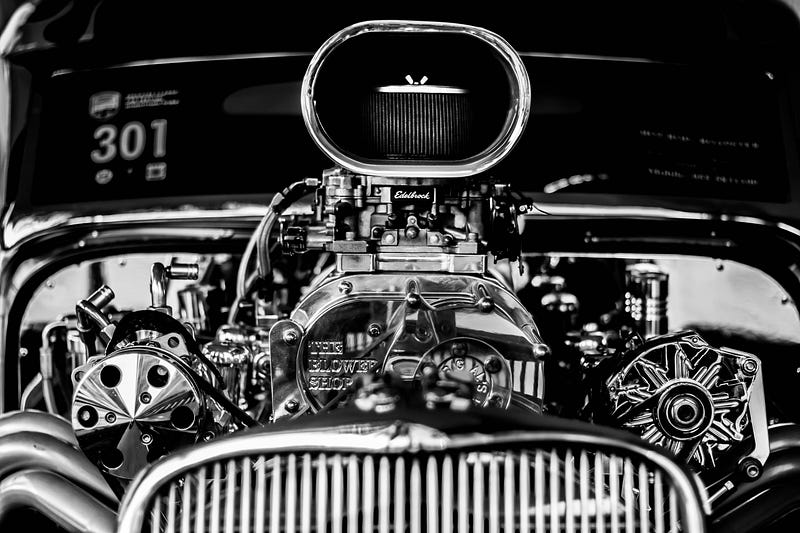
Photo by RKTKN on Unsplash

Today’s New York Times Spelling Bee letters:
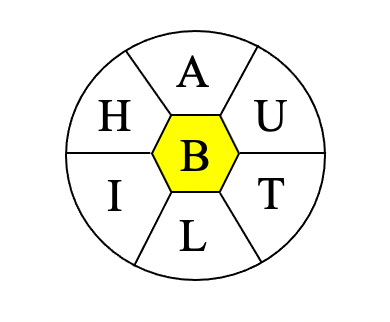
Art: Iva Reztok

A, H, I, L, T, U, and center B (all words must include B)

Merriam-Webster says…
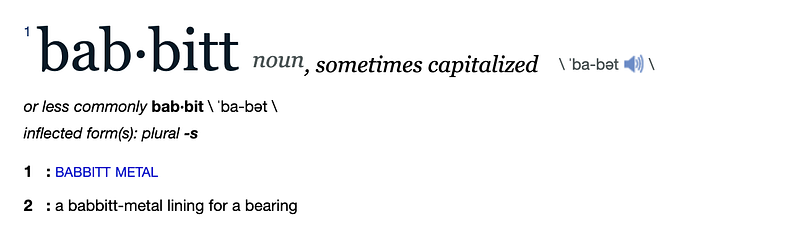
Credit: merriam-webster.com

Silly little dictionary! Don’t you know that babbitt can’t possibly be a word if the New York Times says it ain’t?

For further fascinating facts, check out the Spelling Bee Master.

What’s your favorite dord* from today’s puzzle?

My Two Cents

It often happens that the dictionary provides one synonymous word or phrase as a definition of the term I’m looking up. Most of us know by now that the blue color indicates a link we need to click on. So I did:
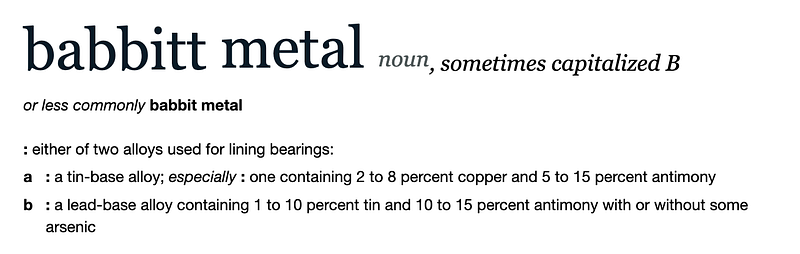
Credit: merriam-webster.com

Why is this noun sometimes spelled with a capital “B”? Probably because the word comes from the last name of its inventor, Isaac Babbitt, a goldsmith who experimented with metal allows and double-letter combinations in names.

In 1824 he was the first person in the United States to make Britannia metal, a pewter alloy, commonly used in silverware, trayware, plateware, and other wares because of its lovely silvery appearance and smoothness factor.

However, 20th-century prophet and writer George Orwell disagreed, claiming in his essay “A Nice Cup of Tea” that “britanniaware” teapots “produce inferior tea” when compared to Chinese ceramics. By that time Isaac Babbitt had been dead for several decades, so he didn’t get a chance to defend his product.

What shall I name this metal I just invented? Hmmm…

In 1839 Babbitt invented the metal he humbly named after himself. His anti-friction alloy was so awesome that the Massachusetts Charitable Mechanic Association awarded him a medal for it two years later, and Congress granted him $20,000 — which is more than half a million dollars today (and yesterday and tomorrow, too).

Babbitt did not patent his alloy per se, but rather filed a patent for a “Mode of making boxes for axles and gudgeons”. If the word gudgeon sounds familiar, that’s because you read the article I wrote yesterday. (Thank you, by the way.)
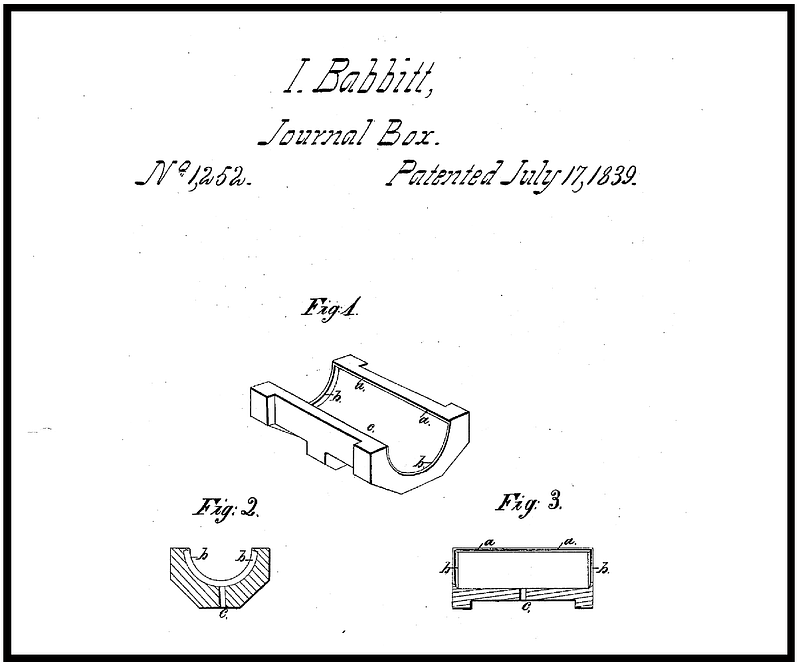
Screenshotted by Iva Reztok

In the patent description, Babbitt wrote:

“The inner parts of the boxes are to be lined with any of the harder kinds of composition known under the names of britannia metal or pewter, of which block tin is the basis. An excellent compound for this purpose I have prepared by taking about 50 parts of tin, five of antimony, and one of copper, but I do not intend to confine myself to this particular composition.”

Seventy-two years later, the 1911 Encyclopedia Britannica had this brief mention about the alloy’s formula: “…it originally consisted of 24 parts of tin, 8 parts of antimony and 4 parts of copper, but in later compositions for the same purpose the proportion of tin is often considerably higher.”

Today’s online edition of the Britannica, however, mentions these combinations:

  1. high-tin alloys with small quantities of antimony and copper
  2. high-lead alloys containing antimony, arsenic, and tin
  3. intermediate tin-lead alloys with antimony and copper

Wikipedia has the different alloys listed in a table that includes such terms as ASTM grade, Yield Point psiD (MPa), and Johnson’s Apparent Elastic Limit psi (MPa)E.

Yeah… my thoughts exactly.

What’s important is the use of babbitt in bearings and internal combustion engines. Why? The alloy is quite resistant to galling, a form of metal wear that occurs due to adhesion between surfaces that slide against each other. Galling is caused by a combination of friction and adhesion between surfaces, followed by slipping and tearing of crystal structure beneath the surface.

Because babbitt has small hard crystals in soft metal, this softer part erodes a bit, creating paths for a lubricant to appear between the hard spots that provide the actual bearing surface. When tin is used in the alloy, that friction causes the tin to melt and become the actual lubricant, protecting the bearing from wear when other lubricants are absent.

However, today most babbitts cannot endure prolonged use in high-performance internal combustion engines, which is why bearings are now made with linings of copper and aluminum alloys.

A Babbitt named George

There is a Babbitt in the dictionary that’s always spelled with a capital “B”:
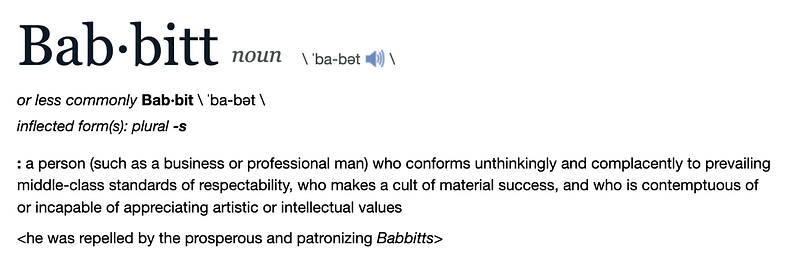
Credit: merriam-webster.com

The origin of this term comes from a novel by Sinclair Lewis, the first American writer to win the Nobel Prize in Literature, awarded to him “for his vigorous and graphic art of description and his ability to create, with wit and humor, new types of characters.”

Henry Louis Mencken (known as Aitch Ell to his friends) described him as a “red-haired tornado from the Minnesota wilds.” You can clearly see the bright red hair and tornado-like attitude in this photo:
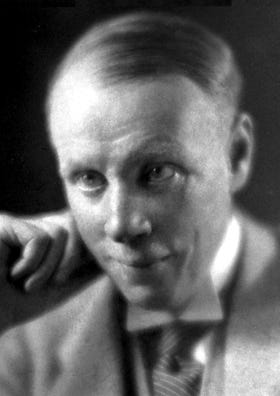
Photo by Nobel Foundation

The book written by Sinclair is titled— shockingly — Babbitt, and its protagonist is named — are you ready for this? — Babbitt. George F. Babbitt to be precise. In his satirical novel, Lewis critiques the emptiness of middle-class American life and its social pressure toward conformity.

In his review, Mencken had this to say: “There is no plot whatever… Babbitt simply grows two years older as the tale unfolds”. Which apparently was part of what Lewis was trying to do in order to make his point.

Babbitt was published in 1922 and many people think the controversy it provoked was a key element in the Nobel Committee’s decision to award him the prize eight years later.
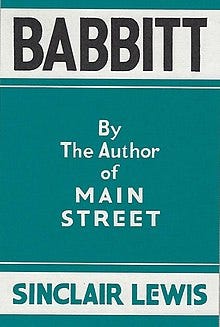
Photo by Publy K’domein

I have not read the book, and although I’m usually loath to reading plot-less novels, I think I’ll have to check this one out. Right after I finish the other three dozen pending books on my reading list.

As for the New York Times, it’s clear they prefer the harsh sounds of heavy metal over the smooth tones of Isaac’s alloy, which is why the editors of the Spelling Bee declared that babbitt is a dord.*

You can check out my previous entry on another dord* here:

*What the heck is a dord, you ask? Here’s the answer:

Spelling Bee
Language
Science
Books
History
Recommended from ReadMedium