
This Little-Known Japanese Corporate Ritual Might Surprise You
As the cherries blossom, ceremonies all across Japan welcome fresh graduates into their new jobs.

April marks new beginnings in Japan.
Across most parts of Japan, sakura are in full bloom during this period. They will display their ephemeral beauty, and within a week, the trees will have shed their flowers. In their place, verdant leaves bud to symbolize the ongoing renewal of life that spring brings.
On the 1st of April every year, many companies also mark their renewal. All across Japan, many companies will welcome their new employees taking their first step into the working world as proper members of society, or shakaijin (社会人).
Many people outside of Japan know about the Japanese corporate culture that encourages group loyalty and conformity. In a previous article of mine, I wrote about the post-work drinking rituals that were obligatory affairs.
Lesser known is this ritual: the nyūshashiki (入社式), which is best translated as “company joining ceremony” or “company initiation ceremony.”
One cannot understand Japanese corporate culture without first understanding what the nyūshashiki is all about.
Job-Hunting in Japan

To first understand the nyūshashiki, one must first understand the entire job-hunting process in Japan.
In Japan, job-hunting often begins when students are in their senior year in university. While students in the West are busy securing internships, Japanese students are attending job interviews in their black corporate suits that they have usually purchased off the rack for less than $200.
In my final year, I was working hard to complete my honors thesis.
Japanese students have it much harder. They were already searching for jobs and preparing to be proper members of society.
The job-hunting process, called shūshoku katsudō (就職活動) in Japanese, also has ritualistic elements. For example, everyone will buy a dark suit. Everyone is expected to turn up in a suit for interviews. Black, or dark navy, or charcoal are accepted colors.
But most people just go with black.
The nail that sticks out gets hammered in, so why risk it?
出る杭は打たれる。
The nail that sticks out gets hammered in.
— Japanese proverb.
Hair needs to be short for men and tied up for women.
Many Japanese men will trim their wild and unruly, long hairstyles and suddenly look like cleaned-up, respectable members of society. And women tone down their hair and makeup.
No more bleached hair and shocking pink locks.
The end goal is to secure an offer, called a naitei (内定) before graduation.
Then you’re all set.
Company Initiation Ceremony
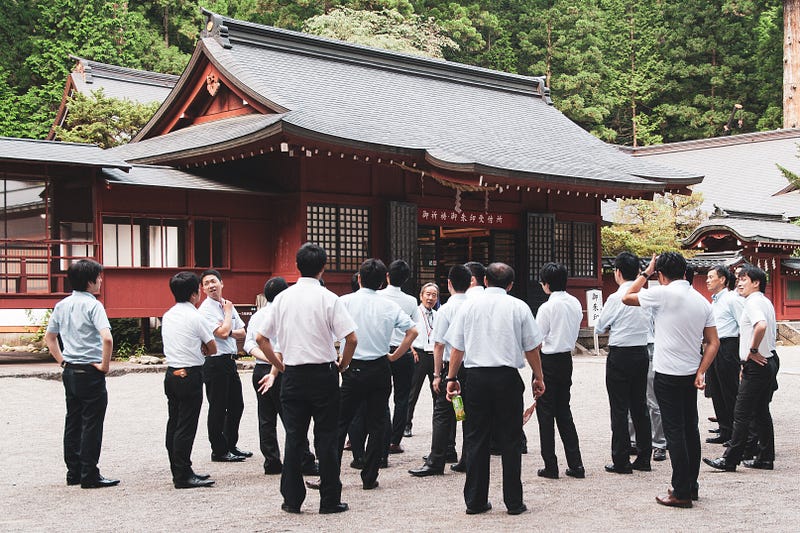
In many ways, the company initiation ceremony is a symbolic relic from postwar corporate Japan, when lifetime employment (終身雇用) was seen as the norm and the ideal corporate system to rebuild the Japanese economy.
It was a social contract between company and employee.
Employees would dedicate their careers— their whole lives to a single company. In return, companies would train the employee to be a company man. Someone who knew the company inside out. Companies would take care of employees, and sometimes, even their families.
In practice, this ideal has more or less been dismantled over the past two decades with the prolonged economic malaise of Japan. And this change has certainly accelerated with the uncertainty and damage that the COVID-19 pandemic has dealt to Japan.
Still, the nyūshashiki seems to have endured.
I was reminded of this when I took the metro just the other day.
Young men and women, more or less of the same age.
Early twenties. All wearing black suits, including the women. They were riding the metro in ill-fitted suits. It was obvious that they had not yet gotten use to suit-wearing.
The black suits eliminate any kind of individuality these young people have. From the company’s point of view, they are blank slates, and the company will then train them to be company men.
For the next couple of years — perhaps for the rest of their lives, they will be rotated between many departments. From sales, to product development, to advertising, to international sales, and then perhaps back again to sales. If he or she stays long enough, they are rewarded with a company send-off at the end of this very long tenure.
The expectation is not to produce specialists, but company men who know the company culture very well.
The First Step to Becoming a Company Man

In my previous company, I met many colleagues who had only worked in that company their entire life. They knew all the key people in the company. They knew most of the products. They could talk about product specifics and advertisement details from more than ten years ago.
I don’t expect these loyal company men to ever move to another company.
Nowadays, it is more acceptable for employees to change their jobs. Recruiters and recruitment agencies have flourished in Japan. Job recruitment websites have sprung up everywhere, and one even sees the ads for these services on the metro.
And when I say company men, I do not mean so in any discriminatory way.
Women are not usually a part of the model of lifelong employment, since the assumption is that men are the breadwinners and women play a domestic role as mothers and housewives.
In this model, women are expected to marry and have children, and when they do, they are dropped from the “regular track.”
Yuko Tamura has written on the gender discrimination that women face in the workplace and more generally.
When I joined my current company, I didn’t expect that I would be invited to the nyūshashiki, since I was not a fresh graduate.
Perhaps my company was a bit ahead of the time in trying to create a new corporate culture to meet halfway between Japanese traditional practices while embracing global standards.
The reality is that the lifelong employment system is slowly but surely coming to an end.
The number of applicants looking to change their jobs has been increasing steadily in the past couple of years — up from 5.57 million in 2015 to 8.78 million in 2019.
My Experience of Nyūshashiki
My company’s nyūshashiki was a spectacle to behold.
The company had spared no expense to send us this message: We are a great company. You are very lucky to be able to join us.
The ceremony took almost half a day to complete. The program was packed to the brim with events and would certainly have awed a fresh, twenty-three year old graduate.
Speeches from directors and managers from different business divisions.
Directors from outside of Japan sent video messages, to signal that our company was a global one.
Celebrities made a special appearance.
How much was the company spending on this?
Then, the new graduates had to go up on stage and give their mission statement or some kind of motto and what they hoped to achieve.
I saw them walk up the stage and speak into the microphone, one by one.
They were all young, eager, and motivated. Fresh graduates, full of hope and possibility.
I remember thinking this to myself:
In only a few years, reality would begin to set into them, but for now, they were at the center of the show.
They were being inducted into a glorious company that had been around for over one hundred years.
Many Japanese companies are very old. Some of the oldest and continuously managed companies are from Japan. In 2020, at least 33,000 businesses had been around for at least 100 years.
While the economic realities of COVID-19 might have changed that, even if that number were to drop by 10 percent or even 20 percent, it would still be a very impressive number.
In the end, there must have been over 300 new graduates. Including us — the so-called “mid-career hires,” there were probably close to 400 new employees in the massive hall.
Singing the Company Song
The ceremony concluded with us singing the company song.
There’s a company song? Yes, company anthems are a thing in Japan.
Don’t believe me?
Just to give you an example, here’s Ichiran’s (一蘭)company anthem.
I don’t work for a ramen company. But I think most people with at least some passing interest in Japan have heard about Ichiran. It is the ramen chain originating from Fukuoka famous for serving ramen in individual cubicles.
Surprised about company songs in Japan?
We all learn something new every day.
©Alvin T. 2022
The author writes on a variety of topics. His key topics are society, culture, modern work, and cryptocurrency, with the occasional fictional story, creative piece, or reflective essay. Discover his most-read stories here.
If these topics interest you, consider subscribing to receive new stories from the author via e-mail.


