
Japanese Salarymen Are Sleeping on the Streets of Tokyo — Guess Why?
A glimpse at Japanese corporate culture and the drinking rituals — from the “inside.”
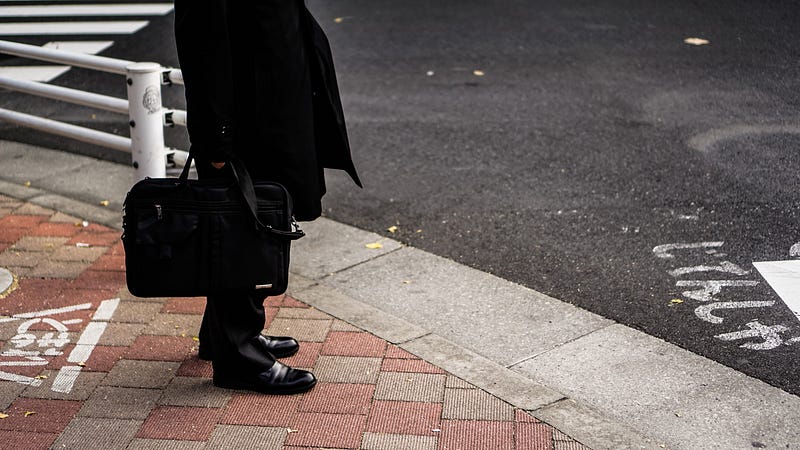
Japan is famous for a lot of beautiful things. Geishas, a famous Golden Temple, and apparently also salarymen in mass-produced, cheap-looking monochromatic suits.
Japanese looks beautiful in every single way.
Until you actually live there.
You see, the corporate culture can be quite shocking. It’s something that I know a little bit about because I’ve lived in Japan since 2016.
“High Fashion”
I came across an old Vice story from around 2018. It’s called “Photos of Japan’s Office Workers During Their 60-Hour Weeks.”
The story is about a somewhat eccentric collection of work by a Polish photographer, Pawel Jaszcuzk. The work is ironically called High Fashion.
The same story was also covered by Business Insider here, in slightly more detail: Japanese Businessmen Sleeping on Streets Capture a Culture of Overwork (businessinsider.com)
Jaszcuzk did something quite interesting (but potentially also a little bit creepy). He stalked the streets of Tokyo and took these photos of sleeping salarymen between 2008–2010.
Jaszczuk uses these photos to tell the story of overworked Japanese salarymen. The implication is that this phenomenon is a symptom of overworked Japanese corporate employees, completely exhausted after working 60 hour weeks.
Jaszcuzk’s observation is essentially correct, and I want to go a bit further.
I’ve seen my share of salarymen sleeping on the streets of Tokyo, and I want to tell you what’s going on.
Japanese companies as seen from the inside
If you have any experience working and living in Japan, if you had any knowledge from the inside of what Japanese companies are like, you would have known that these salarymen were not just exhausted, they would have probably also been drunk.
Like, wasted drunk.
I know because I’ve seen many of these drunk Japanese salarymen myself.
And although I’m not Japanese. I have been one of these drunk salarymen myself. (Though I never ended up sleeping at a train station — thank goodness!)
I’ve partaken in the after-work drinking rituals that lead to these kinds of street-as-a-hotel situations.
It’s not simply a culture of overwork.
It’s a culture of excessive corporate loyalty. Where workers have no identity outside of their companies. Where you are obliged to go drinking with your bosses and your colleagues after work.
The classic Japanese corporate drinking ritual
The obligatory corporate drinking party is a form of group communication and staff bonding.
The Japanese even have a word for it — nominication — coined from the combination of nomi (meaning drink) + communication.
People play the game. I’ve seen it first hand. I’ve been in the same position (but thankfully not to the same degree since I could play the foreigner card).
Here is how it plays out.
It starts off like this — The boss or some senior picks you out.
“Why aren’t you drinking?,” they ask you, in a voice that suggests that he (mostly he, due to the gender inequality in most Japanese companies) is already inebriated.
The unmistakable words of nonde (飲んで) — meaning “DRINK UP!” — start to echo around the tiny izakaya. The chant crescendoes towards its climactic finish, as your colleagues clap rhythmically to the time signature of one–two-three-four.
“Non-de, non-de, non-de, non-de, non-de, non-de, non-de, non-de, non-de, NONDE!”
Bowing down to peer pressure, you drink the entire mug of beer all at once. Of course, that’s not enough. You follow up with 3 more shots of shochu or sake usually follow.
Everyone cheers.
A few people end up being “targeted” this way during the drinking party. Some people seem to love the game. Sometimes, the person who heartily drank everything voluntarily goes to the bathroom and proceeds to throw everything up. So that they can repeat the process.
People get so pissed-drunk they blackout. That’s how they end up missing the train and sleeping at the station.
The truth is, in fact, the truly hardcore workers — were they truly working insane amounts of overtime — they wouldn’t even be sleeping on the streets. Jaszczuk wouldn’t have been able to find his subjects, because they would have been sleeping in the company office.
The author writes on a wide variety of topics. His key topics are Japan, society, culture, modern work, and cryptocurrency. Discover his most-read stories here.
If these topics interest you, consider subscribing to receive new stories from the author via e-mail.


