
When Being a Narcissist Makes Sense
In a classic scene in The Matrix, Neo thinks he is in the Matrix only to learn he is actually in a simulation of the Matrix: an illusion within the illusion: a simulacrum: a copy of a reality that does not exist.
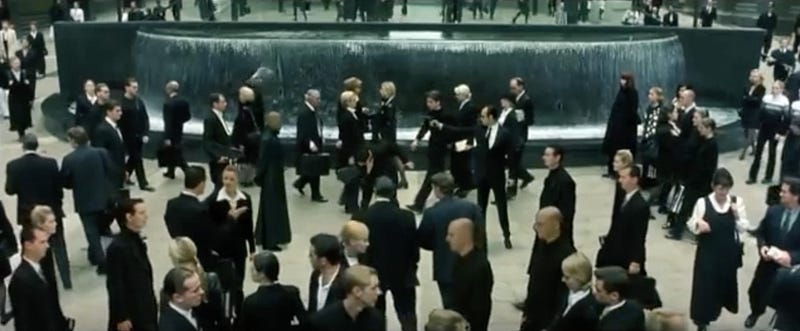
Morpheus (the Greek god of dreams — the god within this dream) even pauses time to prove his point. The world as an extension of will.
Imagine you are Neo. You thought your body and all the people around you, down to their hearts and souls, were real. They are all simulations. What do these simulations called ‘your body’ and ‘other people’ mean to you? If you find yourself in a lucid dream, do you care whose feelings you hurt? Or do you suddenly realize you can hit or love or fuck or speak or emote with total impunity? Would it matter to you if the person you had sex with cried because you walked away? Would you feel any compunction about any harm you rendered anyone? Would it be possible to have compassion for anyone you hurt? And if you lived without compassion, what meaning would you hold that these simulations did not?
For while simulated people look real, they are not. They simulate experiences by smiling or crying or orgasming or meditating or voting or dying or invading or wearing a mask or refusing a vaccination or going to therapy. But none of these events means anything because there is no consciousness experiencing anything; they take on the outer appearance of inner experiences that do not exist. No psyche, no suffering. No suffering, no meaning.
Compassion comes from the Greek ‘to suffer with.’ If one cannot suffer with someone, one cannot experience compassion. The inability to share an inner reality is the inability to share meaning. Hence without compassion, others cannot be meaningful to us. This is what distinguishes real people from simulated ones: an awareness that others have a consciousness just as we have our own, that others are as real as we are.
This brings us to Kant, who states that the moral behaviour lies in engaging others as much as possible as an end in and of themselves, and as little as possible as a means to an end. But with no compassion, others are strictly a means and oneself is the only end. Dostoevsky’s Kirilov states this nakedly: ‘If there is no God, then I am God.’
We spend much of our lives in the variegations of that statement. Because the believer — in God, in love, in oneness — also understands the opposite truth: ‘If there is God, then I am God, too.’
In a simulation, or a reality we treat as though it were, there is no one to suffer with, to love with, to connect with. There are only empty shells looking like ensouled humans (which is paradoxically how the narcissist comes across to non-narcissists) that either meet our needs or must be punished for not doing so.
The narcissist lives in his own Hell insofar as he perceives a world without love. We could turn Hell into Heaven if only we felt love for those suffering alongside us. But the narcissist has no love to give. Every attempt is a projection of his own self-love; hence the mythological image of Narcissus falling in love with his own reflection.
Narcissus was the son of Cephissus, the god of rivers, who raped Narcissus’s mother, Liriope, and in so doing, conceived Narcissus and abandoned the baby. And so Narcissus looks for love as only a narcissist can: through his wound, through his trauma: at the river that symbolizes his father: sex without love: power without compassion. Narcissus dies of unrequited love — the narcissistic ego cannot exist without having its needs met. In his place, a narcissus flower grows. Interestingly, narcissus flowers secrete a sap that is toxic to other flowers. When a narcissist is wounded, he toxifies others.
It is difficult to offer insight to narcissism because it is rarely received as insight. Rather, this becomes fodder for those whose partner at the time was not a narcissist but mysteriously became one upon breaking up. I often tell people that the main diagnostic criterion for Narcissistic Personality Disorder is that they be your ex. Through Buddhist beginner’s mind, one would think narcissism were an affliction we give our partners upon breaking up with them. The victim’s projection is of course the converse: you became a narcissist once you stopped meeting my needs. The narcissism, of course, becomes visible through the retraction of projections in which we see people as they are, or, as they are through another projection.
Hence we can better construe narcissism’s pathology if we de-pathologize it, that is to say, cease projecting upon it. Narcissists are only narcissistic insofar as others are not; indeed, there may be worlds (hells) in which our narcissists are their empaths or (heavens) our empaths are their narcissists. We are all aspects within a range we have learned to name our identity based on subjective norms that, to others subjects ensconced within their norms, are entirely arbitrary. God knows what a species of autistic hominids would call neurotypicals, if they would bother naming them, fixing them, classifying them the way neurotypical hominids do autistics. Because these behaviors themselves are norms to some, pathologies to others.
What is the narcissist’s norm? To be a hominid without empathy. All the other symptoms of narcissism — rages, stonewalling, gaslighting, vanity, shamelessness, impulsivity, avarice — would cease were the narcissist magically given normative empathy. Take the vanity away, and you still have a narcissist. Give the empathy, and you have…a normal person. Narcissism is therefore not a dysfunction of living in a world with empathy so much as a function of living in a world without empathy: the world inside a narcissist’s psyche. That is the simulation in which Narcissus lives.
If you believe this, the narcissist is…perfectly sane.
Also read How Borderlines See Love, How Narcissists See Love, and When You Should be a Borderline.
To follow me: https://medium.com/@myartman
To subscribe: https://medium.com/@myartman/membership