
When you should be a Borderline
I didn’t walk on ice until I was a man. Growing up in a desert had not prepared me for the faith I would need. By the time I walked on the Rhine, it was too late. The children around me freely slid every which way. That they spoke German only affirmed that feeling safe on ice was foreign to me.
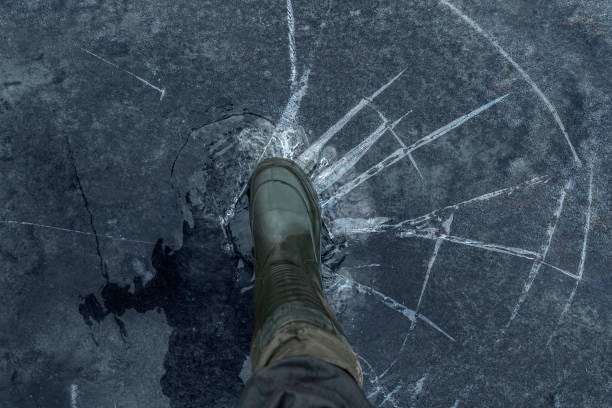
This may serve as a good analogy for the experience of a borderline in love. While others can trust love innocently and happily, the Borderline believes the very journey into love is what will inevitably destroy it. This belief becomes a self-fulfilling prophecy as the borderline defends themselves from love by sabotaging it
The emotional volatility of relationship, the splitting (polarizing others as being the best or worse person in the world), the deep need for an intense connection one is simultaneously terrified of — these are the hallmarks of the Borderline relationship. And they are all premised on the belief that the ice will crack.
One develops Borderline Personality Disorder through childhood trauma. While MRI studies demonstrate differing brain structures in the limbic system related to impulse control and emotional regulation, my clinical and personal experience show, without a single exception, the essential aetiology: a severe childhood trauma, usually related to a betrayal such as molestation, beating or verbal abuse from a loved one. Severe prepubescent trauma reshapes the emotional centers of the brain via neuroplasticity. Hence, with or without genetic predispositions, borderlines are wired from their suffering to maintain their suffering.
This is not permanent, for neuroplasticity works both ways. Just as borderlines are taught that suffering is the way of love, they can contrapuntally be taught that healing from that suffering is the way of love. Hence one must go back on the ice, fear it will break, and hold the hand of their love, saying, ‘I am afraid you will hurt me because that is what I have known. Hold me while I feel my fear. I will learn not run to you, nor from you. I will not believe that you are my angel, nor will I turn that angel into a devil once you fail to save me from myself. I will learn that love is not a means to trust, but that trust is a path to love. Love is not a means to anything. Love is an end to itself.’
Such faith in love turns borderline beliefs on their head and guides one on the path to healing. If however you believe that love is fragile, having BPD is as sensible as not having BPD is for those who believe that love is safe and real. If your parent chose your molester over you, or was your molester, believing love is fragile is as sensible as believing in its safety when your parents are what they should be.
We calibrate our perception of the world based on what love does to us early on. To the young child, whatever the parents do or tolerate is love. To the abused child, love is the molester or the molester’s protector as well as the space of safety and goodness. That severe ambivalence cracks the heart open into paradoxical beliefs:
- I need love, yet love will betray me.
- I need to be betrayed to know this is love.
- If I am not betrayed, I am being fooled into letting my guard down.
- I must provoke a betrayal to experience the love I know.
BPD is not a pathology but human nature when love itself becomes the pathology. That abused child grows up and wants a relationship, wants touch, wants intimacy, wants closeness —all from the angel or demon the grown child projects onto their beloved, for those were the alternating identities of the abusive parents.
If people actually alternated between angels and devils, we would be alternately drawn to or repelled from them, never fully believing either identity. Eventually, the angel will betray us just as the devil will save us, and the cycle shall begin anew.
To follow me: https://medium.com/@myartman
To subscribe: https://medium.com/@myartman/membership