
Awe for the Everyday
Teaching ourselves to see nature again
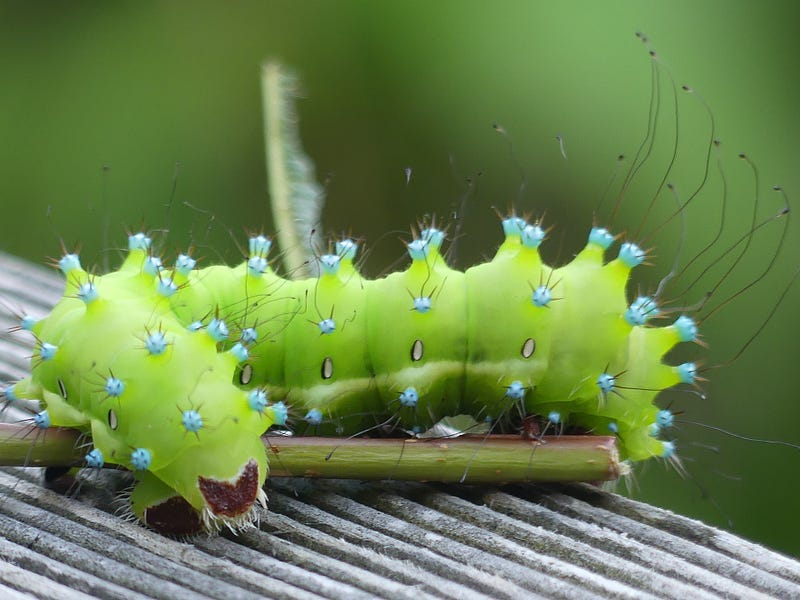
When my seven-year-old daughter approached me carrying an enormous green caterpillar with turquoise dots and announcing it was her new pet, I was secretly quite pleased. William the worm would save me having to look for a suitable puppy.
Although my suspicion was that the caterpillar wasn’t destined for a very long life, I allowed her to place him in the bottom of a shoebox — it was definitely a him she informed me, along with a pile of leaves from the bush in which he had been discovered. After that, I didn’t think much more about it.
Two days later, my daughter and the shoe box reappeared. Her new pet had moved into the corner of the box where it was diligently weaving itself a delicate cocoon of pale gray silk. Within a few hours it had retreated into its new haute couture outfit, and once again, it slipped from my mind, (as with so many other things these days).
The process of metamorphosis is one that we all understand in principle. It is also one of the many miracles of nature with which we have become so familiar with that we often fail to give it the awe that it is due.
An egg is laid. Produces Worm. Worm makes a cocoon. Butterfly pops out. At that level, it all sounds fairly pedestrian, until we really stop to think just how remarkable this transformation is.
In my own clumsy way, all of my nature writing is intended to encourage my readers to return to the state of awe we once held for the natural world when we were kids; that period in our lives before cynicism had gained such a foothold and where each new mystery revealed was a cause for pause and wonder.
If we can rekindle the sense of reverence we had as children, perhaps we might become better custodians of the planet we govern so badly at the moment.
The miracle of metamorphosis
Metamorphosis has its roots in the Greek for transformation and the transformation here is extreme. I thought that breaking out in zits and having my voice break was a tough hormonal transition. This coming of age takes growing up to a whole different level.
Inside that delicate cocoon, the caterpillar breaks itself down using its own digestive juices, until all that is left is a gooey fluid. This fluid consists of what are known as imaginal cells. Imaginal cells are the equivalent of jokers in a deck of cards. They are essentially cells that can become anything.
Gradually the cells congeal until eventually, they solidify into that exquisite butterfly or moth.
It would be the equivalent of me tying myself into a four-season sleeping bag, drinking a few pints of battery acid and then re-emerging two weeks later as George Clooney…. with wings.

Man gods
Humans have proven to be terrible custodians of the natural world. Part of the reason for that is that we have become so separated from it that we have ceased to recognize just how wondrous it is, or that we are just a part of it.
Somewhere along the way, we mentally detached ourselves from the world around us and set ourselves upon our own pedestals. We made ourselves the gods of our own imaginations.
This is nothing new. Throughout history man has been elevating himself, building statues to his own grandeur, and deluding himself that he reigns supreme.
But empire after man-made empire has crumbled and yet nature has silently always come out on top.
The environment may be taking a bit of a beating at our hands right now, yet in the end, my money is on her surviving long after we have crashed and burned into obscurity.
The Re-emergence
A couple of weeks after William went into exile, my daughter approached me with her latest pet, calmly clinging to her jersey as though it were a giant broach. William the worm was now Megan (the moth) Fox.
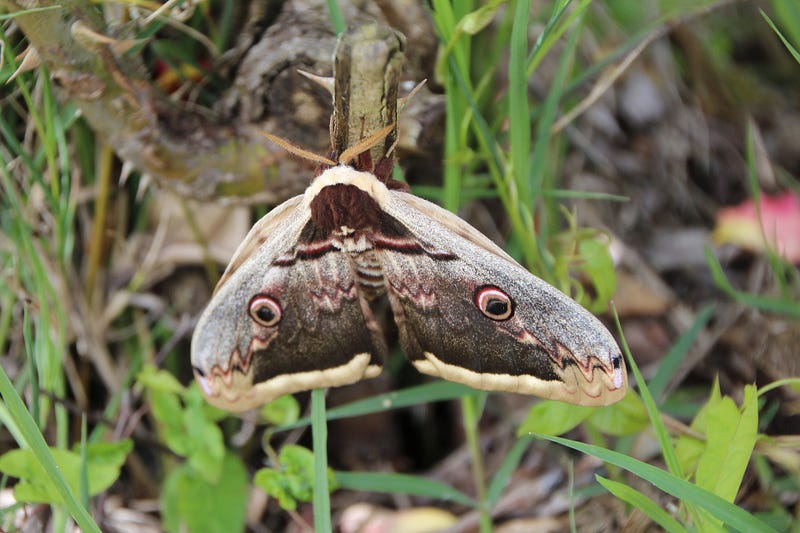
Megan, it turned out, was a Great Peacock Moth (Saturnia pyri), the largest of the European moths, whose wingspan can reach as much as twenty centimeters. To say she was impressive was an understatement. What’s more, she was riding on my daughter as though this was the life she had always been destined to.
Together the three of us headed for the local café. The Café de l’Union is the hub of life in our village. There, people gather to gossip, chat about the weather, discuss local politics and, did I mention gossip? — all whilst sipping bitter black coffee from cups little larger than thimbles.
With her mounds of blonde hair and enormous blue eyes, my daughter was already something of a celebrity in the de l’Union. Now, with Megan on her shoulder, the pair went through a brief moment of superstar status. Every coffee served in the café is accompanied by a neatly wrapped square of dark chocolate. On a normal day, several of these would be sneaked to my daughter by some of the clientele.
On this occasion, as one after another, they lined up to admire her pet moth, the haul of chocolate my daughter was acquiring looked set to create a minor diabetes crisis. For the sake of her health, I was obliged to confiscate some of the hauls and eat it myself.
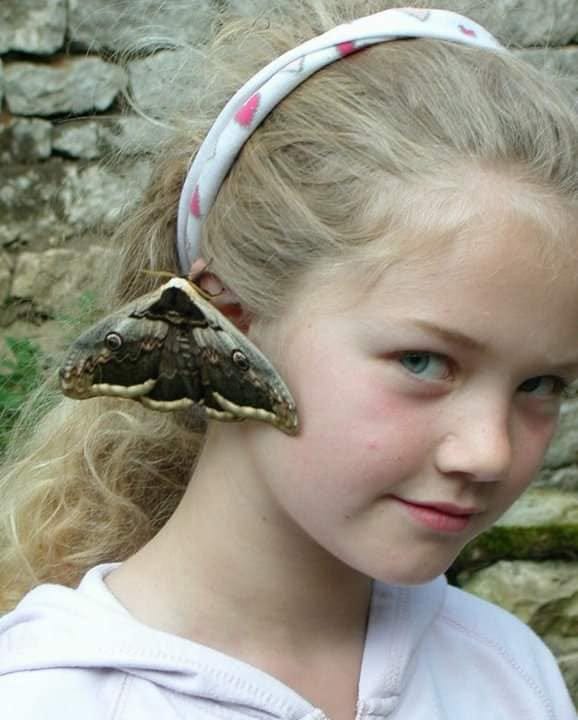
Megan seemed to bask in her role as a chocolate-magnet. She would remain perfectly still and when fans arrived to ascertain if she was genuine or not, she would give a lackadaisical, slightly arrogant flutter of her wings.
Made with one purpose
These moths only survive a few days. Their role after emerging from the cocoon is to do one thing, and one thing only. They seek to mate and lay eggs. So focused are they on this activity that they do not even possess mouth parts. Eating ceases to play any part in their agenda.
At night the female will flutter up to a suitable branch from where she will emit pheromones designed to alert passing males to her presence. This may attract more than a dozen suitors who can detect the pheromones from as far as half a mile away.
After mating, she will lay the eggs that she is already carrying within her body and which required only to be fertilized. She probably won’t even seek a more suitable plant. Instead, she will simply lay her eggs onto the leaves of whichever shrub or tree she had landed.
Not long after that, the whole process will start again as the next generation enters into the mysterious circle of life.
Miracle after miracle while we watch daytime television and congratulate ourselves for being the most wondrous creatures on earth.
Thank you for reading.
If you are an excellent mind who cares about the natural world, you may read my popular articles on the environment and wildlife from the following links.