
Environment
Midwife Crisis
The amphibian world is facing a huge threat
For days a noise coming from either the dry stone walling or the flower bed beneath it had been bugging me. It was the sort of short beep one associates with a mobile phone when it signals you that the battery is about to go flat.
I don’t carry a mobile, and if you are thinking, this makes me somewhat antisocial, you should know that my wife agrees with you.
I knew with some degree of certainty that it could not have been my wife’s phone. Hers was undergoing treatment after its third plunge into the toilet bowl in less than a fortnight. She had managed to resurrect it after the first two swimming lessons, but this time the prognosis wasn’t looking good.
My wife is the one woman I know who spends more time blow-drying her mobile phone than she does blow-dry her hair.
Finding the Noise
By now, I had concluded that the noise beginning to haunt me could only have been made by some creature resident in the garden.
I tried a series of different approaches designed to get me close enough to see what it was. Every time the result was the same. As soon as I got to a point closer than two yards away from the bed, the beep would stop.
I experimented with the slow-motion approach, the sudden burst of speed, and the walk past with the lightning change in direction. They all failed dismally.
Finally, I went for the sit very still, pretending to be a rock approach.
It took a long time, and a lesser man, one without years of experience at sitting around doing nothing very much, might well have given up. I am made of sterner stuff than that, and eventually, my quarry cracked and gave me a tiny beep. I had him pinpointed.
The Midwife Toad
It turns out the creature that makes this noise is a tiny, rather handsome little toad known as a midwife toad. He has some fancy Latin name but doesn’t let’s get bogged down with that.
Midwife toads don’t grow much larger than a man’s thumb, and they use that plaintive little beep to attract a mate.
It is once they locate one that things get interesting. He moves up behind her and gently massages her back — up to three thousand times. If she is happy with the massage, she will spill a small pile of eggs onto the ground and then waddle off without so much as a “wow that was fantastic.”
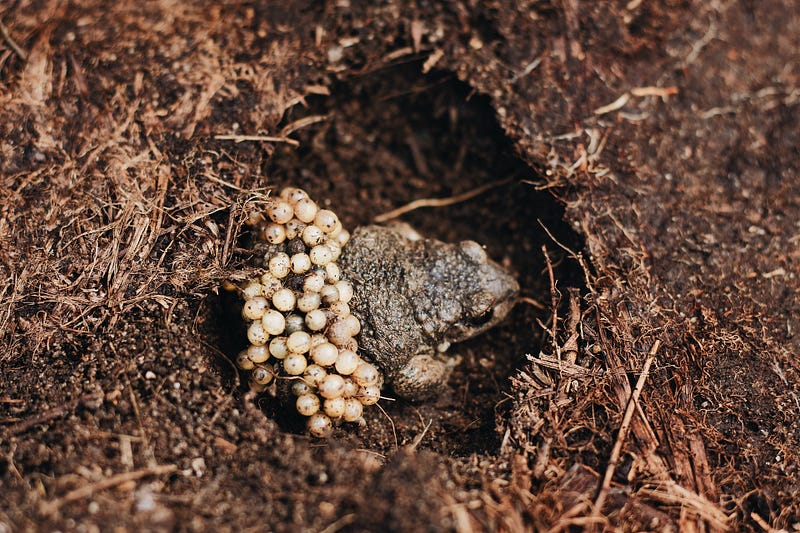
The diligent male now fertilizes the eggs and then wanders among them until they stick to his body like hundreds and thousands to a chocolate cake.
Midwife moms might not be up to much, but the dads are brilliant. For weeks he will wander about carrying this coat of eggs. If it rains, he will stand on his tiptoes so that they don’t get too soggy, and if they get hot, he will make his way to water and take a dip so that they are kept cold and moist.
As the eggs mature, he will wade into his favorite water source every evening, and eventually, the tadpoles will break free of their egg casings and swim off to complete the next stage of their lives.
The Crisis
Amphibians throughout the world are witnessing a massive depletion in their numbers. Because they are vulnerable both on land and in the water, they are exposed to threats in more than one environment and so are more at risk than creatures that are either terrestrial or live purely in the water.
In addition to the threats from loss of biodiversity and habitat that we hear about so often, amphibians are threatened by a pathogen called chytrid fungus.
According to an article in National Geographic, forty percent of the amphibian species known to science are infected by this lethal pathogen, spread in no small part by man’s trade in wild species. It degrades the permeability of the infected creature’s skin and spreads very easily. Besides, because the animal doesn’t die immediately, it tends to carry the disease to others of its species.
In the French Pyrenees, many of the mountain lakes were once home to thousands of these midwife toads. That beeping that once so disturbed me used to be the source of an early morning chorus that has gone sadly quiet.
As far away as the rain forests of Australia, it is now difficult to find certain species of tree frog that you once had to look out for in case you trod on them.
Create a Little Oasis
If you have a garden and you want to help create a little oasis of biodiversity, then one really powerful step you can take in this regard is to put it in a pond.
It doesn’t need to be anything dramatic. If you have read some of my other articles you will know that I am a great believer in taking small steps.
A shallow scrape of just a yard across and six inches deep will do, if you lay a liner in the bottom and keep it filled with water. You will be amazed at how much life it suddenly attracts.
And finally, please, please don’t go buying exotic amphibians as pets. You really will be doing far more harm than good.
Thank you for reading.
All proceeds from this Medium article will go to the World Land Trust