
Avellan(e)
In a nutshell, this word has to do with heraldry
Today’s New York Times Spelling Bee letters:
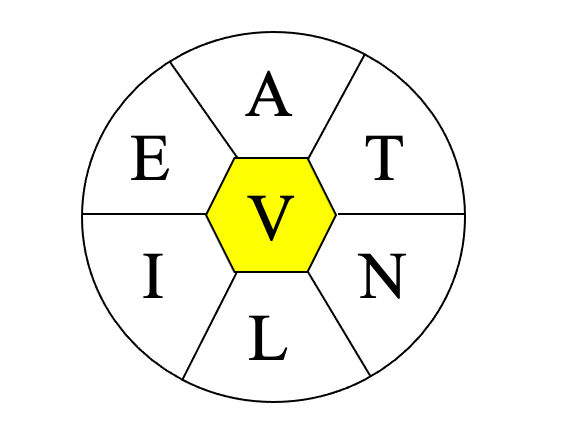
A, E, I, L, N, T, and center V (all words must include V)
Merriam-Webster says…
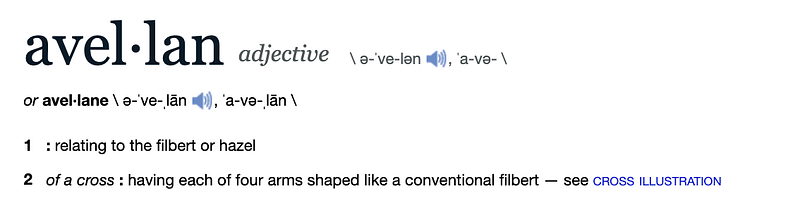
Silly little dictionary! Don’t you know avellan(e) can’t possibly be a word if the New York Times says it ain’t?
For further fascinating facts, check out the Spelling Bee Master.
What’s your favorite dord* from today’s puzzle?
My Two Cents
Spoiler alert! Here comes a spoiler if you haven’t found the pangrams in today’s Spelling Bee game. Skip ahead to the first header, in think dark font, further down. Okay, here goes: today’s Spelling Bee had a pangram (a word that includes all seven letters in the game) very appropriate for today’s date. That’s it. Now, if your birthday happens to fall today, well, first of all, happy birthday! And second, no, the pangram isn’t birthday. That word has eight different letters, not seven, and therefore can never be part of the Spelling Bee as currently conceived.
Don’t go nuts
Although the unabridged version of Merriam-Webster’s entry about avellan(e) includes the definition related to the hazelnut, the one I provide in the link does not. The latter version of the dictionary, which is free, seems to be the collegiate version. The one I use for the screenshots is the unabridged, which entails a paid subscription.
The filbert, or hazel, is a genus (Corylus) of trees and large shrubs native to the temperate areas of the Northern Hemisphere. The fruit of the hazel is…. well done, you guessed it! The hazelnut. In Spanish the name of the nut is avellana, while the tree goes by the masculine avellano. (Most nouns in Spanish are either masculine or feminine, with some being both.)
The most common species of hazel is the Corylus avellana, which is common in Europe, and was especially so in an ancient town of Italy called Abella. Hence the origin of the English adjective avellan(e) and the Spanish nouns avellana/avellano: from the Latin abellana, avellana, meaning “filbert”, from feminine Abellanus, of Abella, from Abella, that ancient town in Italy.
So where did “hazel” come from? The dictionary explains its origin as the Middle English hasel, from Old English hæsel; akin to Old High German hasal, meaning “hazel”, itself somehow from the Latin corulus… somehow. I mean, corulus does not look nor sound anything like hasal, although it does resemble the genus name we mentioned earlier, Corylus.
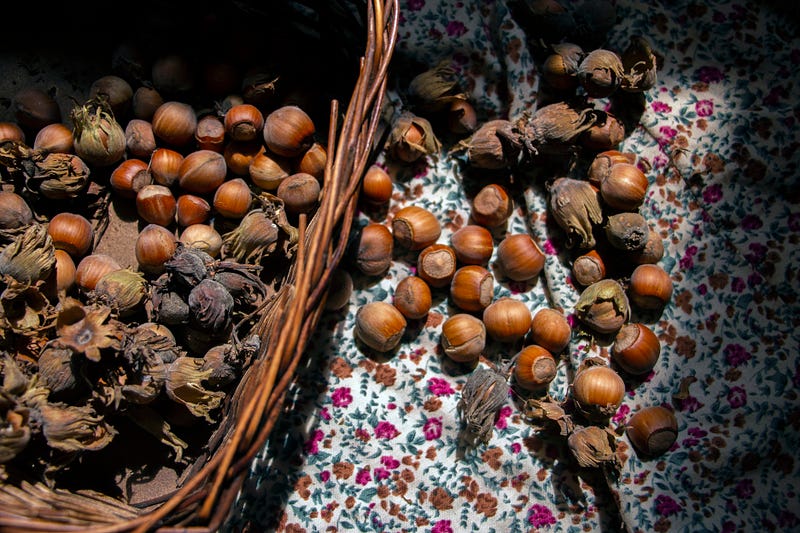
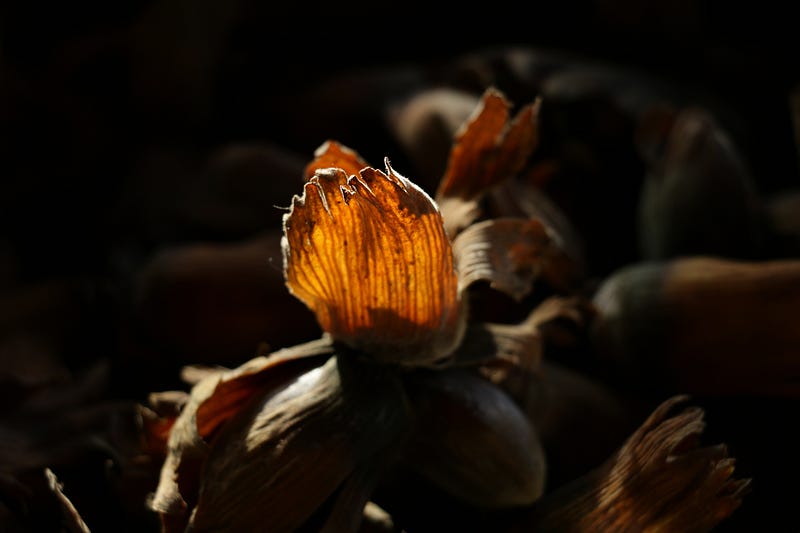
The nut of the Corylus avellana and a few other species are surrounded by soft leafy involucres, or whorls of bracts (leaves) situated below and close to a flower, flower cluster, or fruit. You can see them on the left side of the photo at the top of today’s column, but just so you don’t have to bother going back up, here is a close-up of an involucre:
Hazelnuts are edible and very tasty, in my opinion, and fantastic when added to chocolate, either in solid form, or the world-famous creamy state of matter known as…

Then there’s the lesser-known but still awesome liquid form of the filbert fruit:
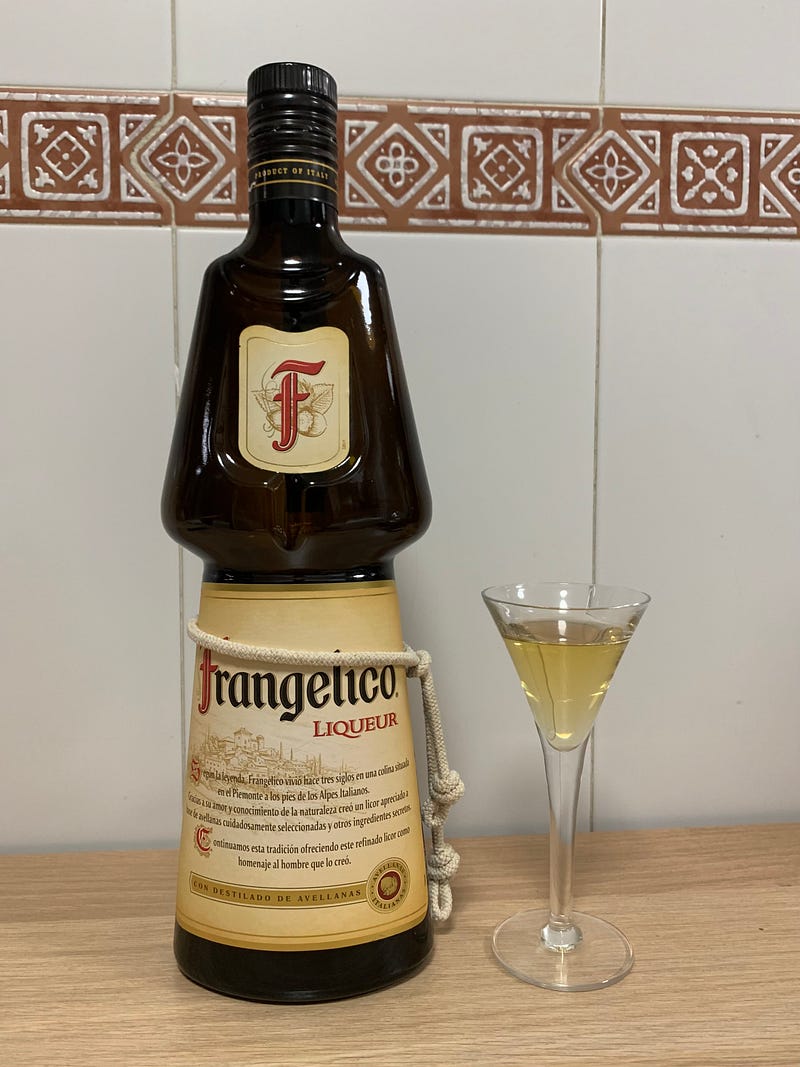
I figured since I was writing about it, I might as well imbibe some. I’m not a big liqueur fan (I prefer whisky, rum, and mezcal when it comes to spirits), but Frangelico, a hazelnut-flavored noisette. Created in 1978, the drink is known for the curious design of its bottle, made to resemble a Franciscan friar with a knotted white cord around the “waist”. If you take a closer look under the F, you’ll notice the hands held in prayer. Per the manufacturer (originally the Barbaro family, but now Gruppo Campari), the name of the liqueur is based on a legend of a hermit monk named Fra Angelico who lived in the Piedmont region of Italy and “created unique recipes for liqueurs”.
Cheers!
Don’t be cross
Heraldry is “the practice of devising, blazoning, and granting armorial insignia [badges] and of tracing and recording genealogies”, according to our friends at Merriam-Webster.
The concept of regular and regulated designs connected to families and heredity, which is what distinguishes heraldry today, did not fully develop until the High Middle Ages (1000 to 1250 AD).
What in heck does that heraldry to do with hazelnuts, you’re wondering. You’re not? I’ll tell you anyway! I gotta actually earn those 13 cents, you know…
Both heraldry and hazelnuts start with an H. There you go. That was easy enough.
Just kidding. I mean, yes, they do both begin with the same letter, but for the purposes of today’s daily dord*, the adjective avellan(e) (hazelnutty) also describes a type of cross whose four tips resemble the husks of the hazelnut.
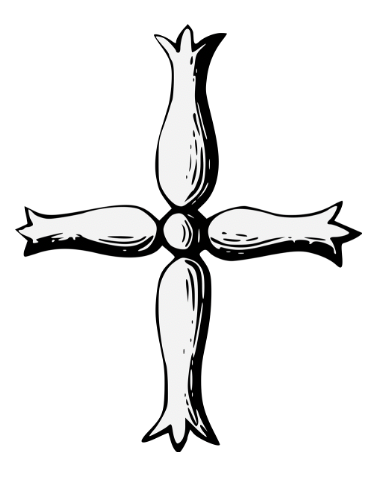
Voila! The magical interconnectedness of language!
As we mentioned earlier, the Latin avellana meant hazel or filbert, with the Latin name nux avellana used to describe the nut itself.
Ephraim Chambers’s Cyclopædia: or, An Universal Dictionary of Arts and Sciences, first published in 1728, contains an entry about this rare heraldic design. Here is a screenshot from the online version:
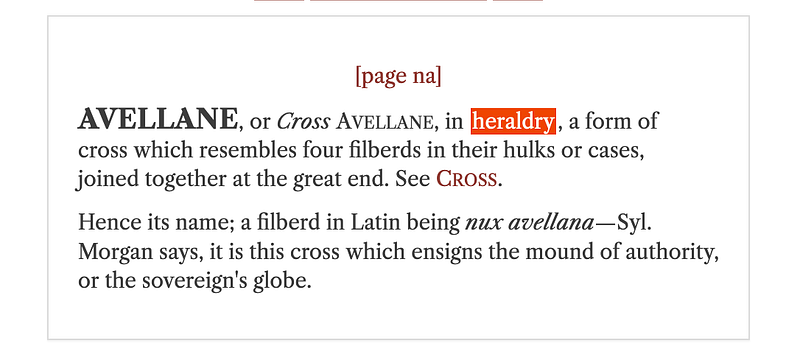
The entry for cross in its heraldic meaning further explains this:
Guillim enumerates thirty-nine different sorts of crosses used in heraldry, the several names whereof here follow; the descriptions are to be looked for under their proper articles. — A cross voided, a cross wavy-voided, a cross pateee simbriated, a cross patee fitched on the foot, a cross patee on three parts and fitched on the fourth, a cross engrailed, a cross patonee, a cross flory, a cross patonee voided, a cross avelane, a cross patee lambeaux, a cross furchee, a cross croslet, a cross coslet fitchee at the point, a cross bottonee, a cross pommee, a cross urdee, a cross degraded fitchee, a cross potent, a cross potent fitched, a cross calvary, a cross croslet set in degrees, a cross patriarchal, a cross anchored, a cross molinee, a cross clechee, a cross flory, or fleurdelisee, a cross double fitchee, a cross a-seize points, a cross milrinee, a cross raguled, a cross pointed voided, a cross pall, a tau or S. Anthony’s cross, a cross voided and couped, a cross couped pierced, a cross molinee pierced lozengeways, a cross molinee quarter-pierced, a saltier, or S. Andrew’s cross, which will be distinctly spoken of under that denomination; and so all the others may be found more particularly described under the names of their several differences.
Lots and lots and lots of crosses. You can get further descriptions and illustrations here:
Now you know! Whether you are talking about the distinct properties of the filbert or the tiny arms on a heraldic cross, beware of using the term avellan(e)… because the editors of the Spelling Bee decided that avellan(e) is a dord*.
You can check out my previous entry on another dord* here:
*What the heck is a dord, you ask? Here’s the answer: