avatarAvi Kotzer

Free AI web copilot to create summaries, insights and extended knowledge, download it at here

4087

Abstract

bt it.</p><p id="da8d">The birds we are discussing today belong to the family Estrildidae of the order <b>Passeriformes</b>, which means they are songbirds. Although among them the waxbills are considered less-talented. According to the online Britannica, there are about 140 species of these Old World birds, some of which are popular to keep as home pets in cages.</p><p id="75dd">True finches, on the other hand, belong to the Fringillidae family, which includes the canaries. Some canaries are also popular as pets, while others are used to warn miners that they are about to die.</p><figure id="c041"><img src="https://cdn-images-1.readmedium.com/v2/resize:fit:800/0*5vqKhpi1ycJdBEFe.jpg"><figcaption>Photo by Ji-Elle</figcaption></figure><p id="e53b">Currently the finch family is divided into three subfamilies that contain 231 species in 50 genera. Raymond Andrew, and American ornithologist, wrote in 1968 that “Limits of the genera and relationships among the species are less understood — and subject to more controversy — in the <b>carduelines</b> than in any other species of passerines, with the possible exception of the <b>estrildines</b>.” (Yeah, those estrildines are the <i>avadavats</i> we are discussing today, although I’ll admit we haven’t actually started discussing them yet.) A few decades later DNA sequencing technology allowed scientists to make revisions in the taxonomy of finches and reclassify them.</p><p id="268a">Finches can be found in most parts of the world, especially after having been introduced in places they were not native to. Most live in the woods, but some prefer the mountains and even the deserts.</p><p id="3805">Below is the common bullfinch.</p><figure id="82e1"><img src="https://cdn-images-1.readmedium.com/v2/resize:fit:800/1*nJEPP4W7csDDd3IG-vTK9Q.png"><figcaption>Credit: Francis C. Franklin</figcaption></figure><p id="949a">No, it didn’t get suddenly sunburned while Francis C. Franklin snapped a couple of pictures. The female is grayish, while male is more colorful, for mating purposes. Who knew female finches liked to be on top, though? Ha!</p><p id="07ea">And below are a pair of male and female American goldfinches, who have clearly had a spat and are not even thinking of mating.</p><figure id="a8c0"><img src="https://cdn-images-1.readmedium.com/v2/resize:fit:800/0*lVOYrFZX8cguDPLD.jpg"><figcaption>Photo by Ken Thomas</figcaption></figure><p id="77b6">You’ll notice the seeds on the right side of the birdfeeder. That’s because finches are mainly <b>granivorous</b>, which is a fancy way of saying they love eating seeds.</p><h2 id="aa60">The colors of the traffic light rainbow</h2><p id="f8f7">The <i>avadavats</i> are also known as <b>amandavas</b>. According to <i>The Helm Dictionary of Scientific Bird Names</i> by James A. Jobling, the word <i>amandava</i> came from the name <b>Ahmedabad</b>, a city in Gujarat, a western state of India. The green <i>avadavat’s</i> distribution in India is shown, appropriately enough, by green dots on on this map.</p><figure id="9475"><img src="https://cdn-images-1.readmedium.com/v2/resize:fit:800/0*hvD1xw798NurKva7.png"><figcaption>Image by L. Shyamal</figcaption></figure><p id="e4de">I assume each dot represents more than just one green <i>avadavat</i>, but don’t quote me on that. We’ll get back to this bird. But let’s start at the top of our avian traffic light.</p><p id="981a">§ The <b>red avadavat</b> (<i>Amandava amandava</i>) is also known as the <b>red munia</b> or the <b>strawberry finch</b>. In fact, the dictionary entry refers us to “strawberry finch” at the end of its definition. But clicking on the link is not very helpful:</p><figure id="500a"><img src="https://cdn-images-1.readmedium.com/v2/resize:fit:800/1*OLF0vnIfDvedURKQmrpNHw.png"><figcaption>Credit: merriam-webster.com</figcaption></figure><p id="3ede">What are helpful however, are the pictures I was able to find online:</p><figure id="0dc6"><img src="https://cdn-images-1.readmedium.com/v2/resize:fit:800/0*sZ59H7N7U1078JWZ.jpg"><figcaption>Photo by Savithri Singh</figcaption></figu

Options

re><p id="b78f">As usual, the more colorful bird is the male one. The female is rather drab, but she does have a red butt.</p><figure id="8483"><img src="https://cdn-images-1.readmedium.com/v2/resize:fit:800/0*Ygykvl0UAa81MJRW.jpg"><figcaption>Photo by J.M.Garg</figcaption></figure><p id="6e9d">§ The <b>orange-breasted waxbill</b> (<i>Amandava subflava</i>), or <b>zebra waxbill</b>, is the only one of the three birds in this genus that is not referred to as an “avadavat”. In the <a href="https://sabap2.birdmap.africa/docs/sabap1/854.pdf"><i>Atlas of South African Birds</i></a>, the scientific name is given as <i>Sporaeginthus subflavus</i>, possibly because <i>Sporaeginthus </i>used to be its genus. Even though it’s called “orange-breasted”, the breast of the males can sometimes be yellowish in color, as in the specimen shown below.</p><figure id="390c"><img src="https://cdn-images-1.readmedium.com/v2/resize:fit:800/0*eoij9dHuw3djLTXb.jpg"><figcaption>Photo by Alan Manso</figcaption></figure><p id="7d1a">Meaning that it will perfectly serve as our middle section in the traffic light.</p><p id="981d">§ The <b>green avadavat </b>(<i>Amandava formosa</i>) we mentioned earlier is also known as the <b>green munia</b>. This may have been the first bird to be called <i>avadavat</i>, as we explained before. Of the three species in the genus, it’s the only one that has a mildly threatened conservation status. And it’s also the only one I found illustrations for, aside from photos:</p><figure id="adf6"><img src="https://cdn-images-1.readmedium.com/v2/resize:fit:800/1*Ur1JhQMZXG6sjUpO6r__PA.png"><figcaption>Art by <a href="https://en.wikipedia.org/wiki/Frederick_William_Frohawk">Frederick William Frohawk</a></figcaption></figure><p id="c955">Not a bad representation of the bird, considering what they look like in real life.</p><figure id="72c5"><img src="https://cdn-images-1.readmedium.com/v2/resize:fit:800/0*iGqnnUKTvj_HGwzu.jpg"><figcaption>Photo by Pkspks</figcaption></figure><p id="cf21">The main threat to this species is bird trade.</p><p id="3a56">And here is the assembled traffic light with all three <i>avadavats</i>:</p><figure id="48ee"><img src="https://cdn-images-1.readmedium.com/v2/resize:fit:800/1*batMqqaQaqNmA_dXEiT1MQ.png"><figcaption>Avian Traffic light constructed by Iva Reztok</figcaption></figure><p id="24d6">That’s it for today. I hope the photos of the brightly-colored birds served to, um, well, brighten <i>your</i> day. If you ever happen to spot one of them, you can let everyone know you saw an <i>avadavat</i>. You may need to show them this article if they don’t believe you… because the editors of the Spelling Bee decided that <i>avadavat </i>is a dord*.</p><p id="9f15">You can check out my previous entry on another <b>dord* </b>here:</p><div id="7065" class="link-block"> <a href="https://readmedium.com/nappe-6a8c0768bce8"> <div> <div> <h2>Nappe</h2> <div><h3>The Spelling Bee was caught nappe-ing with this word (groan)</h3></div> <div><p>medium.com</p></div> </div> <div> <div style="background-image: url(https://miro.readmedium.com/v2/resize:fit:320/0*s8PwaOjToyPwvWzh)"></div> </div> </div> </a> </div><p id="a9e9">*What the heck is a <b>dord, </b>you ask? Here’s the answer:</p><div id="c723" class="link-block"> <a href="https://www.merriam-webster.com/words-at-play/dord-a-ghost-word"> <div> <div> <h2>'Dord': A Ghost Word</h2> <div><h3>One of the questions people like to ask lexicographers is this: Can you sneak something into the dictionary? Can you…</h3></div> <div><p>www.merriam-webster.com</p></div> </div> <div> <div style="background-image: url(https://miro.readmedium.com/v2/resize:fit:320/0*Odo_GSYcX7dQbZ5R)"></div> </div> </div> </a> </div></article></body>

Avadavat

Line these birds vertically and you get an avian traffic light
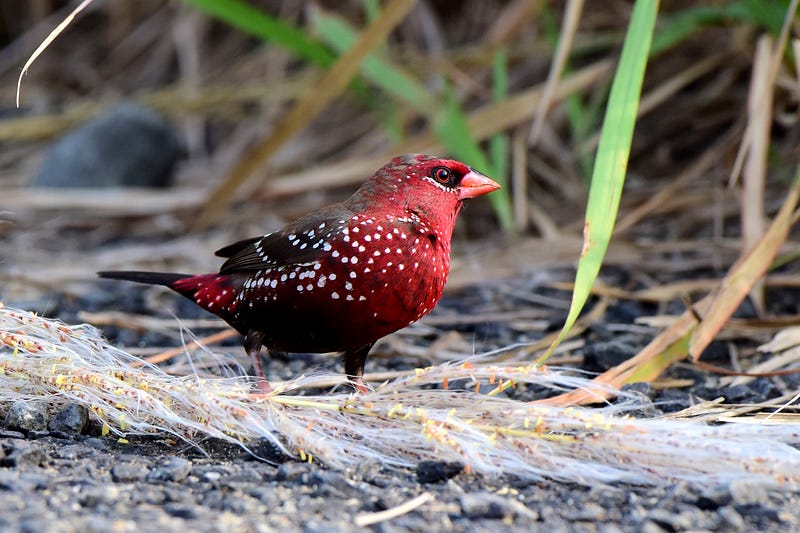
Photo by Saif Rahman on Unsplash

Today’s New York Times Spelling Bee letters:
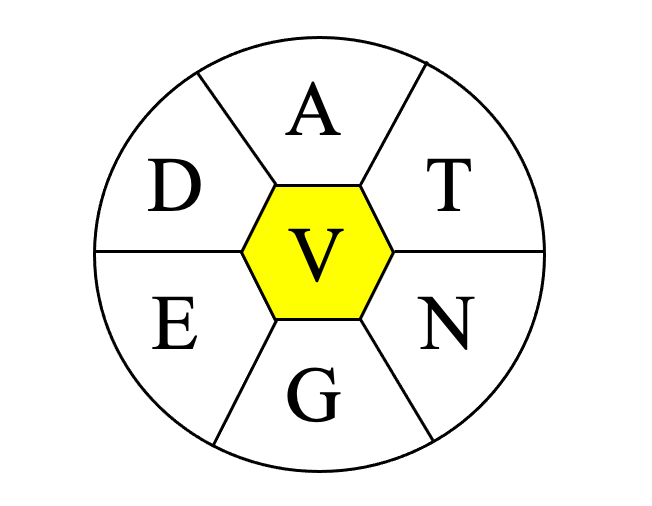
Art: Iva Reztok

A, D, E, G, N, T, and center V (all words must include V)

Merriam-Webster says…
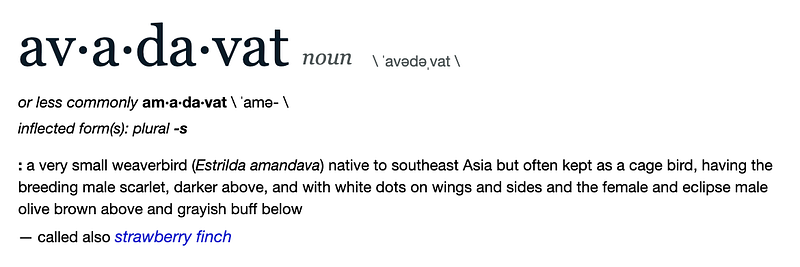
Credit: merriam-webster.com

Silly little dictionary! Don’t you know that avadavat can’t possibly be a word if the New York Times says it ain’t?

For further fascinating facts, check out the Spelling Bee Master.

What’s your favorite dord* from today’s puzzle?

My Two Cents

There were several interesting words to choose for today’s column. Among them was geneva, an old term for Dutch gin, which would have given me the perfect excuse to pour myself some while writing this article; vega, (an open tract of land, or plain) which would have been a way to segue into Don Diego de la Vega, otherwise known as Zorro; and venge, which is a synonym for the verb avenge and would have allowed me to discuss the new Batman movie. Wait… it’s been three months since that one came out, so I’m sure there’s already a newer one being planned.

But how could I pass up avadavat? It’s such a fascinating word to both read and pronounce. From what I gather, the accent is on the first syllable, so pronunciation would be \ ˈavədəˌvat \, but feel free to say aVAdavat or avaDAvat in your mind or even out loud if you want to.

All that’s missing at the end of this word is “doo”, and it would sound very similar to this:

Also, the two avadavats and the one that is but isn’t are pretty birds with pretty colors. What more could you ask for in a Medium article? Opinions about wokeness? Thoughts on racism or mass shootings? Chit-chat on the latest court trial between celebrities? What do you think I’m trying to do here on this platform? Actually have people read my articles so I can earn thousands of dollars? C’mon, now! I’m perfectly happy writing about words for the love of words, and 13 cents a day is more than enough for me.

The finches of Eastwick

I don’t know if there were any finches in John Updike’s fictional town of Eastwick, Rhode Island, but seeing as the birds we are discussing today don’t belong to the family Fringillidae (true finches) and are located mostly in the southern part of Asia and across Africa, well, I doubt it.

The birds we are discussing today belong to the family Estrildidae of the order Passeriformes, which means they are songbirds. Although among them the waxbills are considered less-talented. According to the online Britannica, there are about 140 species of these Old World birds, some of which are popular to keep as home pets in cages.

True finches, on the other hand, belong to the Fringillidae family, which includes the canaries. Some canaries are also popular as pets, while others are used to warn miners that they are about to die.
Photo by Ji-Elle

Currently the finch family is divided into three subfamilies that contain 231 species in 50 genera. Raymond Andrew, and American ornithologist, wrote in 1968 that “Limits of the genera and relationships among the species are less understood — and subject to more controversy — in the carduelines than in any other species of passerines, with the possible exception of the estrildines.” (Yeah, those estrildines are the avadavats we are discussing today, although I’ll admit we haven’t actually started discussing them yet.) A few decades later DNA sequencing technology allowed scientists to make revisions in the taxonomy of finches and reclassify them.

Finches can be found in most parts of the world, especially after having been introduced in places they were not native to. Most live in the woods, but some prefer the mountains and even the deserts.

Below is the common bullfinch.
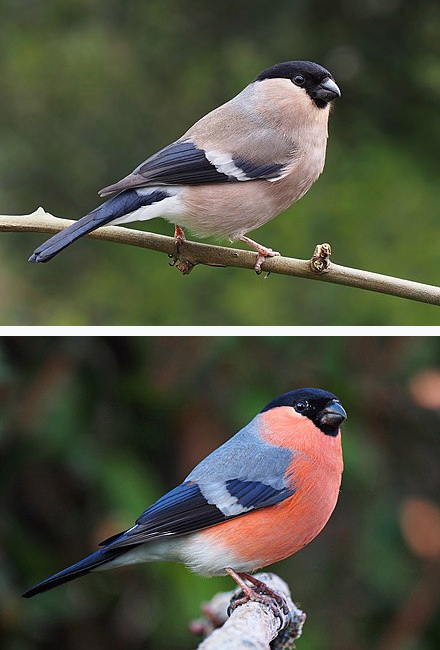
Credit: Francis C. Franklin

No, it didn’t get suddenly sunburned while Francis C. Franklin snapped a couple of pictures. The female is grayish, while male is more colorful, for mating purposes. Who knew female finches liked to be on top, though? Ha!

And below are a pair of male and female American goldfinches, who have clearly had a spat and are not even thinking of mating.
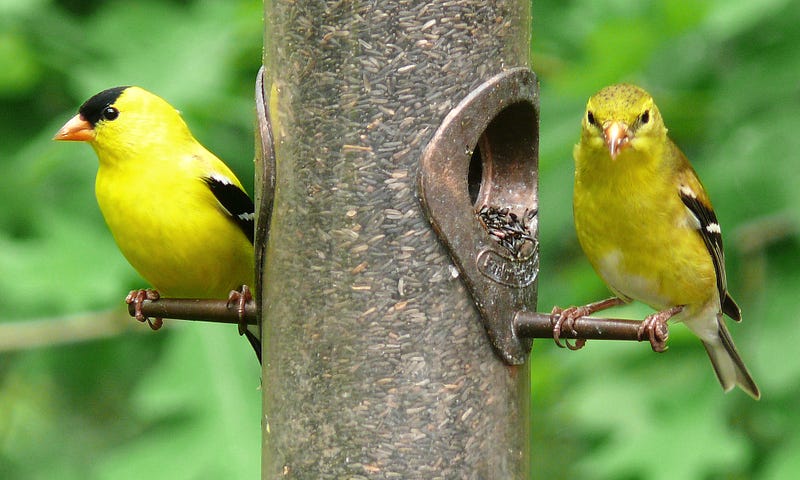
Photo by Ken Thomas

You’ll notice the seeds on the right side of the birdfeeder. That’s because finches are mainly granivorous, which is a fancy way of saying they love eating seeds.

The colors of the traffic light rainbow

The avadavats are also known as amandavas. According to The Helm Dictionary of Scientific Bird Names by James A. Jobling, the word amandava came from the name Ahmedabad, a city in Gujarat, a western state of India. The green avadavat’s distribution in India is shown, appropriately enough, by green dots on on this map.
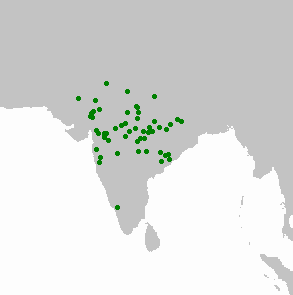
Image by L. Shyamal

I assume each dot represents more than just one green avadavat, but don’t quote me on that. We’ll get back to this bird. But let’s start at the top of our avian traffic light.

§ The red avadavat (Amandava amandava) is also known as the red munia or the strawberry finch. In fact, the dictionary entry refers us to “strawberry finch” at the end of its definition. But clicking on the link is not very helpful:

Credit: merriam-webster.com

What are helpful however, are the pictures I was able to find online:
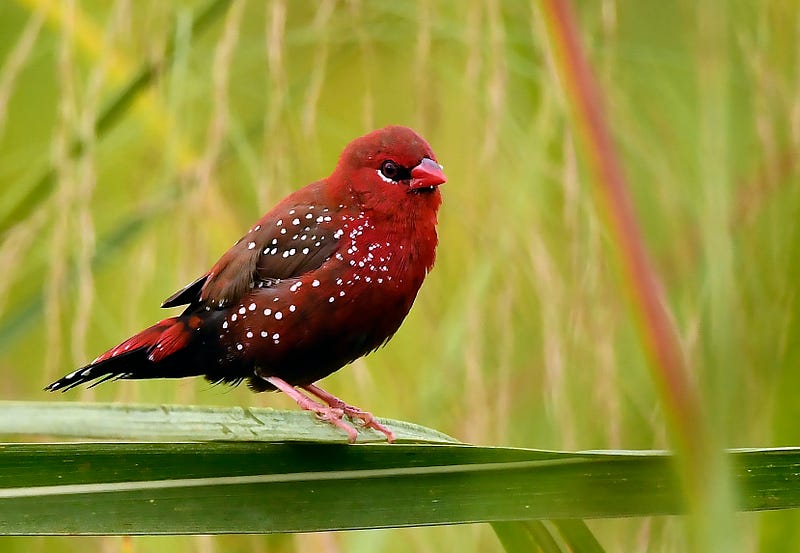
Photo by Savithri Singh

As usual, the more colorful bird is the male one. The female is rather drab, but she does have a red butt.
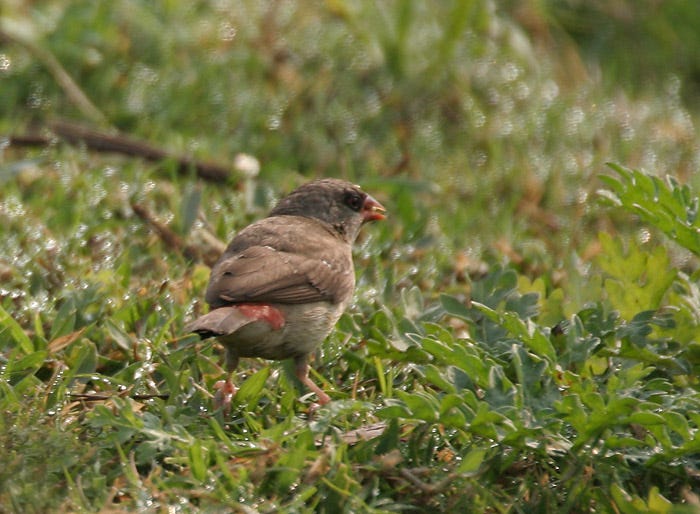
Photo by J.M.Garg

§ The orange-breasted waxbill (Amandava subflava), or zebra waxbill, is the only one of the three birds in this genus that is not referred to as an “avadavat”. In the Atlas of South African Birds, the scientific name is given as Sporaeginthus subflavus, possibly because Sporaeginthus used to be its genus. Even though it’s called “orange-breasted”, the breast of the males can sometimes be yellowish in color, as in the specimen shown below.
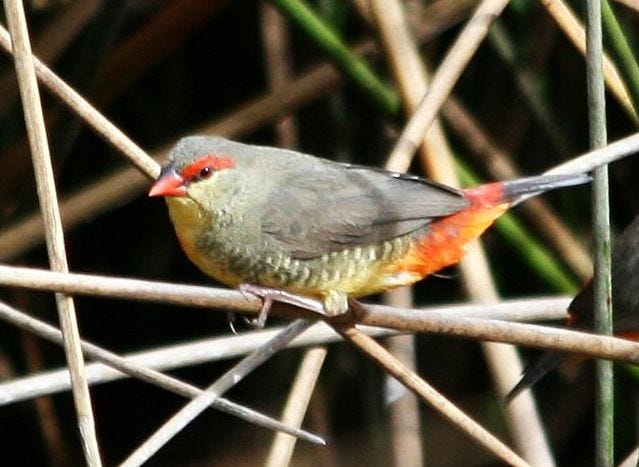
Photo by Alan Manso

Meaning that it will perfectly serve as our middle section in the traffic light.

§ The green avadavat (Amandava formosa) we mentioned earlier is also known as the green munia. This may have been the first bird to be called avadavat, as we explained before. Of the three species in the genus, it’s the only one that has a mildly threatened conservation status. And it’s also the only one I found illustrations for, aside from photos:
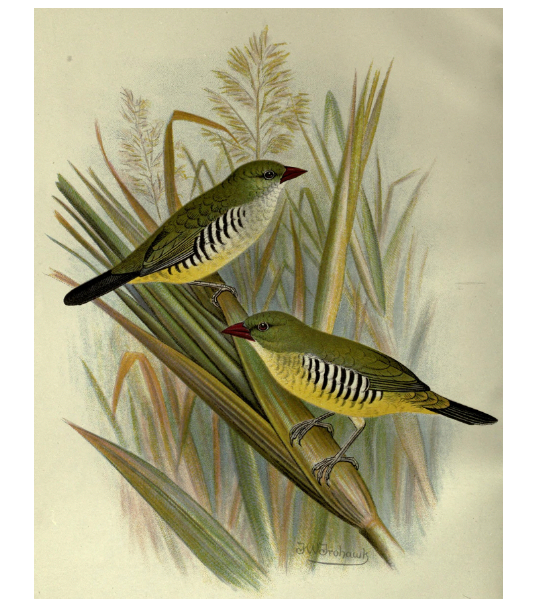
Art by Frederick William Frohawk

Not a bad representation of the bird, considering what they look like in real life.
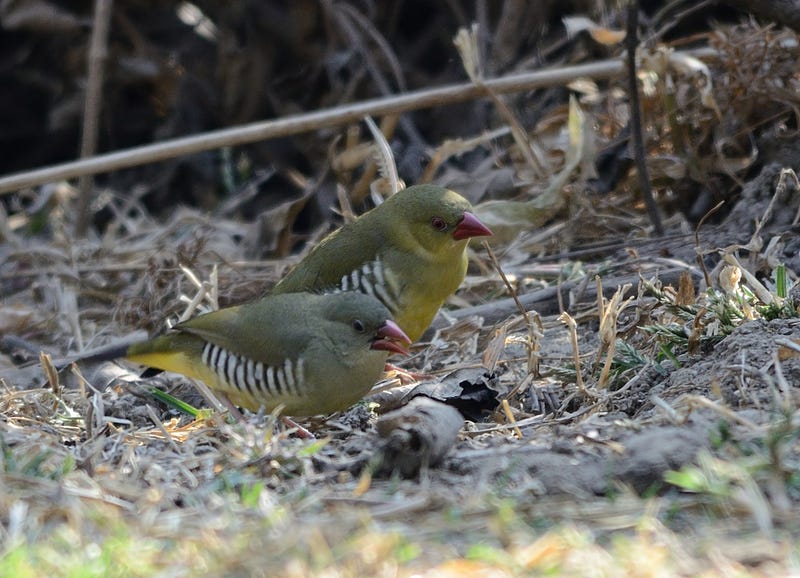
Photo by Pkspks

The main threat to this species is bird trade.

And here is the assembled traffic light with all three avadavats:
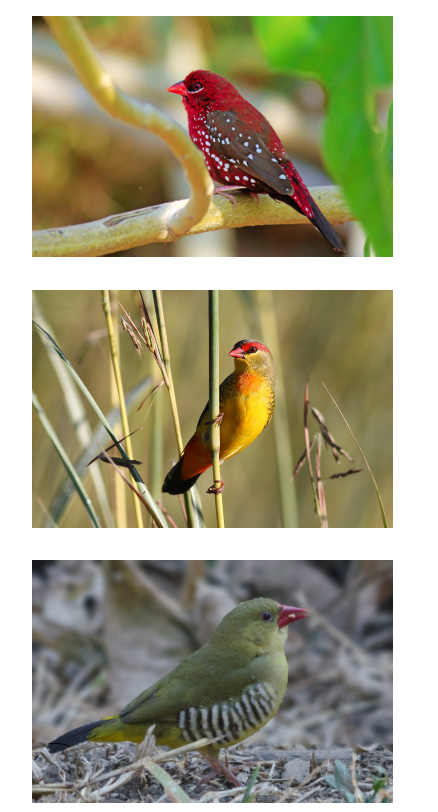
Avian Traffic light constructed by Iva Reztok

That’s it for today. I hope the photos of the brightly-colored birds served to, um, well, brighten your day. If you ever happen to spot one of them, you can let everyone know you saw an avadavat. You may need to show them this article if they don’t believe you… because the editors of the Spelling Bee decided that avadavat is a dord*.

You can check out my previous entry on another dord* here:

*What the heck is a dord, you ask? Here’s the answer:

Spelling Bee
Language
Birds
India
Finch
Recommended from ReadMedium