
Attachment Style is Actually Detachment Style
To a therapist, there are two kinds of people: those who knew unconditional love in their childhood, and the rest of us. Perhaps we are in the business of helping the latter into the experience of the former. Therapy may primarily be learning to explicate our early lessons in love, and reauthoring them where they do not serve us.
Those who knew healthy love the first three years typically grow to become securely attached. Such people have moments of aloofness or insecurity; it is in their baseline that they believe love is there even when it isn’t being controlled.
Insecurely attached people handle love like a thermostat — there is a range at which they want it hotter (anxious) or cooler (avoidant). Love requires a level of control because having it too close makes the one feel smothered while having it too far makes the other feel frightened.
Of course, the opposites are drawn to each other. Like entangled quantum particles, knowing one partner’s attachment style implies the other’s. This either leads to polarization in which the anxious become particularly clingy so as to demand an end to their fear, which only serves to drive the avoidant to the further recesses of their aloofness; or, it leads to balance as the anxious teaches the avoidant to be vulnerable and seek love while the avoidant teaches the anxious to foster independence. Yes, it is possible to be in a relationship without experiencing it directly, just as it is possible to maintain one’s individuality while being in a relationship.
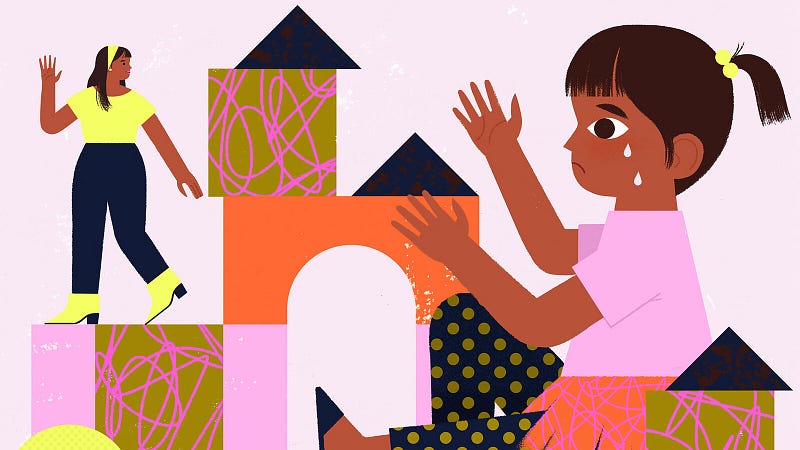
Most attachment specialists geek out when we take our toddlers to preschool. There we get living data in watching how other toddlers decouple from their parents. The ones who melt down when it is time to say goodbye typically grow up to be anxiously attached. The ones who display no emotion at detaching from the parent or attaching to the teacher usually grow up to be avoidant. While attachment can change at any age, it is usually formed within the first three years, meaning, as far as love goes, half of what a parent will ever get right or wrong happens by the time the child is potty-trained.
And what parents get right is teaching children to detach from the parent to find love in the world. Your ontological introduction to the world is finding out you are not it. In the womb, you are the world. You and the Mother are an entity. (She still carries your DNA.) At some point after birth, you discover you are not the Mother in the murky infant consciousness that is you. At this point, duality begins, and thus there are separate beings held in their oneness not by identity, but by love.
So that the child who learned that love is safe and connection is real goes into a world that carries that imprint of childhood. The child who learned to always seek more love because there was never enough grows up to text too often, to believe love is going away, to seek validation just before and just after…seeking validation.

When Oliver Twist asks for more food from the master, he is also depicting the inner world of the anxious who feels he is never cared for enough, never emotionally fed enough, never able to convince others or themself that they are worthy of love.
The main path to becoming the anxious child comprises being the child who did not get enough love, and then grows to seek it in the outside world because they do not believe it lies within themselves.
There tends however to be three discrete paths to becoming the avoidant child:
- Some avoidants are responding to the the same lack of love that the anxious’s were. They simply have learned not to seek it out because they have succumbed to believing it isn’t there. Hence when it is offered them, they don’t know what to do, and shut down.
- Some avoidants were smothered by projecting parents who were overfeeding their own inner child the love they themselves did not receive. You see, the biggest predictive factor in your attachment style is your parents’ style. The smothering anxious mother (or, more rarely, father) can in fact produce the opposite child: the avoidant, aloof child who shuts down because they are overwhelmed at the suffocating parent who is selfish in their giving as they mistake their child for the receptable of their own unlived life. As Jung said, ‘Nothing affects the life of the child so much as the unlived life of the parent.’
- Children of emotionally volatile parents may shift their primary focus from seeking love to avoiding pain. Hence they are not trying to connect with their parents so much as to not set them off. The best way to do this is with a flat affect, a quiet disposition and an aloof demeanor. Hence an avoidant attachment style may be a coping mechanism in which the child cuts their losses because the world is unsafe; the less of the child that happens, the safer the child is. When their grown partner asks them to ‘open up,’ they are unknowingly contradicting the inner child’s survival mechanism.
Attachment style should have been named detachment style because it is precisely the children who learned to detach from their parents and form healthy bonds that were labeled as secure. Children who do not attach securely are the ones who did not get the right love environment in which they could detach.
Parenting is a bigger deal than you may have thought. Parents are ambassadors to love. The parents represent the embodiment of society for socialization, the embodiment of adulthood for modeling, and the embodiment of love for normalization. For whatever parents do to their children becomes that child’s norm. We only discover how our childhoods are or aren’t normal once we compare them to others’. But that takes place both cognitively and chronologically years after the fact. Hence the child of the alcoholic and the child of the angel and the child of the orphanage and the child of the tribe all know themselves as children without label. It is once they grow up and attempt to mix their love with others’ that the difference styles emerge.
As for my daughters’ first day of preschool — they took one look at me, smiled and disappeared around the corner. It was I who walked away and cried.
Also read Swimming Upstream for Love, It’s Only Trauma Until We Heal, and The Master and the Slave: Your Internal Dialogue.
To follow me: https://medium.com/@myartman
To subscribe: https://medium.com/@myartman/membership


