
Swimming Upstream for Love
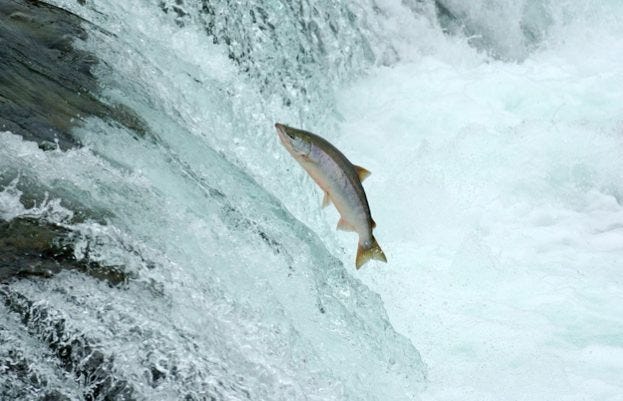
Washington state is filled with hydroelectric dams whose placement kills rivers’ natural currents. Naturalists worry over salmon’s attempting to spawn being interfered with whereas engineers claim they will actually have an easier time spawning by having no current to fight. Once salmon return to the rivers where they have swam upstream for thousands of generations only to find no current to fight, they refuse to enter. To save the salmon, the engineers provide an artificial current which promptly indicates to the salmon that they have found the right river to fight against. They exhaust themselves to death in a battle their instincts insist on having. This is the best way to visualize how we fight against available love.
If I can’t fight for it, it’s not my river. If love is easy, it’s not for me.
This is how those with unresolved trauma may see love: as something they are drawn to but can only recognize as love through resistance.
In psychotherapy, we witness patients who have learned in childhood that love is conditional, or painful, or portends abandonment or betrayal. Hence the misery of childhood gets recreated in adult relationships. We often recreate the pain we felt as children in ourselves or in our partners. In most romantic relationships, either you or your partner will at some point feel the way you or your parent did — even and especially if no one realizes what they’re doing or whom they’re emulating.
We recreate what we know of love, whether we like the variation or not. Humans are more psychologically based on legacy and precedent than individuality and choice, postmodern biases notwithstanding. The role of psychotherapy is often to make explicit the implicit algorithm we call childhood. Once we become aware how we are programmed, we cease being a program and start becoming our own programmer.
A painful childhood tells us that love is a struggle: to have it, to keep it; to give it, to receive; to trust it and to be it. So we recognize love as a temporary and often tragic experience found after a massive struggle and before a massive pain. We are like salmon.
The reason my analogy is poor is simultaneously the reason we should be optimistic: we are unlike salmon, whose actions are exclusively a byproduct of their algorithm: their genetic (and, if you’re into Sheldrake, morphogenetic) programming.
Humans by contrast can discover how that current is a self-fulfilling prophecy:
- The way the child of an emotionally unavailable parent pursues or becomes an emotionally unavailable partner;
- The way an abused child becomes or marries an abusive parent;
- The way a stonewalled child grows to ignore their child or partner;
- The way an ignored child manages love by either clinging or being aloof;
- The way a molested child becomes promiscuous or celibate or pedophiliac;
- The way a betrayed child can become a Borderline;
- The way an abandoned child can become a Narcissist;
- The way a child punished for showing emotion becomes an emotionally unexpressive partner;
- The way trauma remains trauma until we heal it.
It is by discovering the prophecy is true only because we believe it, and not that we believe it because it is true, that we realize there is no fate other than the agreements we make with ourselves. As Sarah Conner carves in Terminator 2:

I’ll close with Rumi’s poetry:
Your task is not to seek for love, but merely to seek and find all the barriers within yourself that you have built against it.
The biggest barrier we may have, is believing we need one.
To follow me: https://medium.com/@myartman
To subscribe: https://medium.com/@myartman/membership


