Astronomers just discovered One of the biggest Black holes ever
The massive celestial body lies about 700 million light-years away
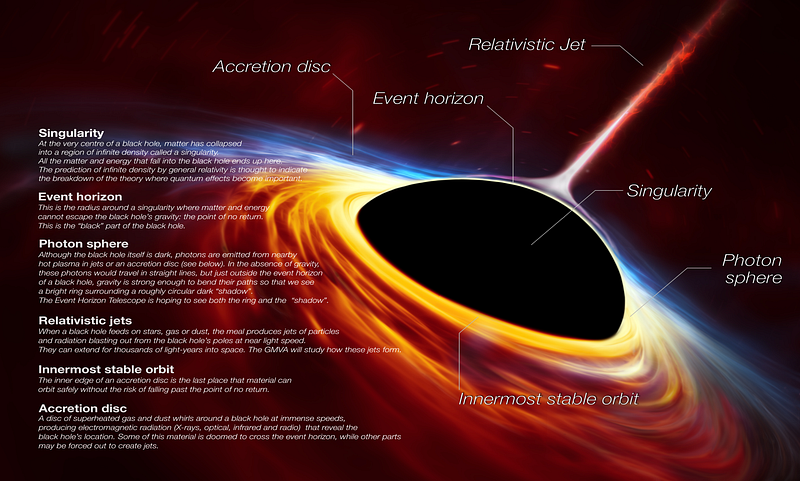
Black holes are the scavengers of the Universe, gobbling up anything & everything that comes their way. Even the light can’t escape them. One exists in every galaxy. Usually, these bodies of intense density devour all energy and matter that comes in their path thus creating a point of infinite density at the center called the singularity. The best example of an Apocalypse scenario would be a planet crossing path with one such black hole.
The black holes also create jet streams of electromagnetic radiation — X-rays, Radio waves, optical & infrared rays circling the black hole at immense speeds. These are the by-products when the black holes feed on stars, gas and dust. A detailed description of how black holes work is in the infographic above.
Recently Our very own supermassive black hole Sagittarius A* was observed to have grown 75 times brighter than usual over a two hour time period. This was a significant cosmic event considering it is not very active and doesn’t fluctuate much in brightness. Tuan Do, an astronomer with the University of California Los Angeles told Science Alert about the incident.
The team of astronomers led by Do gathered the data from the W. M. Keck Observatory based in Hawaii. As Do explained, this kind of event can happen due to the black hole swallowing up a nearby object, which in this case could have been the star S0–2 which orbits the black hole every 16 years.
The bigger news, however, was the discovery of a monstrous black hole by the astronomers at the Max Planck Institute for extraterrestrial Physics in Germany. The behemoth is located at the center of a giant elliptical galaxy and is called Holmberg 15A some 700 million light-years away from us in the Abell 85 galaxy cluster.
Using the data from the European Southern Observatory’s Very Large Telescope (VLT), the team determined that the black hole weighs about 40 billion times the mass of the Sun. It is one of the biggest black holes ever detected — the biggest by far is quasar TON 618 measuring at 66 billion times the mass of the sun. The readings for Holmberg 15A are more accurate since they are a result of direct measurement as submitted in the paper for peer review to The Astrophysical Journal.
The researchers noted that at this mass the black hole’s event horizon ( also known as the Schwarzschild radius) would be so huge that it can engulf all the planets in our solar system and more. Astronomers are trying to figure out how these supermassive black holes might have formed. One theory suggests they might be the result of stars made out of dark matter merging together.
The team intends to continue to research on these cosmic beasts based on more detailed & complex modeling techniques to figure out the mystery behind their formation.
Email 📭| Twitter📜 | LinkedIn 📑| StockTwits 📉 | Telegram 🔗