avatarSalvatore Raieli

Free AI web copilot to create summaries, insights and extended knowledge, download it at here

4257

Abstract

escopes are normally set in zones where human presence is scarce. This is in order to minimize interferences, however, the authors state:</p><blockquote id="e1ff"><p>Despite the fact that these radio telescopes are located in radio-quiet zones, radiofrequency interference (RFI) due to human technology still poses a major challenge for SETI research. — <a href="https://www.nature.com/articles/s41550-022-01872-z">source</a></p></blockquote><p id="a468">The authors showed an example of how to apply deep learning to filter out these potential nuisance signals. They used a variational autoencoder to analyze 115 million signal snippets collected from telescopes. (150 terabytes, which represents <a href="https://www.space.com/machine-learning-seti-technosignatures">the observation of 820 stars</a>). The output of this algorithm is used to feed a random forest. The random forest is trained to distinguish candidate signals from the noise background. The authors in the article stress that they design the algorithm to be interpretable.</p><figure id="adad"><img src="https://cdn-images-1.readmedium.com/v2/resize:fit:800/0*PM69pllGBW-tT0FY"><figcaption>image by <a href="https://unsplash.com/it/@profwicks">Ben Wicks</a> at unsplash.com</figcaption></figure><p id="3183"><a href="http://www.dunlap.utoronto.ca/ai-accelerate-seti/">The first author</a>, an undergraduate student at Toronto University, said that he combined unsupervised and supervised machine learning to better discover hidden patterns in the data (he also declared: “I only told my team after the paper’s publication that this all started as a high-school project that wasn’t really appreciated by my teachers.”)</p><blockquote id="604d"><p>“The vast majority of the signals detected by our telescopes originate from our own technology — GPS satellites, mobile phones, and the like. Our algorithm gives us a more effective way to filter the haystack and find signals that have the characteristics we expect from technosignatures.” — Steve Croft, one of the authors of the study (<a href="https://www.sci.news/astronomy/breakthrough-listens-technosignature-signals-of-interest-11611.html">source</a>)</p></blockquote><p id="83b1">To demonstrate the algorithm’s capability, it was to identify the Voyager 1 signature that is currently 20 million km away. After analyzing more than 100 million signals and identifying 8 signals of interest. These signals are coming from stars that are near earth and could be possible signs of intelligent life.</p><blockquote id="8ace"><p>“The new algorithm is even more effective in finding signals like this. Any technosignature candidate needs to be confirmed, however, and when we looked at these targets again with the Green Bank Telescope, the signals did not reappear.” — Andrew Siemion, <a href="https://www.sci.news/astronomy/breakthrough-listens-technosignature-signals-of-interest-11611.html">source</a></p></blockquote><figure id="4a60"><img src="https://cdn-images-1.readmedium.com/v2/resize:fit:800/0*1DQ8x4wD1nY_sCe_"><figcaption>image by <a href="https://unsplash.com/it/@bryangoffphoto">Bryan Goff</a> at unsplash.com</figcaption></figure><p id="6f98">The authors, however, make no assumptions about what originated these signals or whether they were generated by extraterrestrials but rather press scientists into examining them. Moreover, in the future, they would like to analyze much larger datasets with the same method to look for other potential interesting targets.</p><p id="0cdc">The authors are now scaling to the whole 1 million-star project. They are convinced that artificial intelligence will change astronomy.</p><blockquote id="a34c"><p>“These results dramatically illustrate the power of applying modern machine learning and computer vision methods to data challenges in astronomy, resulting in both new detections and higher performance. Application of these techniques at scale will be transformational for radio technosignature science.” — Cherry NG, an author of the study, <a href="https://www.seti.org/press-release/will-machine-learning-help-us-find-extraterrestrial-life">source</a></p></blockquote><p id="cf1d">This study still does not answer the question “are we alone in the universe?” It does, however, g

Options

ive us another tool to look for another form of intelligence scans the sky, and asks the same question. What do you think? let me know in the comments.</p><h1 id="6618">If you have found it interesting:</h1><p id="b73e">You can look for my other articles, you can also <a href="https://salvatore-raieli.medium.com/subscribe"><b>subscribe</b></a> to get notified when I publish articles, and you can also connect or reach me on<b> <a href="https://www.linkedin.com/in/salvatore-raieli/">LinkedIn</a>. </b>If you want to support me, <b>please clap and share</b>, or you can also <b>sign up <a href="https://salvatore-raieli.medium.com/membership">here</a></b> (I’ll earn a small commission at no extra cost to you).</p><p id="4c18">Here is the link to my GitHub repository, where I am planning to collect code and many resources related to machine learning, artificial intelligence, and more.</p><div id="d04a" class="link-block"> <a href="https://github.com/SalvatoreRa/tutorial"> <div> <div> <h2>GitHub - SalvatoreRa/tutorial: Tutorials on machine learning, artificial intelligence, data science…</h2> <div><h3>Tutorials on machine learning, artificial intelligence, data science with math explanation and reusable code (in python…</h3></div> <div><p>github.com</p></div> </div> <div> <div style="background-image: url(https://miro.readmedium.com/v2/resize:fit:320/0*A7B5sEqmvB_jQYbh)"></div> </div> </div> </a> </div><p id="4984">or you may be interested in one of my recent articles:</p><div id="dee6" class="link-block"> <a href="https://readmedium.com/deep-learning-can-tell-if-you-are-above-the-drinking-limit-40bea9205878"> <div> <div> <h2>Deep learning can tell if you are above the drinking limit</h2> <div><h3>A new algorithm that can measure your alcohol consumption from your speech</h3></div> <div><p>medium.com</p></div> </div> <div> <div style="background-image: url(https://miro.readmedium.com/v2/resize:fit:320/0*0imu9hMF5VXzedER.jpg)"></div> </div> </div> </a> </div><div id="62dc" class="link-block"> <a href="https://pub.towardsai.net/this-is-your-brain-on-code-ad24b55c16dd"> <div> <div> <h2>This Is Your Brain On Code</h2> <div><h3>New research highlights what happens in the brain while coding</h3></div> <div><p>pub.towardsai.net</p></div> </div> <div> <div style="background-image: url(https://miro.readmedium.com/v2/resize:fit:320/0*GoH9TwI5dEZ7E7Zc.png)"></div> </div> </div> </a> </div><div id="5663" class="link-block"> <a href="https://readmedium.com/create-your-painting-app-with-ai-and-streamlit-62ad079fb117"> <div> <div> <h2>Create your painting app with AI and Streamlit</h2> <div><h3>How to make an app with few lines of code and a spare afternoon</h3></div> <div><p>medium.com</p></div> </div> <div> <div style="background-image: url(https://miro.readmedium.com/v2/resize:fit:320/0*FfjLRa1vqJY_1qbo)"></div> </div> </div> </a> </div><div id="d3a0" class="link-block"> <a href="https://readmedium.com/everything-but-everything-you-need-to-know-about-chatgpt-546af7153ee2"> <div> <div> <h2>Everything but everything you need to know about ChatGPT</h2> <div><h3>what is known, the latest news, what it is impacting, and what is changing. all in one article</h3></div> <div><p>medium.com</p></div> </div> <div> <div style="background-image: url(https://miro.readmedium.com/v2/resize:fit:320/0*RzPI5E3ygDypkyls.png)"></div> </div> </div> </a> </div></article></body>

Artificial intelligence to search for alien intelligence

How SETI project is using AI to answer the question: are we alone?
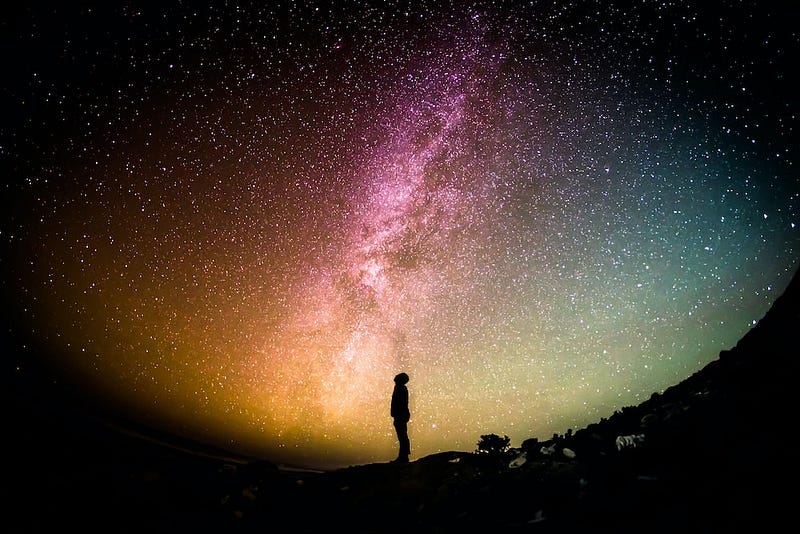
image by Greg Rakozy at unsplash.com

Artificial intelligence is changing life on earth, what if it allows us to find it on other worlds as well?

It sounds a bit like a science fiction premise, there is actually a serious research project focused on finding life on other planets. The project in question is Search For Extraterrestrial Intelligence (SETI).

The SETI project aims to answer one question, “are we alone?” And it plans to answer it by scanning the cosmos for evidence of intelligent life, trying to find electronic signatures or “technosignatures.” Mainly, using radio telescopes that analyze radio signals coming from space. These radio sequences could be produced by extraterrestrial technologies.

What does artificial intelligence have to do with extraterrestrial intelligence? A new paper just published in Nature Astronomy discusses how artificial intelligence can be used to search for aliens.

“It is a new era for SETI research that is opening up thanks to machine-learning technology” — Franck Marchis, planetary astronomer, SETI Institute (source)
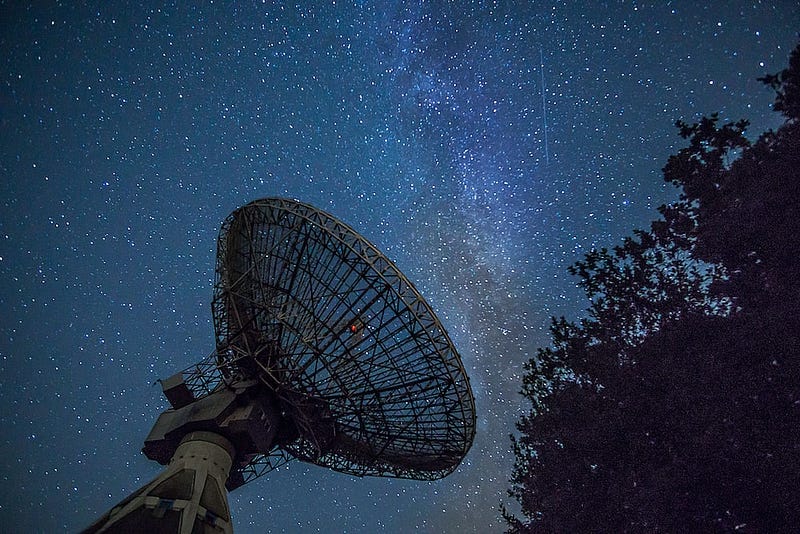
image by Stefan Widua at unsplash.com

The SETI project was founded by famous astronomer Frank Drake in 1960 by pointing a telescope at two stars and listening for radio signals. Underfunded, the project was limited at first to focusing on a handful of stars. things began to change in 2015 when the project got big funding from billionaire Yuri Milner. The project is expected to observe 1 million stars in the Milky Way and nearby galaxies. In this way, the project went from having little data to much more than expected.

“In an infinite Universe, there must be other life, there is no bigger question. It is time to commit to finding the answer” — Stephen Hawking in 2015 at the launch of 1 million star project (source)

From the beginning, researchers envisioned the arrival of a huge amount of data. However, in such an amount of data finding an extraterrestrial signal is not easy.

“The biggest challenge for us in looking for SETI signals is not at this point getting the data. The difficult part is differentiating signals from human or Earth technology from the kind of signals we’d be looking for from technology somewhere else out in the Galaxy.” — Sofia Sheikh, astronomer, SETI Institute (source)

In fact, the collection of extraterrestrial signals is disturbed by signals that are all too terrestrial. In 2019, a promising signal turned out to be a false positive. Today, electronic instruments, airplanes, and repeaters all emit signals in the same frequencies that researchers analyzed.
image by Gilles Rolland-Monnet at usplash.com

In fact, telescopes are normally set in zones where human presence is scarce. This is in order to minimize interferences, however, the authors state:

Despite the fact that these radio telescopes are located in radio-quiet zones, radiofrequency interference (RFI) due to human technology still poses a major challenge for SETI research. — source

The authors showed an example of how to apply deep learning to filter out these potential nuisance signals. They used a variational autoencoder to analyze 115 million signal snippets collected from telescopes. (150 terabytes, which represents the observation of 820 stars). The output of this algorithm is used to feed a random forest. The random forest is trained to distinguish candidate signals from the noise background. The authors in the article stress that they design the algorithm to be interpretable.
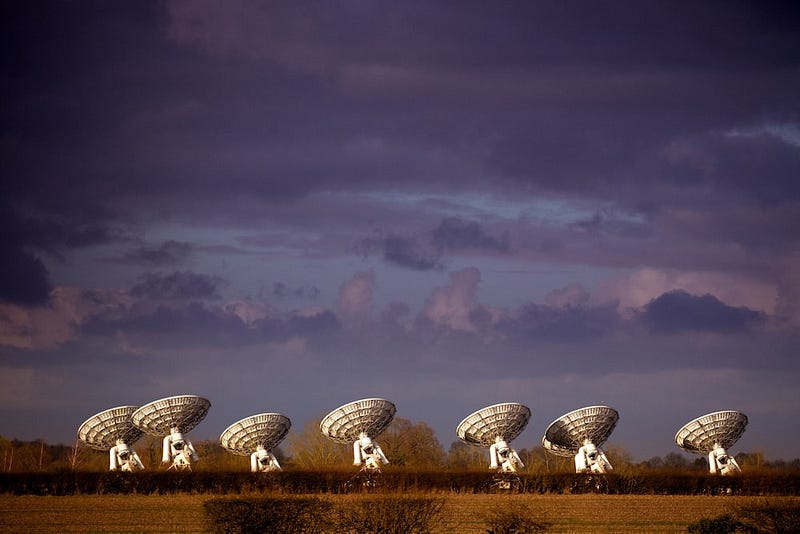
image by Ben Wicks at unsplash.com

The first author, an undergraduate student at Toronto University, said that he combined unsupervised and supervised machine learning to better discover hidden patterns in the data (he also declared: “I only told my team after the paper’s publication that this all started as a high-school project that wasn’t really appreciated by my teachers.”)

“The vast majority of the signals detected by our telescopes originate from our own technology — GPS satellites, mobile phones, and the like. Our algorithm gives us a more effective way to filter the haystack and find signals that have the characteristics we expect from technosignatures.” — Steve Croft, one of the authors of the study (source)

To demonstrate the algorithm’s capability, it was to identify the Voyager 1 signature that is currently 20 million km away. After analyzing more than 100 million signals and identifying 8 signals of interest. These signals are coming from stars that are near earth and could be possible signs of intelligent life.

“The new algorithm is even more effective in finding signals like this. Any technosignature candidate needs to be confirmed, however, and when we looked at these targets again with the Green Bank Telescope, the signals did not reappear.” — Andrew Siemion, source
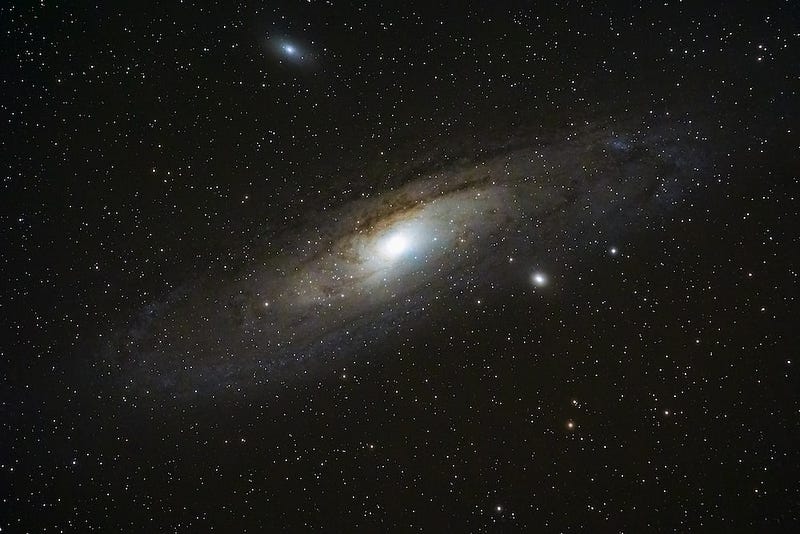
image by Bryan Goff at unsplash.com

The authors, however, make no assumptions about what originated these signals or whether they were generated by extraterrestrials but rather press scientists into examining them. Moreover, in the future, they would like to analyze much larger datasets with the same method to look for other potential interesting targets.

The authors are now scaling to the whole 1 million-star project. They are convinced that artificial intelligence will change astronomy.

“These results dramatically illustrate the power of applying modern machine learning and computer vision methods to data challenges in astronomy, resulting in both new detections and higher performance. Application of these techniques at scale will be transformational for radio technosignature science.” — Cherry NG, an author of the study, source

This study still does not answer the question “are we alone in the universe?” It does, however, give us another tool to look for another form of intelligence scans the sky, and asks the same question. What do you think? let me know in the comments.

If you have found it interesting:

You can look for my other articles, you can also subscribe to get notified when I publish articles, and you can also connect or reach me on LinkedIn. If you want to support me, please clap and share, or you can also sign up here (I’ll earn a small commission at no extra cost to you).

Here is the link to my GitHub repository, where I am planning to collect code and many resources related to machine learning, artificial intelligence, and more.

or you may be interested in one of my recent articles:

Artificial Intelligence
Science
Space
Life
Machine Learning
Recommended from ReadMedium