
Are You Planning To Be A Writer Any Time Soon?
If so, let me present to you a golden opportunity, and a framework to help you when you feel lost!

In this article I write about the ILLUMINATION initiative of Dr Mehmet Yildiz, called Illumination Book Chapters. It’s an opportunity for any aspiring writer to have a go within Illumination.
I’d suggest to you, that if you want to write within a supportive and encouraging environment, that is, ILLUMINATION, this opportunity might be just for you.
It contains a part of this article that you are now reading, simply because it was appropriate to include it, so apologies if you feel you have read it before. You will have! So feel free to skip the italics, and scroll down to the next part of the story!
‘So, the idea that many people have about writing is that, you just sit down at the keyboard and the words just kinda flow!
‘WRONG!!
‘Right now I am tutoring a friend’s daughter. Both her parents are lawyers and yet, the one thing their daughter is struggling with, is getting creative thoughts on paper, and risk-taking.
‘She’s a Michelangelo…great at math, art, and technology, so she’s not short on brainpower, but a little intimidated by some aspects of creativity.
‘She’s just thirteen, and though shy, has a whole raft of years ahead of her to build on her skills. One thing I said to her when we met for the first time last week is, that she needs to get away from the idea that only by physically writing, is she writing.
‘Thinking, for instance, is writing.
‘Drawing, is writing.
‘Mulling thoughts in your mind, is writing.
‘Thoughts flying around in your head and trapping them somewhere for reference, is writing.
‘Drama, is writing
‘I knew she was confused.
‘You have a smartphone?’ I asked.
‘She did.
‘So use it! Every thought that passes your way, however dumb you think it might be, write it down.
‘Use your study as a stage. Play around with scenes. Get your emotive words out, then write them down.
‘If quirky plots jump into your mind, that’s writing.’
‘When our brains are most relaxed, amazing thoughts can present themselves. Don’t let them run free. They are your thoughts. You can curate them at your leisure. Rest assured, many of them you will use, but some you may discard.
‘So what am I saying here? Just that writing is hard, and demanding, and not for the fainthearted, and yet, it’s at the same time exciting and exhilarating, and incredible rewarding.
‘It’s not often a window of opportunity presents itself so graciously, with all the padding of a prized artifact, (read help, understanding and encouragement), so what do you have to lose?
“If somebody offers you an amazing opportunity but you are not sure you can do it, say yes — then learn how to do it later.”
So once again, apologies for reading this twice, if you did so.
So assuming that you are interested in writing, let’s talk about the most exciting part, that is, the PLANNING!
Planning to write? Did I really say that? I did, BECAUSE, you have to.
Grrr! But I just want to write.
Maybe so, but plan you must. It doesn’t have to be super-rigorous. Nor do you have to stick to the initial plan. And it may be as brief, and as reed-thin as you choose. Reed-thin is fine, by the way, especially if you’re a new kid on the block. Just make sure you leave enough room between elements of the plan in order to fill in at a later date.
But first, decide on the genre you wish to write in. If you are unsure about that, think about the kind of books you personally like to read, for instance, romance, mystery, adventure.
Now take time to study the format that best suits you.
What is their bare-bones plan? Write it down.
How do they keep the reader turning pages?
What cliff-hangers do they use?
Do they show or tell?
What kind of vocabulary do they use?
When, how, and why do they insert cameos? In what way are they effective?
Still unsure? Still jittery?
Then let me tell you something. This may, or may not come as a surprise to you, but it’s true. Almost every story follows a pattern. Check The Hero’s Journey by Joseph Campbell. Campbell, an American writer, believed that every story ever written follows a basic pattern.
That may be hard to believe initially, but think about stories like, The Hunger Games, Cinderella, and The Lion King, and you will begin to identify the elements of story, that Campbell outlines.
‘The Hero’s Journey is a myth based framework. Incredibly flexible, it has three main parts — the separation, where the hero sets out on his journey, seeking (possibly reluctantly) adventure. Secondly, the initiation, where the majority of the journey happens — the hero arrives. Finally is the return. The hero has finished whatever they set out to do and has obtained the object (treasure, love, or knowledge). Now he must return home. These are the basic elements of every Hero’s journey, and can be used in a variety of ways to improve, analyze, and create narratives.’
Now here is an example of Campbell’s structure, all prepared for you, and like many writers before you, you can follow it and plan your own story journey.
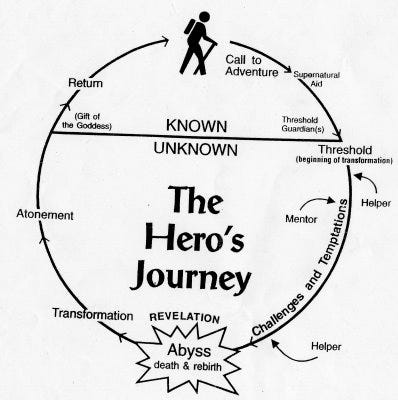
Let me assure you, if you use his structure, even as the loosest of frameworks, you will have the elements of story, just the elements, right at your fingertips! Your job is now made much more easy, that is, to fill in the juicy parts, to add excitement and teeth-chattering words, to imagine sloppy love scenes, or blood and guts fear.
That’s all you have to do. If you re-read this article, and accept the statements below as ‘gospel’, you may well become a sought-after writer on Chapter Books.
It’s not all about sitting at or, slogging over a keyboard. It’s about seeing the ideas below as part of a whole.
Thinking, for instance, is writing.
Drawing, is writing.
Mulling thoughts in your mind, is writing.
Thoughts flying around in your head and trapping them somewhere for reference, is writing.
Drama, is writing
If quirky plots jump into your mind, that’s writing.’
And now it doesn’t seem so hard! Does it? So will you consider joining Illumination Chapter Books?