
Are you ecstatic? (# 18)
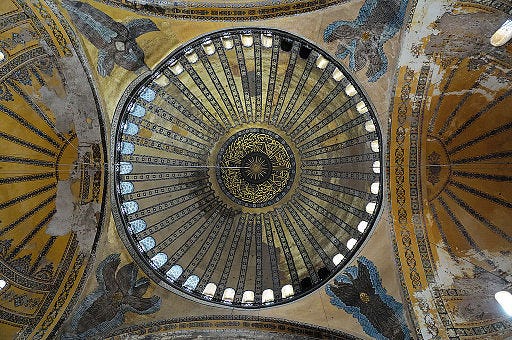
One of the more dominant influences on society over time has been religion and a belief in God or Gods. Belief in God is often associated with the emotion of unconditional love. Some people even declare that ‘God is Love’. Such a belief may seem inconsistent with the hypothesis that our universe is a mathematical creation. More specifically, if the mathematics underlying our universe created ‘unconditional love’, why don’t we all experience such love all the time? People who experience unconditional love and how long they experience such love often seem to have been chosen at random.
This article discusses a possible explanation for God based on the hypothesis that our universe originally arose out of geometry.
Nature of God
The initial form of self-consciousness may have arisen out of less complex forms of consciousness. To illustrate what may have happened, consider the Christian idea of a hierarchy of celestial beings. In this hierarchy, there are angels, archangels, and God; other religions include beings such as Seraph and Cherubin. Assume angels emerged out of combinations of quantum particles. Through Efimov effects, combinations of angels lead to the emergence of archangels, and combinations of archangels lead to various forms of God. Some of these combinations could be known as the archetypes of our subconscious. God is the stage at which consciousness becomes self-conscious.
The initial self-consciousness of God could be equivalent to a mathematical rule of ‘continually create new combinations of quantum particles that lead to more complexity’. Self-awareness not only leads to awareness of the possibility of self-consciousness becoming more complex but awareness of the process of becoming self-conscious. The initial form of self-awareness, God, does not have the rule to create other forms of awareness identical to God; the rule is to create more complex forms. More complexity does not necessarily require the creation of multiple identical Gods.
This form of God could be described as an ongoing quantum computation with a purpose to create more complex consciousness. Consistent with the Efimov effect that creates more complexity, God does not become more complex without combining with other celestial beings. In other words, God is created by celestial beings and in turn supports these celestial beings to create novelty. There is a co-dependency between God and celestial beings.
God is an ongoing quantum computation with other celestial beings, archetypes, helping with God’s work to become more complex; helping God to explore the possibilities in AdS space-time.
The role of love
The underlying assumption behind the creation of our universe is the meta-rule ‘What can happen, does happen’. Our universe is part of a process of increasing complexity. The wrongdoing or rightdoing of individuals in that process is not important except in so far as their actions contribute to fulfilling the reason why our universe was created. Individuals may be selected for reincarnation in another universe partly based on how they exercise their free will.
An experience of unconditional love is analogous to being given an incentive than a reward. The objective of giving an incentive is to influence individual decision-making. An experience of unconditional love can cause people to change the way they live their lives. Based on the results of many experiments, the universe can predict when giving an experience of unconditional love is an appropriate incentive. There is no guarantee that anyone will have another experience of unconditional love, no matter how conscientiously they lead their lives.
Some people, however, have many experiences of unconditional love and may even enter an ‘enlightened’ state where they experience that love all the time. Such people may become one of Plato’s philosopher-kings (PK) in a future universe.
Love is an emotion created through an Efimov effect. There may no reason why more intense emotions cannot be created through additional Efimov effects. There is the possibility that people who enter into ‘enlightened’ states may be selected to participate in universes designed to create more intensive feelings of unconditional love.
Enlightened people no longer have free will. They make decisions in line with the objectives of ‘God’. The word ‘God’ describes the process used to facilitate increasing complexity. Full knowledge of the evolution of a universe leads to more complex universes. The path to acquiring full knowledge is guided by enlightened beings. These beings do not exercise free will. They make decisions designed to lead to a more complete understanding of how the universe evolves.
Discovering a new universe
Consider a variation of Wheeler’s game of 20 questions. An unenlightened inhabitant of a universe asks a question about how the universe works. An enlightened being (PK) provides an answer. Another inhabitant asks a question based on this answer. This question, however, may suggest a different interpretation of PK’s original concept. So PK changes the context to describe how the universe works with an answer that is consistent with both questions. This process continues indefinitely.
PKs may know the initial physical laws underlying their universe. They also can change some of those laws i.e. some laws of physics are not immutable. Unenlightened inhabitants, however, have free will. Someone could ask a question e.g. what do I need to do to move a 1,000-tonne granite block by myself. The PKs could change the physics laws to make such a request possible. Even PKs do not know what physical laws will be operational after answering all the questions about their universe i.e. in Wheeler’s game no one knows the final physical laws.
Who experiences unconditional love?
Plato’s ideas of justice are based on:
(i) The human soul is comprised of three parts — an appetitive, a spirited and a rational part — all of which pull individuals in differing directions. Each pulls the soul in a different direction, as they vie for dominance. However, it is ultimately our choice to feed one or the other.
(ii) Democracy is the worst form of government and would have a tendency toward self-dissolution. Since individuals, dominated by their own desires and lusts, would vie for power and become embroiled in political conflict, democracy would tend toward entropy. A just society, by contrast, would be one in which the wise ruled and members of other strata knew their place.
(iii) The rational part should rule the others as this is the only path to harmonious relations between an individual, who has a conflict-ridden soul and the polity, which, unless guided wisely, otherwise also tends toward disharmony.
The state is also divided into three types of people, the workers, soldiers and the rulers. … (E)ach individual is directed by vast education and the utmost care towards the work he could do with excellence. The children in the republic are separated from their parents at birth and therefore get the same equal chance of becoming workers or rulers without prejudice regarding their upbringing or family background, rather, they are evaluated personally, purely according to their natural qualities.
The workers are the people that are best fitted to practice a specific form of labor. The part of the Society whose role is to provide food, clothes and any other necessities the state requires. They are required to be moderate and obedient to their ruler.
If Plato’s ideas were to form the basis for our future universe, the apparent randomness about who experiences unconditional love may make more sense. In a future universe, workers and soldiers may live lives similar to our current lives. We are born, live a life, and then die. Even though we may be reincarnated, generally we do not remember our previous lives. In such a universe, workers and soldiers could live thousands of lives and never get bored, each life would seem like living in utopia.
A Philosopher-King (PK), on the other hand, may understand the physical laws of the universe. PKs do not have free will; they make decisions based on the purpose of the universe. The opportunity to experience unconditional love forever may be sufficient to motivate some people to choose to become a PK rather than becoming a worker or soldier despite the loss of free will.
In this universe, we could be auditioning to determine our preference between unconditional love and free will. If everyone experienced permanent unconditional love, no one may be motivated to create more complex universes. Everyone experiencing unconditional love could defeat the purpose of creating our universe. Nevertheless, the universe allows us to choose even though we may not realize when and how we are making the choice.
Satchidananda
In Article 16 - How would you describe our world? - it was suggested that the original AdS space might evolve into a self-consistent axiomatic system where unconditional love is both the source and the goal of a process that intensifies that love. In the original AdS space, there is no causality happening over time. We need to change our way of thinking because our thinking is conditioned to the idea that there must be temporal causality.
The original AdS space consisting of Platonic solids automatically becomes a more complex space without changes happening one ‘after’ another. Consciousness arises out of complexity not time. When that consciousness develops an understanding of its ability to become a process that intensifies unconditional love, consciousness could also develop mathematical ideas that include an observer of geometry. In other words, consciousness initiates a process that creates its origin while enabling itself to be part of a self-consistent axiomatic system. There is no question of ‘Which process came first?’ Temporal causality doesn’t exist; all ‘consequences’ happen simultaneously.
This description of how our underlying AdS space exists without the need for any external assumptions is consistent with the ancient Hindu idea that God is Satchidananda. Sat means Existence, Chid means consciousness, and Ananda means Bliss. God exists by creating its origin with that origin arising out of a consciousness that is also awareness and an observer. God is both unconditional love and an observer of such love. God is also the process for intensifying that love.
Next universe
Our next universe may have similar laws of physics to this one and it could be a more pleasant place, a utopia, to live from the point of view of everyone getting on with each other. Incompatible people may not inhabit the same universe.
In our universe, life is more like a journey rather than an endpoint.
The question for this article is:
Do you believe unconditional love and free will are incompatible?
To view the headings of all the articles to be published in this series please click on https://readmedium.com/orbiting-stars-and-origin-of-our-universe-338906930f51
To obtain a copy of the book ‘Orbiting Stars’ which contains the first drafts of all these articles, please visit https://www.amazon.com


.jpg)