
How would you describe our world? (# 16)
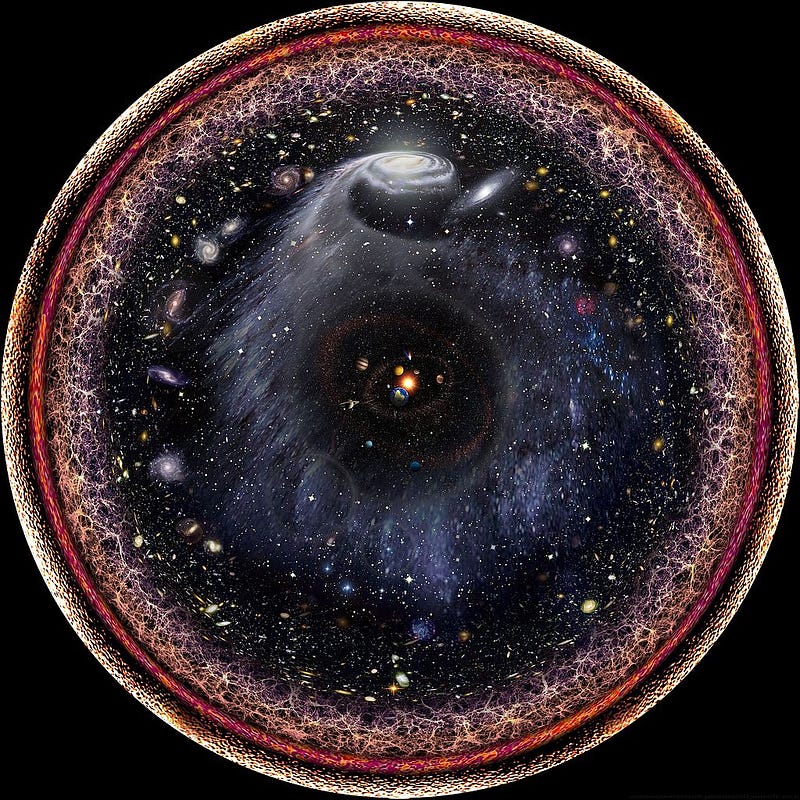
This series of articles has presented a model of our universe that differs from that set out by mainstream science; differences that arise from other interpretations of the same research. While both models could provide the same explanation for events after the Big Bang, only the ideas described in these articles explain the reason for the Big Bang and what happened before the Big Bang. Some of the main differences in conclusions between the two models are summarised in this article. Circumstantial evidence in support of the argument described in these articles is also briefly discussed.
Origin of our universe?
Mainstream science does not set out a self-consistent set of axioms that explain the origin of our universe. At the heart of mainstream cosmology is something that cannot be explained; something must be assumed such as the existence of an eternal consciousness or tiny vibrating one-dimensional strings.
Mathematicians have shown that Elementary Euclidean Geometry is a complete axiomatic theory in 3-dimensional Anti-de Sitter (AdS) space. The existence of this eternal self-consistent axiomatic system can be complemented by other discoveries in logic such as George Spencer-Brown’s Laws of Form. When AdS space has a topological structure like a Klein bottle, content in AdS space such as a Platonic solid becomes its own dual. Using Spencer-Brown’s interpretation of Distinctions arising from his Laws of Form, the change of a Platonic polyhedron into its own dual can be described mathematically by the addition of a time-like dimension.
When time-like content becomes the fourth dimension in a 3-dimensional AdS space, the mathematical description of the space contains singularities that are incorporated into its boundaries. When content such as combinations of Platonic polyhedrons is included in a boundary, the mathematical description of the inside of the boundary consists of the original four dimensions as well as a second time-like dimension. A boundary displays the content of the space in one less dimension i.e. a hologram. Such a boundary is not in a fixed position in the space; an analogy for the boundary would be a mirage i.e. an insubstantial image in a desert.
Our universe exists as a boundary in AdS space. Philosophically, our universe may be described as a kind of holographic idealism or a dream. Each of us behaves as if we are part of the content in AdS space inside a black hole; we view avatars of ourselves displayed in a boundary of that AdS space. What we see could be compared to icons on a computer screen. These icons are not actual particles. We are under the illusion that we are alive in the boundary. The origin of the laws of physics that exist in our universe can be explained by various phenomena such as the Efimov effect which has been proven to exist in laboratories.
The foregoing summary of the origin of our universe is an example of how our universe may have been created without assuming something that cannot be explained. For centuries, philosophers have assumed that the origin of our universe cannot have a logical explanation; consequently, many different theories have been developed. Once philosophers accept the possibility that the origin of our universe may be explicable, many more theories may emerge.
For a theory of the origin of our universe to be seriously considered by philosophers, some potentially testable implications of the theory need to be specified. The testable implications for the ideas set out in these articles involve dark energy and the law of gravity. A theoretical explanation of Newton’s inverse square law of gravity is developed. When this explanation is used to predict the rotation velocities of stars, the nature of dark matter and dark energy is revealed.
Self-consistent axiomatic mathematical theories
So far, this discussion about the origin of our universe reflects the belief that the existence of a complete axiomatic mathematical system does not require further justification. This belief may not be true. For example, does the existence of geometry require the existence of a thinker or observer? The idea of a self-reflexive model, however, might provide such a justification.
The original AdS reality might have evolved into a process for self-replication. A self-consistent axiomatic system could become both the origin and the goal of a process. Such an origin may only exist when there is the possibility of the origin being the outcome of a process. This is a ‘bootstraps’ concept. The existence of a self-consistent system does not require justification when the system is a logical outcome of a process where the origin’s ‘template’ has been removed before being recreated. For example, a process might allow for an Efimov effect that creates a self-consistent axiomatic system i.e. a system that cannot be explained in terms of content in any of the individual components causing the effect.
The eternal existence of an AdS space consisting of Platonic solids is based on the idea of geometry being eternal. A preferred starting point would be a concept that does not depend on anything else. One such concept might be unconditional love. Some people say they have had experiences of unconditional love that did have any prerequisites. Such an experience is analogous to an Efimov effect: a force that is not part of any of the individual elements that create the force.
If consciousness arising out of an AdS space could create unconditional love out of an Efimov-type effect, consciousness may also be able to evolve into a process where unconditional love is both the origin and the goal; a process for self-replication. While the feeling of love is unconditional, there may be several elements to that love such as a drive to become more intense. Unconditional love may not be a limited concept; there may be no limit to the intensity of that love. Consciousness might evolve into a system of ever-deepening love through a process involving ever-increasing complexity.
As will be discussed later, Constructor Theory (CT) provides a model for such a process. According to CT, self reproduction is a construction where the self-reproducer, S, is a constructor for constructing another instance of itself given raw materials containing neither S nor constructors for S. The raw materials could be information.
Does human history have a purpose?
Mainstream scientific cosmology does not include human history as an essential element in the existence of our universe. One of the ideas in these articles is that human history needs to be included in the scientific description of our universe. In other words, a cosmology that does not contain human history as an integral element is incomplete. Human history needs to be explained at the same time as a description of our physical reality.
The following features are considered circumstantial evidence supporting the ideas underlying the origin of our universe discussed in previous articles.
First, ancient philosophers using more symbolic language provided a very similar description of the origin of our universe. These philosophers may not have known that certain curvatures of space-time could give rise to black holes and imaginary boundaries. Nevertheless, scriptures such as the Shiva Sutras describe how the source of everything creates our universe on a screen created out of its being.
Shiva Sutra 2:
By the power of her own will, she (Consciousness) unfolds the universe upon part of herself.
Source: The Splendor of Recognition, Swami Shantananda
An apparent similarity between ancient Eastern scriptures and modern physics has been noted by many authors over the last century. The point made here is it is not accidental that science is discovering a similarity. We are observers of events in our universe, not the creator. The universe is making us observe what we need to see to fulfill its objectives. How we understand our universe will influence how we exercise our free will.
The previous paragraphs are not meant to imply the proposed theory about the origin of our universe is correct; the issue is how to include human history in a scientific explanation of the origin of our universe. How could ancient seers have described a cosmology that would probably have been incomprehensible to people at that time? The seers’ description, however, makes sense based on current scientific knowledge. Their description provides circumstantial evidence that the intended audience for ancient philosophy is not only people living at the time but also today’s scientists. Modern cosmologists may make discoveries consistent with modern interpretations of ancient scriptures.
A second feature providing circumstantial evidence is how the structure of ancient buildings such as the Great Pyramid at Giza in Egypt contains information about geometry consistent with the origin of our underlying reality i.e. Platonic solids and more generally sacred geometry. The proportions used in the construction of the Great Pyramid suggest the builders knew many facts such as the Earth being round and the size of the equator, facts which today’s Egyptologists cannot explain.
With Google maps, researchers have discovered that many natural geographical features are consistent with the tenets of sacred geometry such as the construction and location of ancient cairns (places where people gather) on many islands. As with the Giant Pyramid, these places may not only have significance to ancient people but also can provide new perspectives on cosmology.
Thirdly, ancient philosophical texts such as Plato’s The Republic continue to be part of philosophy courses despite the apparent implausibility of The Republic’s assumptions including, among other things, human nature. This continuing interest may be a sign that Plato’s dialogues need to be reinterpreted from the perspective of preparing to live in another universe.
Several esoteric teachings refer to the phrase ‘As above, so below’. One interpretation is that there is a relationship between the macrocosm (the universe) and the microcosm (individual).
The explanation for the origin of our universe presented in these articles is consistent with our universe having a purpose. Individuals, as a group, have a role to play in that purpose but there is not necessarily a specific purpose for each individual.
The next two articles discuss in more detail some implications of this theory for the origin of our universe. In particular, ideas are put forward explaining why, if the origin of the universe is explicable, that knowledge may have been kept from us. Secondly, the role of religion and unconditional love are discussed.
The question for this article is:
Do you believe an understanding of how our universe was created could explain human history?
To view the headings of all the articles to be published in this series please click on https://readmedium.com/orbiting-stars-and-origin-of-our-universe-338906930f51
To obtain a copy of the book ‘Orbiting Stars’ which contains the first drafts of all these articles, please visit https://www.amazon.com


