
Are You Burning to Visit Bern? You Should Be — It’s a Gem!
In all my years of traveling, I’ve never once considered Bern, Switzerland, a must-see destination. But now I’m here and I can only say: put it on your bucket list.
We’re sitting in our room in the Hotel Savoy in the medieval city of Bern, taking the weight off our feet before we go out to dinner. The Savoy sounds fancy, but in reality, it’s quite minimalist — definitely not one of those places with a big plush lobby and a fountain. But it’s clean and air-conditioned , with USB ports for phone charging , so I’m not complaining.
We’ve done a lot of walking today which is great. Good to be hungry when you’re about to spend a king’s ransom on your food. Bern, like all of Switzerland, isn’t cheap.
(We’ll probably have to take out a second mortgage when we get home just to cover our son’s steak-eating habit.)
Mind you, we didn’t eat lunch. We had an ice cream, instead. But breakfast was included at the hotel, so after tucking into Bircher muesli, croissants, and coffee, we walked out into the bustle of the streets.
It’s the height of the tourist season, and the place is packed. We aren’t hearing a lot of English, though, and we’ve seen hardly any Americans.
German is the language most commonly spoken in these parts, and I’ve tried hard to remember the phrases I learned years ago when I took German 1 at university. Vielen Dank. Wo sind die Toiletten? Hast du den Bleistift meiner Tante gesehen?
It’s difficult. I keep saying Grazie and being stared at in confusion.
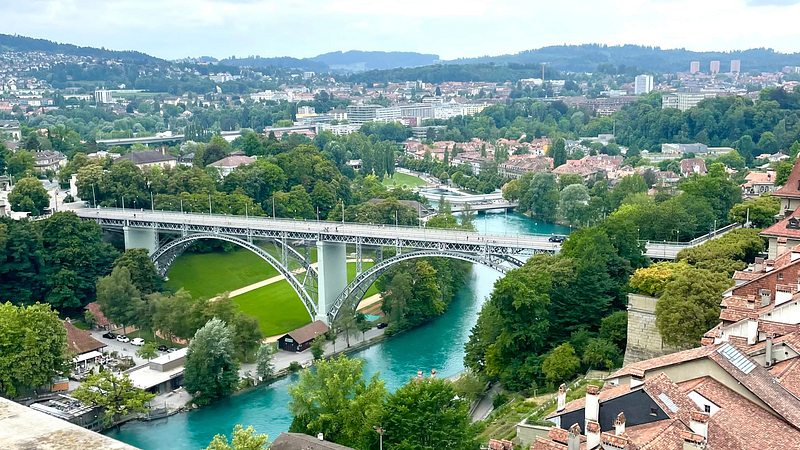
Anyhow. Our first long walk was from our hotel near the Bahnhof (the station) to the Aare River which we crossed via one of the city’s 17 bridges. The Aare is wide and swift moving, mesmerizing to watch from above.
Swimmers clutching buoyant ‘dry bags’ swept by beneath us, carried along by the powerful current.
After gazing for a while at the spectacle, we made our way down a series of stairs to the riverbank and set off along the riverside path, going upstream in a bid to find out more about where people were jumping into the river, and what the water temperature was like.
After watching a French couple take calmly to the water down a handy flight of steps— no screams of terror at the cold — we decided we might try a bit of river swimming ourselves tomorrow. (And here’s the story about that.)
Once we’d made this decision, we knew we needed to buy a couple of the ‘dry bags’ we saw people using to keep their clothes and towels in as they floated along.
We had another mission — to book a restaurant for the night’s meal. We had already tried the Kornhauskeller — a famous Bern restaurant housed in a former granary. Built between 1711 and 1718, the sandstone Kornhaus is considered an outstanding example of Bernese High Baroque style. Dining there is a highlight of any visit to Bern — but we were out of luck. The maitre d’ told us that he couldn’t fit in another table because he didn’t have enough staff. Another example of pandemic aftermath.
So — word of advice — if you ever go to Bern, reserve a table at the Kornhauskeller several days in advance. We aren’t plan-ahead types, but in some ways that makes me uniquely equipped to give out travel tips. You can learn from our many and varied mistakes. You’re welcome!
We crossed back over the Aare via the Untertor bridge, one of the oldest bridges in Switzerland and the oldest in Bern. Our walk then took us along the Kramgasse to the famous clock tower of Bern. As we wandered along, stopping to talk to a Bernese Mountain dog and his owner, we also browsed the menus posted on restaurant walls.
We made reservations at three restaurants.
I’m not feeling guilty about that. Not at all. At one of the restaurants, the maitre d’ didn’t even pretend to write down a name or any other details. No restaurant is going to hold a reserved table for longer than a few minutes in this tourist-saturated town. But we have triple insurance against going hungry to bed!
With three restaurants safely in the bag, we headed to the Tourist Information office at the Bahnhof (station) where we were able to buy the ‘dry bags’ for our swimming adventure. Naturally, these feature a picture of a bear’s head.
After a little break for a cup of tea from the handy kettle in our room while our phones charged, we were off again, this time to the Bernisches Historisches Museum/Einstein Museum.
Here’s another priceless tip: several museums and cultural institutions in Bern are free on Saturdays!
The highlight of the museum trip, for me, was Albrect Kauw’s 1649 copy of Niklaus Manuel’s 1520 Dance of Death, a mural of 24 scenes depicting death (a skeletal figure, strangely animated and gleeful-looking) dancing with all kinds of people, ranging in rank from an emperor to a beggar.
Why did I love this mural so much? It was the only medieval art on display in which women made an appearance — other than the Virgin Mary and a statue of Lady Justice.
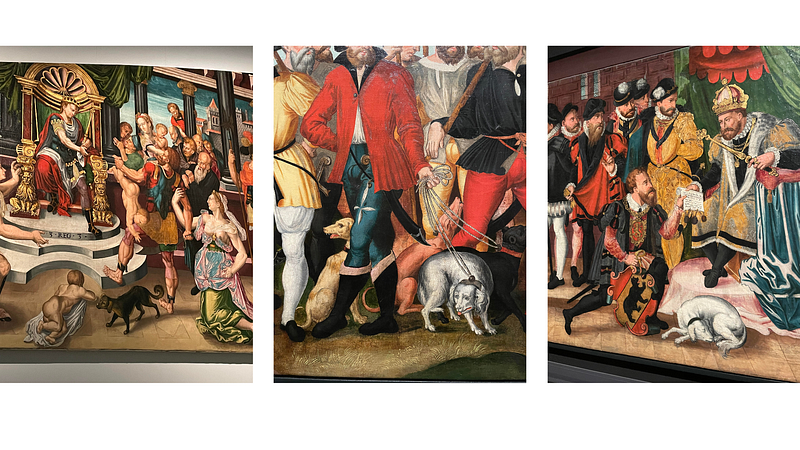
(Oh, there was also a massive painting of a man dangling a chubby baby by one foot in front of Solomon as he prepared to slice it in half while two women looked on, one in evident horror, the other with a certain amount of complacency.)
Dogs, on the other hand, featured in at least every second painting on display, including the Solomon tableau.
In the Dance of Death, women of ‘all walks of life’ were featured. And what were these walks of life? You could be Eve (made from a spare rib and doomed to damn mankind to mortality by persuading the possessor of the full ribcage to eat an apple). Alternatively, you could be a spinster, a widow, a wife, a whore, a nun, or an empress.
Note how each one of these titles refers to the woman in question’s relationship to a man: not yet married; husband dead; husband alive; available for rent by any man; married to God; married to the emperor.
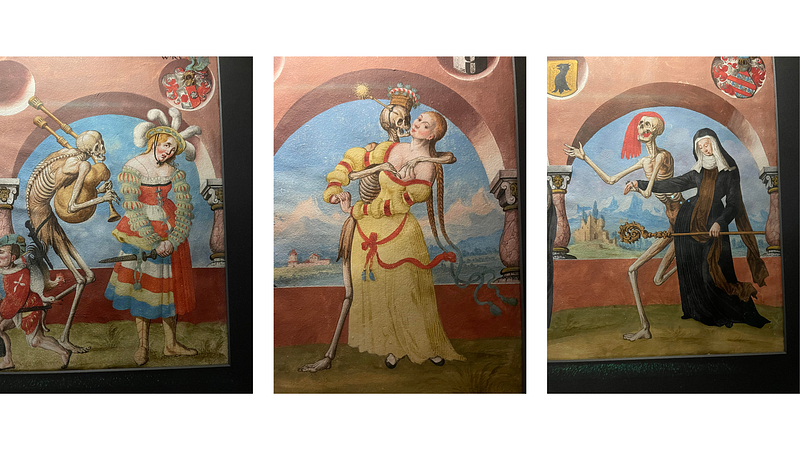
There was no way to describe a woman without describing her marital status. Her existence was determined by her relationship to a man. She didn’t have any meaning or identity as an individual.
Instead of brooding on this too much, I decided instead to celebrate the fact that women all over the city of Bern on that very day were identifying themselves by their professions — doctors, lawyers, scientists, teachers, zoologists, fashion designers, violinists, circus performers, whatever — and not by their relationship status.
We left the museum and went out to dinner at one of the three restaurants we’d reserved. As we ate our chicken cordon bleu, we congratulated ourselves on a day well spent. Bern was an unlikely destination for us, but it is turning out to be full of surprises. Perhaps it’s greatest feature is that it’s a pocket-sized city, so you can walk everywhere and get your steps in while enjoying an abundance of beautiful architecture and quirky statues of bears.
Check back to see whether we mustered up the courage to jump into the fast-moving current of the Aarle River with those expensive ‘dry bags’, after all.