
What can you learn by jumping into a fast-flowing river against your better judgment?
I found out in the Swiss city of Bern exactly a week ago.
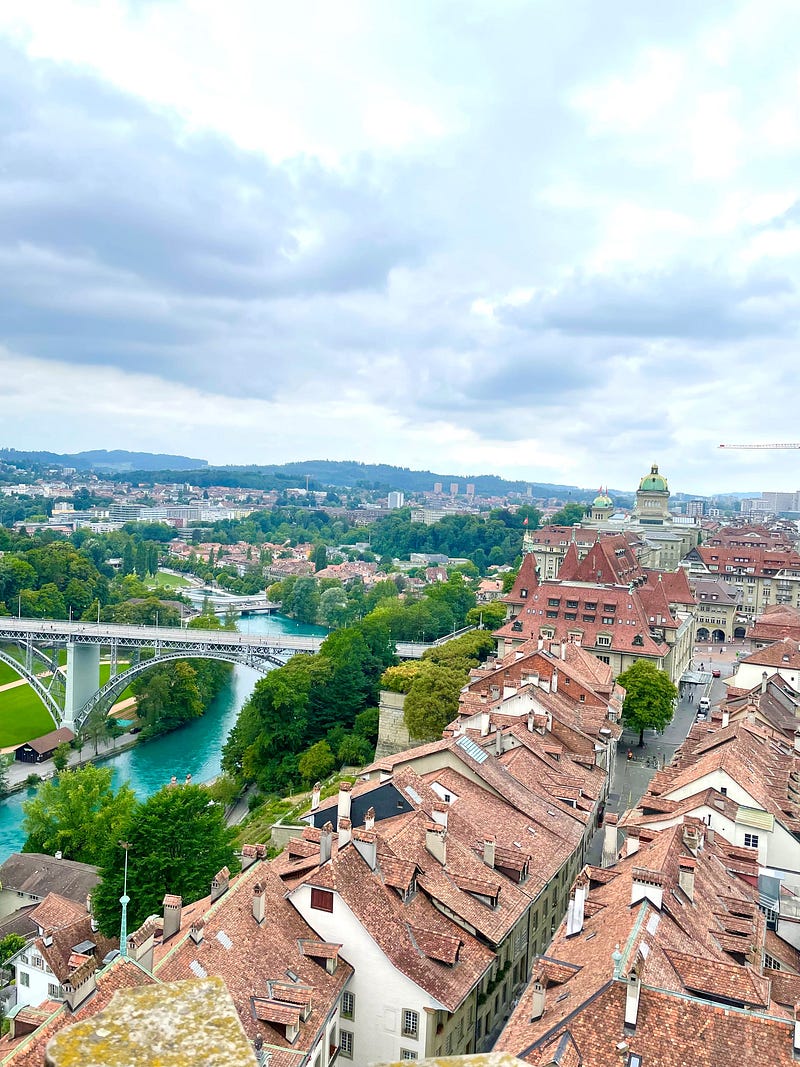
When we first arrived in the city under blue skies, a heat wave was in full swing. As we stood on a bridge looking down at the muscular ripple of the current sweeping by, the water such a brilliant and unlikely shade of turquoise, it didn’t seem like too much of a stretch to imagine jumping in and being swept away.
Plenty of people were doing it — floating by like corks bobbing in a bath tub, some splayed on their backs staring up at the sky — and not a single one of them was yelling for help.
“We’ll do it,” we said. “Tomorrow.”
And to cement this promise,we went off and bought ‘dry-bags’ from the Tourist Information office at the Bahnhof (station).
These bags are waterproof backpacks made for storing your clothes and shoes while you float down the river. They cost around $35 each — not ruinously expensive (then again, about equivalent to what I earned on Medium last month, which does make them seem rather costly) but once you’ve bought one you feel more of less obligated to use it in order to justify the outlay.
But the next day the weather changed.
When we went out to visit the bears after breakfast, the temperature had plunged into the low sixties (around 16 degrees Celsius), and the sky was gray.
Oh, by the way, you have to visit the bears if you go to Bern. Although the city is studded with ancient statues of bears wearing armor and wielding weapons, and although its name actually means Bear, I was still surprised to discover that there’s a bear park beside the river where visitors can watch three captive bears going about their daily business.
Usually, seeing animals in captivity upsets me, but the park where these bears live is spacious and full of berry trees. The attractive riverside enclosure is connected by a tunnel to the original ‘bear pit’ — a much less inviting looking space where as many as twelve captive bears were kept in the bad old days.
The bear park even includes an enclosed channel of the river where you can spot live fish in the clear turquoise water.
Something struck me rather forcibly as we watched the bears: the chill in the air was such that even they weren’t swimming.
We had scheduled our swim for around 4pm, because our phones told us that that was when the temperature would reach around 74 degrees Fahrenheit (23 degrees Celsius).
To pass the time, we decided to climb up to the top of the cathedral.
“It’s pretty small,” I said, looking up at the cathedral tower. I was comparing it with the Duomo in Milan, which I was lucky enough to see (and climb) last summer.
Famous last words.
Something that looks small from the bottom can seem sickeningly tall when you are climbing it via a tightly spiralling staircase that seems to go on forever. The narrow tower windows — more gaping holes than actual windows — didn’t help.
The higher we climbed, the more dizzy all that spiralling made me feel — and the views of the rapidly shrinking rooftops below didn’t help. By the time we reached the top, I was reduced to creeping around the metal platform with one hand on the stonework, as far away from the edge as possible, feeling too nauseous to take photos.
Don’t let this put you off. The views are spectacular, and I have a documented fear of heights.
Every vista of the beautiful medieval city featured the rushing blue-green waters of the Aare — the waters we were supposed to jump into in mere hours. And even from that high eyrie, the sheer speed and force of the river was visible. You could see that it was the kind of current that could sweep people off their feet. Not just people. Bears. Horses. Elephants, even.
Notably, nobody was floating down the river clutching a dry-bag that day. Not a single soul.
What madness had possessed me to agree to ‘swimming’ in that icy, raging river?
By the time we got back to terra firma, my son — also not too crazy about heights — said, “Well, if we can go up that cathedral,we can jump into the river.”
Darn.
We walked back to the hotel and put on our swimsuits in a sort of chilly hush, jaws set.
Then came the long walk from the hotel to the river, past the Kornhaus, over the bridge, and down the steps to the water’s edge. It was like the trudge of the condemned.
At last we reached our designated jumping-in spot: a set of stone steps with a hand rail, painted red, that led straight down into the rush and swirl of the crystal clear water.
And suddenly there were a few people in the river, floating by.
Encouraged, we secured our dry-bags and stepped down into the cold current. It sucked and pulled at our legs.
Now or never.
My son threw himself first and was whipped away. Next went my husband. He too was in the slip stream pulling away from me at speed.
“It’s not that cooooold,” they cried, their voices fading.
I stepped out and let it take me.
And it wasn’t that cold. And it wasn’t hard to keep my head above the water. And do you know what? It was fantastic — like a lazy river at a water park, but much, much faster.
I propped my elbows on my dry-bag which turned out to be pretty buoyant. Leisurely, I moved my legs in a breastroke kick. I shot down the river at speed, catching up and overtaking the others with only the slightest effort.
We passed a stone tower, undoubtedly medieval, down on the water’s edge. So strange to see the city from this angle, from the surface of its rapidly flowing river.
The Aare rises in the Bernese Alps, in the Aare Glacier, and flows through Lake Thun into a deeply entrenched valley that takes it all the way to Bern, where it makes a bend that almost encloses the medieval city.
Seeing the river from the bridges and the cathedral had given me a shiver. It looked beautiful but deadly.
Now I was in it; it was carrying me along, and I was part of the landscape myself — a small head resting on a red dry-bag, probably being viewed from above by anxious tourists who might be thinking of jumping in themselves.
The clouds parted and the sun shone. It was glorious.
We passed under two bridges and then began looking for the public swimming pool on the right, which was where we had to get out if we didn’t want to be swept down to the weir.
The pool was marked by a wall covered in cheerful graffiti, and two sets of steps with red hand rails. Two of us managed to grab the hand rail at the first stairway. One of us didn’t start making his way over quickly enough to the riverbank and barely managed to grab the second hand rail.
Even so, as soon as he’d tugged himself up the steps and onto the pathway, he shouted, “Let’s do it again!”
And we did.
So, finally, what did ‘wild swimming’ in Bern teach me?
- Be wild.
- Take chances.
- Don’t give in to the temptation to stay safe.
- Always do the thing that takes you out of your comfort zone.
- Never pass up on a unique opportunity. Remember, you may never walk that way again.


