
Are You a Life-long Learner?
Read on to discover 5 reasons why being a life-long learner is a good thing.
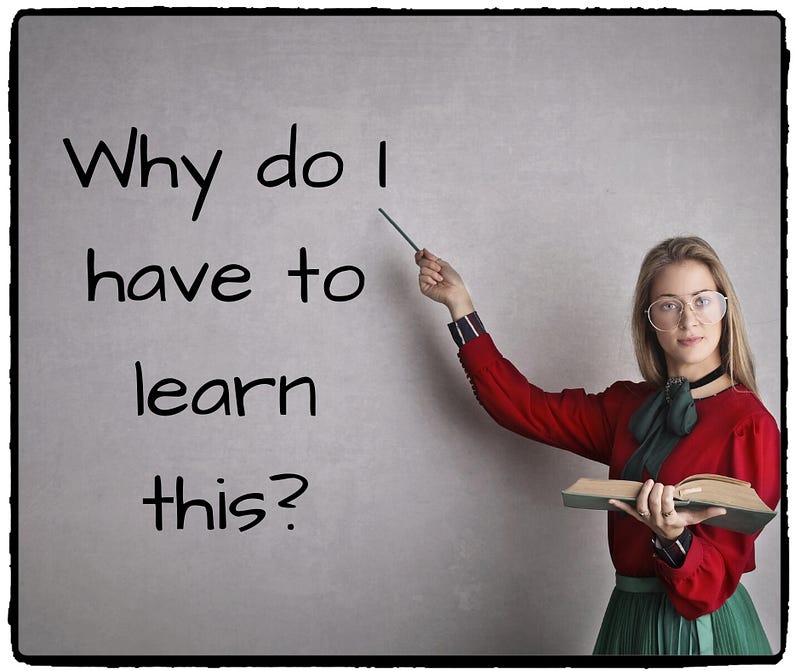
Let’s face it — as a student, you probably said something along the same line to your teacher.
AND
If you have ever been a teacher or parent, you probably heard the above statement.
“Why do I need to know this?”
(my response to learning how to read flight maps in college Earth Science)
“I’ll never use this after I graduate.”
(my response to geometry in high school)
As a teacher and parent, my response to this was
“You never know when you will need or use something you learned earlier in life.”
“You may not be enrolled in a formal type of school, but as an adult you are enrolled in the school of life.”
“If you do not learn, or refuse to learn, you cannot grow and evolve as an individual. You might just get left behind.”
As a teacher, my students often asked these questions at the beginning of the year or when starting a new unit or novel that didn’t interest them.
As a parent, my children often asked these questions about things I expected them to do or learn (think piano lessons) or the assignments they brought home from school.
As a life-long learner myself, I often overhear people wonder why they need to know or learn something.
Where Do We Get the Term, Life-long Learner?
Maybe it was because my mother was a teacher. Maybe it was because my parents read the newspaper and listened to the news. Maybe it was because there were only four channels on television when I was growing up. BUT, I knew that once I graduated high school and college learning didn’t stop.
So, what is a life-long learner?
A life-long learner, to me, is a person who takes both formal and informal opportunities to gain new knowledge and skills as they journey throughout life. They read a wide variety of material, watch documentaries, and take advantage of experiences. They usually possess an open mind and a hunger to learn.
In some circles, the term “life-long learning” began in 1962 when The New School for Social Research (now, New School University) in New York experimented with learning in retirement.
In other circles, the term is linked to “life-long learners,” a term coined by Leslie Watkins and used by the superintendent in his mission statement for Temple City Unified School District in 1993.
I came across the phrase and concept at some point in my teaching career. We were supposed to impress on our students that as they would be a student of life after graduation that they should consider themselves “life-long learners” and develop the skills necessary to learn things for themselves. As you can probably guess, that was met with serious groaning.
“If you learn one new thing each and every day, you will die a genius. “ (my husband’s grandfather)
Too many high school and college students believe that once they graduate there is no reason to read or learn anything.
BUT
In order to live a life fulfilled, it is essential to continue learning.
Actually, acting as a life-long learner sneaks into your daily life.
- You begin dating someone new who enjoys downhill skiing, but growing up in Florida, you have never experienced snow. You find someone to teach you how to ski.
- You’ve always wanted to play the piano, but your parents didn’t have the money to buy a piano and have you take lessons. The affordability of electronic keyboards has given you the opportunity to take lessons from your friend who teaches piano.
- Your child is diagnosed with autism. You read books about autism and join groups that help you learn about the illness.
- You tour a famous building or site or city on your vacation.
“If you learn one new thing each and every day, you will die a genius.” (my husband’s grandfather)
Life-long learning seems like one of the newest buzz words. Learning should NOT stop once you graduate from high school or college.
The desire to learn about something is the driving force behind people researching at the library or on the internet. It is the driving force behind colleges and universities and communities opening courses and developing workshops for adults and senior citizens.
Whether you turn on a television show that presents a subject you knew nothing about (think “How It’s Made” or “Mysteries of the Unknown”), research a topic on the internet to learn about what your friends were discussing, pick up a book on a topic that looks interesting, or enroll in a course (at a local college, sponsored by a local organization, or online), make time today — this week — to learn something new.
Benefits of Being a Life-Long Learner
#1. In many cases, getting a promotion or earning more at your job is a motivation to develop your skills and learn more.
This can mean just going back to school to get your GED, or it might mean attending community college and getting an associate degree.
#2. Change of career or job category.
As technology changes the picture of the work force, it’s important to be open-minded enough to learn the skills for a new career if you get laid off or your place of business closes.
#3. Life-long learners take advantage of opportunities because they want to be there.
As a high school or college student, you attended classes because it was expected of you. You wanted to graduate? You took the courses and, hopefully, did your best.
If you head back to school for a degree, it is generally because you WANT to. Your parents aren’t taking your hand and leading you to a high school diploma, or for some, the bachelor’s degree.
#4. Continued learning is healthy for your brain.
Come on. You exercise to keep your muscles fit and your joints healthy. Learning is exercise for your brain.
- Take a class or workshop (sometimes only a couple of hours for only a day) and learn something new.
- Read a book on a subject that is new to you.
- Watch a documentary on a new topic.
Get your brain doing those mental push-ups.
#5. Learning can fight boredom.
Let’s be real. The same routine day in and day out can get boring. BUT, add in that one-day workshop on how to make soap and you have put a detour in your daily routine.
Add enough of this kind of learning and you will have something to look forward to.
What new thing will you learn today?
How can you add learning something new to your daily routine?
Originally published at https://www.rebeccakojetin.com.
For more of my articles, visit
Rebecca Writes The articles and comments in Rebecca Writes relate to living in this crazy world. Articles about being a parent and grandparent to traveling to relationships to education to health and wellness to being a decent human being — and beyond.
Rebecca (Becky) spent 34 years in a teaching career, but when she retired in 2014, she picked up her pen and pursued her passion to write. As a high school English teacher, Becky held the philosophy that she wouldn’t give any writing assignment that she personally wouldn’t or couldn’t do. That philosophy strengthened and broadened her own writing.
In addition to publishing her writing on various platforms, Becky also blogs at Life is for Living, a blog to encourage, motivate, and help others live the best life possible. As an extension of Life is for Living, she also publishes a weekly newsletter, Let’s Chat. (Check it out HERE.) Life is for Living also has a social media presence with the group Coffee on my Porch. (Check it out HERE.)
After teaching writing for 34 years, Becky began Ink & Keyboard, a blog for writers at all levels. She supplements what she writes on the blog with a subscription newsletter, The Writer’s Notebook (Check it out HERE.), the social media group Ink & Keyboard (Check it out HERE.), and a Medium publication Ink & Keyboard (Check it out HERE.).
Here are some other stories you might enjoy


