GENETICS AND HUMAN NATURE
Are we just our genes? And what the hell is evolution anyway?
Breaking down the four dimensions of evolution, and why life is about more than just genetics
Since genes were discovered around 1900, they’ve become a synonym for human nature. This is especially true in the West, where innate essences appeal to WEIRD psychology. Even somewhat abstract entities, like organisations and institutions, talk about how their DNA makes them who/what they are.
However, it turns out that evolution and biology involve more than just genes. True, genes play an essential role in life as we know it. But genes are also just one tool at our disposal, and the full picture is a lot more interesting.
If you’d like to learn more about this topic, I recommend Evolution in Four Dimensions: Genetic, Epigenetic, Behavioral, and Symbolic Variation in the History of Life by Eva Jablonka and Marion Lamb
The four dimensions of evolution
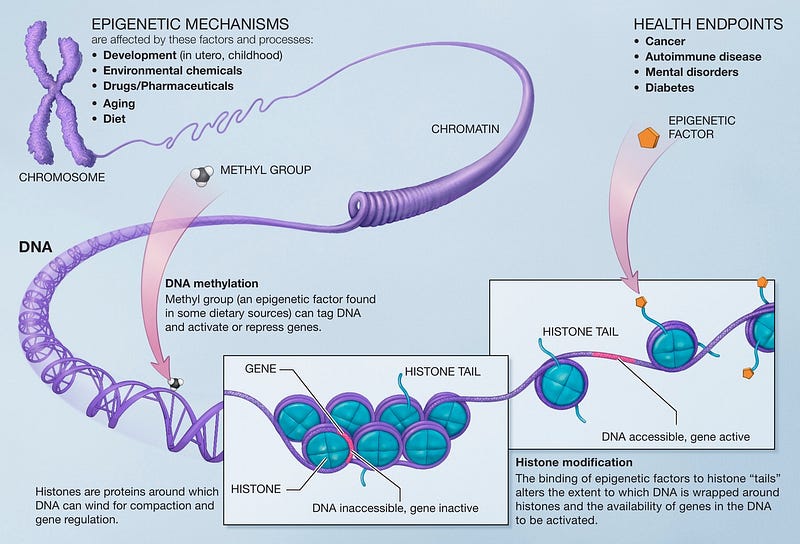
Evolution occurs along four dimensions. Two of them involve genes, the first dimension being the genes themselves. The second dimension is the system of regulatory mechanisms that coordinate the activity of genes. The first dimension is genetics, and the second is epigenetics.
The third dimension concerns behaviour. Like genes, behaviours can be inherited and modified. Behaviours can also affect reproductive outcomes, like by improving hunting and/or gathering. This can be an unconscious process, as is often the case with rituals.
Many rituals have major benefits for individuals and groups, even when no one understands how they work. Sometimes, knowing can actually ruin the magic of the ritual. This satisfies the criteria for classic Darwinian evolution: variation, inheritance, and differential selection.
The fourth dimension concerns symbols. This applies to species that use symbols to communicate information (i.e., language). Every organism communicates, but only humans appear to have language. And language allows us to create worldviews and ideologies.
Like behaviours, symbols can be inherited and modified; and history has repeatedly demonstrated the power of symbols and ideologies to influence the fate of societies. This is symbolic or ideological evolution, another serious force in human life. The behavioural and symbolic dimensions combine to make culture.
Comparing the dimensions
Let’s briefly take a closer look at each of the four dimensions and then wrap up.
1st dimension: genetics
We have two types of genes. One lives in the nucleus of our cells, and the second lives inside our mitochondria. There’s no denying that both play crucial roles in our biology. But in their mania for internal essences, WEIRD scientists put genes on a pedestal that they don’t deserve.
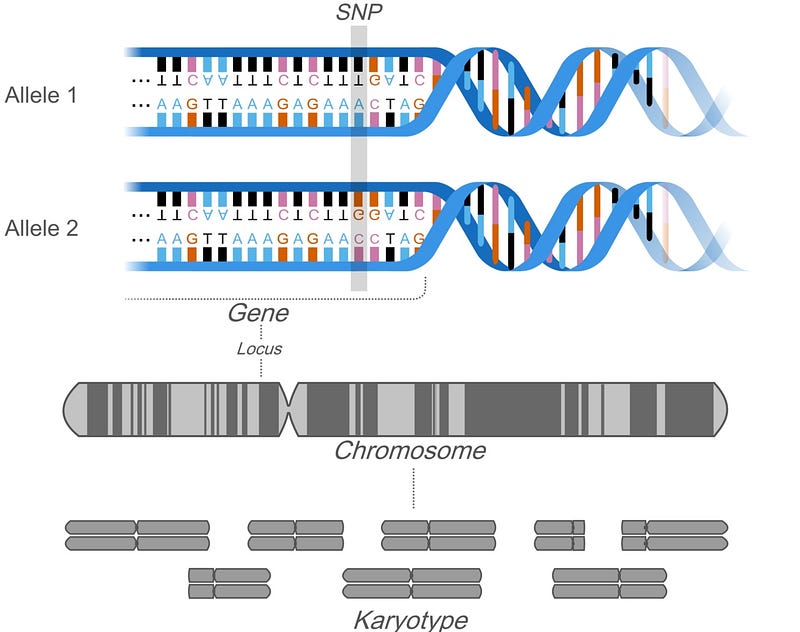
Genes were painted as a puppet master, ingeniously pulling the strings of life. For science writers like Richard Dawkins (who is not a researcher), the organism itself was merely a protective shell for genes. He made this idea famous in his book The Selfish Gene.
This is known as genetic determinism or genetic reductionism. This belief was eagerly embraced in the West, as it’s intuitive for WEIRD psychology. But decades of research have shown that this claim is too strong.
Let’s look at some big reasons why genes fail to account for human nature. For example, identical twins have different brains, but share 100% of their genes.
Variation between species also can’t be reduced to genes. When the human genome project began, it was assumed that the size of an organism’s genetic library would scale with its complexity.
We already knew that C. elegans, a tiny worm popular in genetics research, has about 20,000 genes. Since we’re much more complex than C. elegans, it was generally expected that we’d have at least 100,000 genes or more.
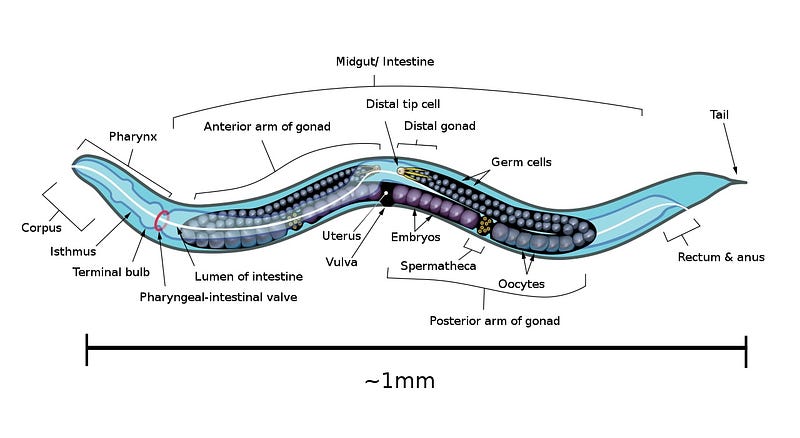
But the human genome project shocked the world: we have roughly the same number of genes as C. elegans. This is known as the c-value paradox/enigma.
Race is another instance where genes fall short. Until recently, the existence of different human races seemed like an obvious fact to many. But when you look at genes, you find that people from the same ‘race’ can be less genetically alike than people from different ‘races’.
One last example involves an evolutionary phenomenon known as convergence. This occurs when two organisms with different genes evolve to look and behave the same. They have the same ‘phenotype’, but different ‘genotypes’. Eyes are a classic case, as they independently evolved many times, and have very similar structure and function across species.
Be it plants or animals, you can find many other examples where organisms with different genes look and behave the same. Birds can even evolve to act like mammals, as happened in New Zealand.
Evolutionary biologist, Jonathan Losos, points out that New Zealand lacked big mammals for most of its history. This created an opportunity for odd balls like the Kiwi to fill those empty niches and chart a different evolutionary path. In this way, Kiwis became more like a mammal, and less like conventional birds.
Convergence shows that environments offer ways to survive, and animals with different genes can fill the same niche in the same way. Despite WEIRD psychology’s bias for internal essences, it’s not all about genes.
2nd dimension: epigenetics
Remarkably, research suggests that the mechanisms that regulate gene activity may also be heritable. In principle, this would be a type of molecular memory passed between generations. For the real aficionados, this type of inheritance is Lamarckian, rather than Darwinian.
3rd dimension: behaviour
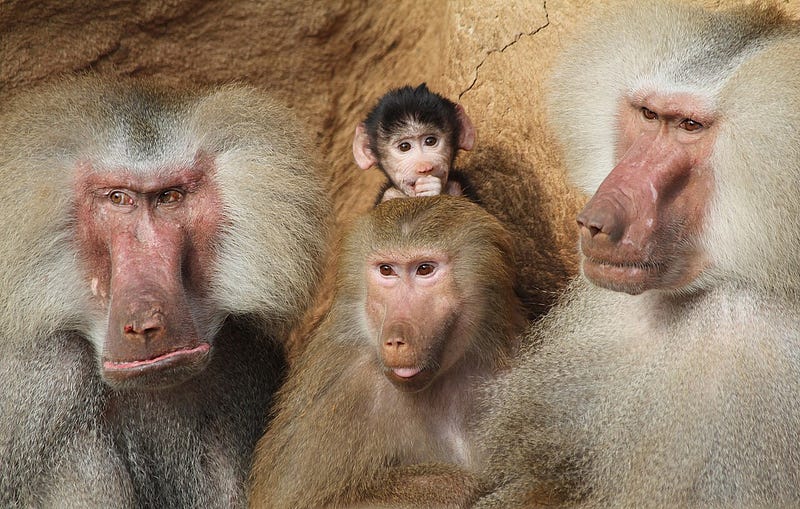
Behavioural evolution is found widely in nature. A baboon troop in Kenya provides an amazing example of this.
Baboons live in communities, known as troops. Most are dominated by aggression and violence, and this was thought to simply be the nature of baboons. But a tuberculosis outbreak proved this wrong.
The outbreak killed the biggest, scariest males, who stole bad food from their neighbours’ territory. This led to a shift in behaviour, as violence and aggression decreased, and cooperative behaviours like grooming and play increased.
What’s more, this behavioural change has persisted for decades. This is especially impressive because new males have since joined the troop, as male baboons join new troops when they reach adulthood, while females typically stay in their birth troop.
When new males arrive, it seems the troop teaches the newcomers the ropes. At first, the new males are accustomed to more conventionally-aggressive and violent rules of baboon society. But soon they adjust, and the new culture continues.
Similarly, it’s fairly common in nature that parents teach offspring to hunt, and gradually introduce their young to more dangerous prey.
Lastly, many human rituals turn out to protect against various dangers, like reducing social tension with community events, or neutralising germs by cooking with spices. These behaviours are beneficial even though the people doing them may have no idea how they work.
4th dimension: symbols
Ideologies and beliefs can have powerful effects on societies. The 20th century saw major ideological battles, like democracy against fascism and monarchy, and capitalism against communism. In various forms, these struggles remain with us today. And given the power of modern humans, our ideologies have global consequences.
Key points: we are partly our genes, but not only our genes
Genes are important in biology and evolution, but they aren’t an essence that defines who we are. That idea is a cultural bias of the WEIRD world.
Most organisms evolve along three dimensions, and species with language (currently just us) evolve along four. No one dimension is more important or fundamental than the others. All of them make us who we are.