
Apport
An appropriate word for April Fool’s

Today’s New York Times Spelling Bee letters:
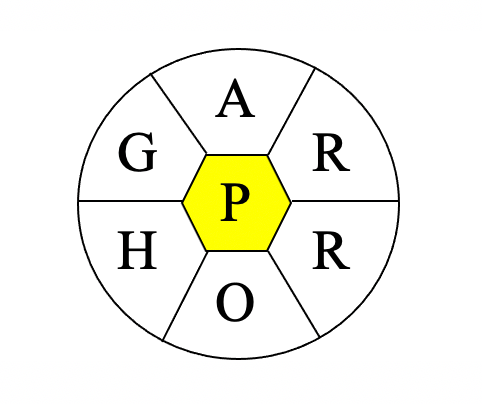
A, G, H, O, R, T and center P (all words must include P).
Merriam-Webster says…
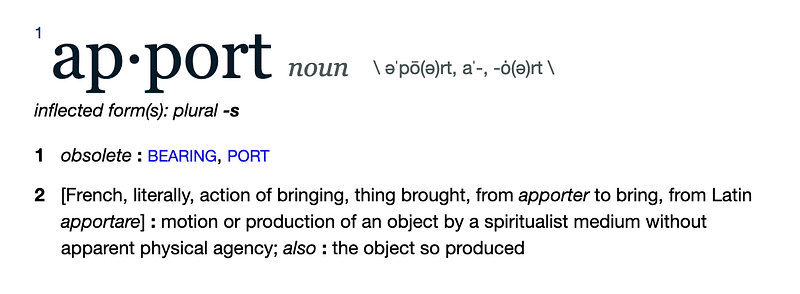
Silly little dictionary! Don’t you know apport can’t possibly be a word if the New York Times says it ain’t?
For further fascinating facts, check out the Spelling Bee Master.
What’s your favorite dord* from today’s puzzle?
My Two Cents
Just in time for April 1st, the Spelling Bee decided to help us out… by rejecting just the right word. Well, to be honest, there were plenty of interesting words not deemed good enough to be included: rotograph, apograph, troppo, paraph, and a favorite of mine: aphtha (commonly called “canker sore”).
But none of the words just listed has to do with tricking people, which is what April Fool’s Day is all about.
Some trivia here: In Spain and the Spanish-speaking American countries, December 28 is the day chosen to prank people. On that date people commemorate “el Día de los Santos Inocentes” (The Day of the Holy Innocents), on which date King Herod decreed that all male children be killed, in his quest to get rid of the newly born Jesus of Nazareth. This according to the gospel of Matthew, although there seems to be no historical evidence to support the decree or the killings.
It is odd, though, that this was the day designated to play jokes and hoaxes on other people.
Regarding April Fool’s, its origins are much murkier than those of the Holy Innocents. Some people blame Geoffrey “Jeff” Chaucer and his Canterbury Tales, in which he supposedly wrote of a rooster who gets tricked by a fox on March 32nd. But not everyone agrees he was referencing April 1st; it may have been a typo made by a transcriber.
Other rumors had the prankster day originating in France, the Netherlands, and Britain, all under very specific circumstances that don’t explain the celebration’s international appeal.
Harper’s Weekly cartoonist Bertha R. McDonald gave April Fool’s a biblical spin:
“Authorities gravely back with it to the time of Noah and the ark. The London Public Advertiser of March 13, 1769, printed: “The mistake of Noah sending the dove out of the ark before the water had abated, on the first day of April, and to perpetuate the memory of this deliverance it was thought proper, whoever forgot so remarkable a circumstance, to punish them by sending them upon some sleeveless errand similar to that ineffectual message upon which the bird was sent by the patriarch.”
Now, being that she was a cartoonist, and that she may have written this on April 1st, 1908, I’m not sure whether or not I should believe her.
As a New York Mets die-hard, I am well aware of the most infamous prank played on the team’s suffering fans in the April 1, 1985 edition of Sports Illustrated. The piece was written by none other than George Plimpton, and profiled a Sidd Finch, a young, unknown Mets prospect who could throw a baseball at 168 miles per hour. He also had a penchant for pitching with one bare foot, and playing the French horn.

Mets fans were furious when their hopes of another franchise pitcher were dashed against the mound once the gag was revealed in all its glory.
Today, we would all just collectively shrug, knowing that even if he did exist, he would probably need Tommy John Surgery two weeks into the season, which would sideline him for the next three years. After that, he would sign a multi-year deal with the Yankees and win eight World Series in just under five years.
Now you see the séance; now you don’t!
The word séance comes from the French “session”, from the Old French seoir, “to sit”. No mention of the term “scam”, which certainly was happening a lot when stage and social séances rose in popularity in the 18th and 19th centuries.
Here is a cool picture from an 1872 séance conducted by John Beattie in Bristol, England.
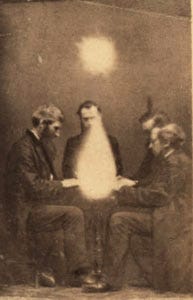
One of the popular tricks was the apport, today’s protagonist word. Also from the French, this time the Middle one and its word aport, from Old French, aporter, “to bring”, and this from the Latin apportare, with the same meaning.
Basically, an apport is the paranormal transference of an object from one place to the other, most often from the ether to our world. So far, most séance apports have been proven to be frauds, and no medium or psychic has yet to unfailingly demonstrate beyond a shadow of a doubt that they can apport under scientific scrutiny.
That’s right, apport is also a verb. You can apport an apport.
Unfortunately, James Randi, the magician and skeptic who always kept paranormal and pseudoscientific scammers in check, passed away last October.
For more than forty years, Randi and the James Randi Educational Foundation offered a $1 million prize to anyone who could show, “under proper observing conditions, evidence of any paranormal, supernatural, or occult power.”
And for over forty years, no one was able to claim the prize (now no longer offered).
No word on who has taken Randi’s place as the ultimate unmasker of fraudsters and con artists.
Too taxing to discuss
The term apport is also used to refer to a type of tribute paid in Medieval times. I didn’t really feel like looking into this in detail, because I’m tired, it’s April Fool’s, and I’m tired. (If anyone has any knowledge about that usage of the word, feel free to comment about it in the commenting about it section.)
Instead, here’s a link to something much more interesting. A list of some of 2019’s April Fool internet hoaxes and pranks.
In any case, today, April 1st, you may play pranks and jests and jokes and hoaxes on the people you love… and those you hate, too, if you wish. (Although hating people can be a waste of your time, in my experience.)
What you can’t do is use an apport to trick anyone, because the editors of the Spelling Bee puzzle decided that apport is a dord.*
You can check out my previous entry on another dord* here:
*What the heck is a dord, you ask? Here’s the answer: