
avatarAndrew Zuo

Free AI web copilot to create summaries, insights and extended knowledge, download it at here

4835

Abstract

Apple in a precarious position. Markets evolve, consumer preferences shift, and technologies become outdated. As we’ve seen time and time again, what’s popular today may not hold the same allure tomorrow.</p><p id="f291">This lack of diversification not only stifles Apple’s potential for growth but also exposes them to vulnerability. A single misstep, a sudden market shift, or a technological disruption could send shockwaves through Apple’s revenue streams. It’s akin to putting all your eggs in one basket and hoping that nothing goes wrong.</p><p id="bdba">Now I’m not saying Apple is doomed. Even if their profits dropped 85% they’ll still be fine. And, realistically, it’s not going to drop 85%. It’s going to drop like 5%. Apple will do fine. But I’m just very disappointed that Apple has not really diversified under Tim Cook.</p><p id="a0d4">Now part of this is not Apple’s fault. The reason they make so much money from the iPhone is because it’s the low hanging fruit. Everyone has a phone so you can sell a lot of them. If Apple were to instead focus on pro devices they may be able to make more money on each sale, but they’ll also sell a lot less of them.</p><p id="961b">But I do fault Tim Cook for not trying to at least pursue other revenue avenues like cloud computing.</p><div id="acea" class="link-block"> <a href="https://readmedium.com/apple-is-being-left-behind-in-the-serverless-wars-177f2c5fd5dc"> <div> <div> <h2>Apple Is Being Left Behind In The Serverless Wars</h2> <div><h3>Everyone’s talking about Apple’s alleged AR headset. Yes, even I am talking about it.</h3></div> <div><p>medium.com</p></div> </div> <div> <div style="background-image: url(https://miro.readmedium.com/v2/resize:fit:320/0*Y2r5oO_pDZnsTJP7)"></div> </div> </div> </a> </div><p id="b1ee">While competitors like Amazon and Google have diversified their businesses by expanding into cloud services, smart home devices, and even space exploration, Apple has remained largely confined to its existing ecosystem. It’s as if they’re content with their slice of the pie, neglecting the broader landscape of opportunities that lie beyond.</p><p id="c3e1">In my opinion Apple focuses way too much on their existing products. They’re trying to invent ways to squeeze out more and more money from them. The iPad isn’t enough, you need an iPad Pro now. The Apple Watch isn’t enough, you need an Apple Watch Ultra. Even the iPhone has been getting more expensive. They’re trying to squeeze blood from a stone. One has to wonder: how much more will their customers put up with?</p><p id="a681">And because they’re not diversified Apple’s reliance on the iPhone ecosystem can have ripple effects on their overall brand perception. If the iPhone were to lose its shine or face negative public sentiment, it could tarnish the perception of the entire Apple brand. Diversification would allow Apple to mitigate such risks by creating a more balanced and resilient brand image that transcends the success or failure of a single product.</p><p id="228e">Imagine if Apple had taken bold steps to diversify into areas like electric vehicles, healthcare technology, or renewable energy. These are sectors ripe for disruption, where Apple’s expertise in design, user experience, and integration could have made a substantial impact. Instead, they have chosen to play it safe, treading familiar territory rather than venturing into uncharted waters.</p><p id="1fef">Now there was an attempt at automotive disruption. But they scaled down their efforts for whatever reason.</p><div id="0e87" class="link-block"> <a href="https://readmedium.com/who-killed-the-apple-car-c97c32bf5172"> <div> <div> <h2>Who Killed The Apple Car?</h2> <div><h3>Picture this: It’s 2014, and rumours are swirling around the tech industry that Apple is working on a secret car…</h3></div> <div><p>medium.com</p></div> </div> <div> <div style="background-image: url(https://miro.readmedium.com/v2/resize:fit:320/0*KUSnvbsbqwT0U3Hw)"></div> </div> </div> </a> </div><p id="2ee7">I think they’re going too slow. When did Apple announce CarPlay 2? WWDC 2022. So where is it? What is Apple’s timeline? When will they release an actual self driving product? 2030? That’s way too late.</p><p id="f9d3">One could argue that Apple’s focus on refining its existing product lines is a testament to their commitment to excellence. I don’t think so. Who could forget the quantity vs quality pots story?</p><blockquote id="3f4f"><p>The ceramics teacher

Options

announced on opening day that he was dividing the class into two groups. All those on the left side of the studio, he said, would be graded solely on the quantity of work they produced, all those on the right solely on its quality. His procedure was simple: on the final day of class he would bring in his bathroom scales and weigh the work of the “quantity” group: fifty pound of pots rated an “A”, forty pounds a “B”, and so on. Those being graded on “quality”, however, needed to produce only one pot — albeit a perfect one — to get an “A”.

Well, came grading time and a curious fact emerged: the works of highest quality were all produced by the group being graded for quantity. It seems that while the “quantity” group was busily churning out piles of work — and learning from their mistakes — the “quality” group had sat theorizing about perfection, and in the end had little more to show for their efforts than grandiose theories and a pile of dead clay.</p></blockquote><div id="f79e" class="link-block"> <a href="https://blog.codinghorror.com/quantity-always-trumps-quality/"> <div> <div> <h2>Quantity Always Trumps Quality</h2> <div><h3>Nathan Bowers pointed me to this five year old Cool Tools entry on the book Art & Fear.</h3></div> <div><p>blog.codinghorror.com</p></div> </div> <div> <div style="background-image: url(https://miro.readmedium.com/v2/resize:fit:320/0*lx8mFdiHc8HbuUok)"></div> </div> </div> </a> </div><p id="b232">This story is a little too perfect, but it illustrates that quantity and quality are not mutually exclusive. In fact exploring new markets and industries often necessitates pushing boundaries, thinking outside the box, and fostering a culture of experimentation. Look at all the AI features the Pixel is getting. Do you think they could do that if Google didn’t invest heavily in AI? Maybe some, but not all.</p><h2 id="c9dd">Conclusion</h2><p id="68c6">Apple is the most valuable company in the world right now. And to be honest I think they’re a little overvalued. Sure, they make a lot of money, but most of it comes from a single product. A single product that has flatlined and, to be honest, isn’t even that competitive.</p><p id="7d27">I have to wonder how much longer is Apple going to stay number 1. Now it could be argued that Apple is incredibly innovative. Which is true. They invented Animojis, the Dynamic Island (even though I hate it)</p><div id="6502" class="link-block"> <a href="https://andrewzuo.com/stop-trying-to-make-dynamic-island-happen-8a72813ecd4f"> <div> <div> <h2>Stop Trying To Make Dynamic Island Happen</h2> <div><h3>A while ago I wrote about the iPhone 14’s dynamic island.</h3></div> <div><p>andrewzuo.com</p></div> </div> <div> <div style="background-image: url(https://miro.readmedium.com/v2/resize:fit:320/0*cx2tiLormLio5u7D)"></div> </div> </div> </a> </div><p id="7d0c">and the whole swiping navigation gesture system. But all these innovations are more evolutionary than revolutionary. And they’re easily copied.</p><p id="7822">To overcome the challenges of an ever-changing market, Apple must break free from the constraints of its iPhone-centric approach and embrace a broader vision that encompasses bold ventures and meaningful expansion beyond their core offerings. Anything less is setting them up for disaster.</p><p id="be30">If you liked this article consider following me on one of my publications: <a href="https://medium.com/lost-but-coding">Lost But Coding</a> (for programming content) or <a href="https://medium.com/the-rest-of-the-story">The Rest Of The Story</a> (for everything else). You can do so with my RSS reader available on <a href="https://apps.apple.com/us/app/id6445805598?platform=iphone">iOS (and Apple Silicon Macs)</a> and <a href="https://play.google.com/store/apps/details?id=com.amorfatite.keystone">Android</a>.</p><div id="d0d6" class="link-block"> <a href="https://andrewzuo.com/membership"> <div> <div> <h2>Join Medium with my referral link - Andrew Zuo</h2> <div><h3>Read every story from Andrew Zuo (and thousands of other writers on Medium). Your membership fee directly supports…</h3></div> <div><p>andrewzuo.com</p></div> </div> <div> <div style="background-image: url(https://miro.readmedium.com/v2/resize:fit:320/0*5tLe6O_rdF2TskHF)"></div> </div> </div> </a> </div></article></body>

Photo by Alex Belogub on Unsplash

Apple Is Setting Themselves Up For A Disaster

I’m looking at Apple’s financial data and I have mixed thoughts. Sure, they’re a 2.7 trillion dollar company. And it looks like they’re doing pretty well. But then you dig into their financials and there’s this table that I find incredibly worrying.
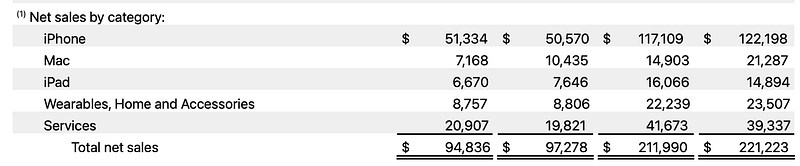
51 billion dollars in iPhone sales. 7 billion in Mac sales. 6 billion iPad. 8 billion wearable/home/accessory. And 20 billion services. So that means 54% of Apple’s sales come from the iPhone. More than half.

And it gets even worse. Who do you think are buying Apple accessories: the Apple watch and Airpods? Just random people? No, it’s iPhone buyers. So if we consider wearables and services as iPhone-related we get that 85% of Apple’s money comes from iPhone and iPhone-related products.

If Apple made really great phones then I wouldn’t be that worried. But I’ve complained about the iPhone a lot before. I just don’t think it’s that competitive with what’s out there.

Wouldn’t it just be a shame if some other OEM somehow snuck in there with an explosive 230% YoY growth?

Relying so heavily on a single product puts Apple in a precarious position. Markets evolve, consumer preferences shift, and technologies become outdated. As we’ve seen time and time again, what’s popular today may not hold the same allure tomorrow.

This lack of diversification not only stifles Apple’s potential for growth but also exposes them to vulnerability. A single misstep, a sudden market shift, or a technological disruption could send shockwaves through Apple’s revenue streams. It’s akin to putting all your eggs in one basket and hoping that nothing goes wrong.

Now I’m not saying Apple is doomed. Even if their profits dropped 85% they’ll still be fine. And, realistically, it’s not going to drop 85%. It’s going to drop like 5%. Apple will do fine. But I’m just very disappointed that Apple has not really diversified under Tim Cook.

Now part of this is not Apple’s fault. The reason they make so much money from the iPhone is because it’s the low hanging fruit. Everyone has a phone so you can sell a lot of them. If Apple were to instead focus on pro devices they may be able to make more money on each sale, but they’ll also sell a lot less of them.

But I do fault Tim Cook for not trying to at least pursue other revenue avenues like cloud computing.

While competitors like Amazon and Google have diversified their businesses by expanding into cloud services, smart home devices, and even space exploration, Apple has remained largely confined to its existing ecosystem. It’s as if they’re content with their slice of the pie, neglecting the broader landscape of opportunities that lie beyond.

In my opinion Apple focuses way too much on their existing products. They’re trying to invent ways to squeeze out more and more money from them. The iPad isn’t enough, you need an iPad Pro now. The Apple Watch isn’t enough, you need an Apple Watch Ultra. Even the iPhone has been getting more expensive. They’re trying to squeeze blood from a stone. One has to wonder: how much more will their customers put up with?

And because they’re not diversified Apple’s reliance on the iPhone ecosystem can have ripple effects on their overall brand perception. If the iPhone were to lose its shine or face negative public sentiment, it could tarnish the perception of the entire Apple brand. Diversification would allow Apple to mitigate such risks by creating a more balanced and resilient brand image that transcends the success or failure of a single product.

Imagine if Apple had taken bold steps to diversify into areas like electric vehicles, healthcare technology, or renewable energy. These are sectors ripe for disruption, where Apple’s expertise in design, user experience, and integration could have made a substantial impact. Instead, they have chosen to play it safe, treading familiar territory rather than venturing into uncharted waters.

Now there was an attempt at automotive disruption. But they scaled down their efforts for whatever reason.

I think they’re going too slow. When did Apple announce CarPlay 2? WWDC 2022. So where is it? What is Apple’s timeline? When will they release an actual self driving product? 2030? That’s way too late.

One could argue that Apple’s focus on refining its existing product lines is a testament to their commitment to excellence. I don’t think so. Who could forget the quantity vs quality pots story?

The ceramics teacher announced on opening day that he was dividing the class into two groups. All those on the left side of the studio, he said, would be graded solely on the quantity of work they produced, all those on the right solely on its quality. His procedure was simple: on the final day of class he would bring in his bathroom scales and weigh the work of the “quantity” group: fifty pound of pots rated an “A”, forty pounds a “B”, and so on. Those being graded on “quality”, however, needed to produce only one pot — albeit a perfect one — to get an “A”. Well, came grading time and a curious fact emerged: the works of highest quality were all produced by the group being graded for quantity. It seems that while the “quantity” group was busily churning out piles of work — and learning from their mistakes — the “quality” group had sat theorizing about perfection, and in the end had little more to show for their efforts than grandiose theories and a pile of dead clay.

This story is a little too perfect, but it illustrates that quantity and quality are not mutually exclusive. In fact exploring new markets and industries often necessitates pushing boundaries, thinking outside the box, and fostering a culture of experimentation. Look at all the AI features the Pixel is getting. Do you think they could do that if Google didn’t invest heavily in AI? Maybe some, but not all.

Conclusion

Apple is the most valuable company in the world right now. And to be honest I think they’re a little overvalued. Sure, they make a lot of money, but most of it comes from a single product. A single product that has flatlined and, to be honest, isn’t even that competitive.

I have to wonder how much longer is Apple going to stay number 1. Now it could be argued that Apple is incredibly innovative. Which is true. They invented Animojis, the Dynamic Island (even though I hate it)

and the whole swiping navigation gesture system. But all these innovations are more evolutionary than revolutionary. And they’re easily copied.

To overcome the challenges of an ever-changing market, Apple must break free from the constraints of its iPhone-centric approach and embrace a broader vision that encompasses bold ventures and meaningful expansion beyond their core offerings. Anything less is setting them up for disaster.

If you liked this article consider following me on one of my publications: Lost But Coding (for programming content) or The Rest Of The Story (for everything else). You can do so with my RSS reader available on iOS (and Apple Silicon Macs) and Android.

Apple
Innovation
Apple Innovation
Recommended from ReadMedium