
Apophony
a, e, i, o, u… and sometimes y

Today’s New York Times Spelling Bee letters:
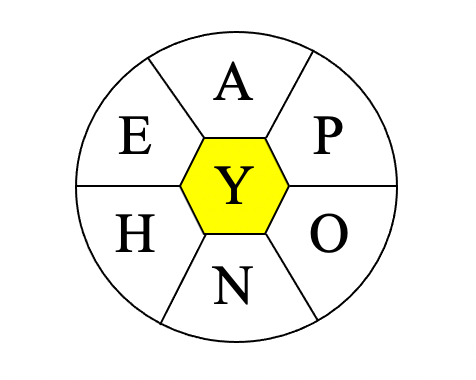
A, E, H, N, O, P, and center Y (all words must include Y)
Merriam-Webster says…
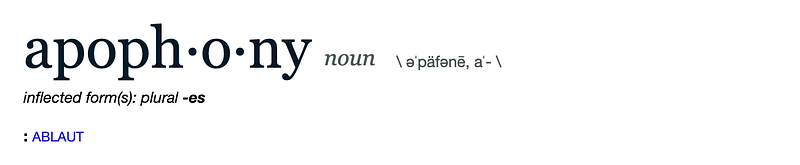
Silly little dictionary! Don’t you know that apophony can’t possibly be a word if the New York Times says it ain’t?
For further fascinating facts, check out the Spelling Bee Master.
What’s your favorite dord* from today’s puzzle?
My Two Cents
What is this ablaut that the dictionary uses to frugally define apophony? It seems that our friends at Merriam-Webster have been playing us for a bit of click-bait yesterday and today. As usual, though, I’ll bite. Ablaut is defined as:
a systematic variation of vowels in the same root or affix or in related roots or affixes in the Indo-European languages usually paralleled by differences in use or meaning (as sing, sang, sung, song;… a similar variation in any language or language family.
Turns out, there are a lot of similar variations in many languages.
Mutant words
I don’t know about you, but I didn’t find the dictionary’s definition of ablaut very helpful. I did like the more succinct and direct explanation given by Wikipedia at the beginning of its article. Apophony is “any sound change within a word that indicates grammatical information (often inflectional).”
Furthermore, according to some very cunning linguists, ablaut is a type of apophony, one typical in Indo-European languages. So technically speaking, defining apophony as an ablaut would be incorrect, since there are other types of apophony. Remember that old explanation about the differences between a rectangle and a square? “All squares are rectangles, but not all rectangles are squares”.
Hmmm… maybe I need to write to my friends at Merriam-Webster about this.
In English, the apophony is most commonly seen in vowel changes indicating verb tense or plurality. The classic example used is with the noun song.
▹ song (noun)
▹ sing (verb; both the infinitive form and the first- and second-person singular)
▹ sang (simple past tense)
▹ sung (past participle)
By changing just one vowel, you are changing the information given to the listener or reader. This works with some plurals, too, especially with words that came via German and had an umlaut that language:
▹ tooth → teeth
▹ goose → geese
▹ foot → feet
Moose, by the way, is a word borrowed from the Algonquian language. Now you know why the plural of moose isn’t meese.
English also has words that use consonant apophony. You can change the meaning of certain words by changing the pronunciation of the consonant that follows a vowel. (The evolution of this has resulted in different spellings for the pairs of apophonetic words.)
For example, the noun advice becomes the verb advise when the softer “ess” sound of the letter “c” becomes a harder “z” sound, now spelled as an “s”. The noun gift and the verb give work in a similar way.
English pronunciation is tough to learn; perhaps this is one of the reasons. Here’s another reason: some words in English require context in order to determine their pronunciation. Take read. In your mind, did you pronounce it like “reed” or “red”? Both are correct, but the former is the present-tense form while the latter is the past tense. There is no way of knowing which tense is being used unless you see the word in a sentence. (Most people instinctively think “reed”.) In this case, the apophony of read cannot be expressed in writing.
Neither can the apophony of the word use. Did you read this in your mind as “yooz”? That’s the verb. The noun is pronounced as the softer “yooce”. Again, only context can let you know which way you should say it.
Similar cases happen in Hebrew and Spanish, but in Spanish the pronunciation does not change, meaning the words are homonyms in the strictest sense. For example, the word siento can mean “I feel” or be the singular first-person present-tense conjugation of “to sit”.
Apophony may also involve other types of alternations. Changes in prosodic elements (tone, syllable length, stress) can be seen in Vietnamese, Albanian, and even English. When you change the stress from the first syllable to the second one, insult transforms from a noun to a verb.
Chinese and other East Asian languages famously have tonal apophony. One syllable or word can mean completely different things depending on the “tone contour” the speaker gives it. This goes beyond the intonation used in English (for example) to indicate a word is a question or an exclamation. Right? Right!
Typoglycemia
Apophony has some practical uses. Among them, economy of words and ease of understanding. Remember song, sing, sang, sung? You’ve basically assigned a meaning to a word formed by three consonants: s-n-g. Those three consonants have the same basic relationship (song-related), while the vowels allow you to change the meanings for specific instances (noun, present tense verb, past tense verb). Imagine if song was the noun, dorth was the verb in present tense, and vartenied was the past participle. Instead of saying “I sing the song that was sung yesterday” you’d utter “I dorth the song that was vartenied yesterday”.
Kinda weird, right? Right! Right…
Remember this famous email/meme from years ago?
Aoccdrnig to a rscheearch at Cmabrigde Uinervtisy, it deosn’t mttaer in waht oredr the ltteers in a wrod are, the olny iprmoetnt tihng is taht the frist and lsat ltteer be at the rghit pclae. The rset can be a toatl mses and you can sitll raed it wouthit a porbelm. Tihs is bcuseae the huamn mnid deos not raed ervey lteter by istlef, but the wrod as a wlohe.
(According to a researcher at Cambridge University, it doesn’t matter in what order the letters in a word are, the only important thing is that the first and last letter be at the right place. The rest can be a total mess and you can still read it without a problem. This is because the human mind does not read every letter by itself but the word as a whole.)
The phenomenon coined the portmanteau typoglycemia. Formed from combining the words “typo” and “hypoglycemia” (low blood sugar), it refers to the ability of readers to understand a text even if that text has spelling errors and misplaced letters in the words.
This took the internet by storm for a while, and pops up again every now and then. (Social media is the perfect environment for senile dementia, as we recycle the same jokes again and again… and laugh at them again and again.)
By the way, the first sentence is completely false. There was no researcher at Cambridge who established this theory. The two strongest possibilities for the origin of the email / meme are (1) a letter from Graham Rawlinson of the University of Nottingham to New Scientist in 1999. In that letter, Rawlinson discusses his 1976 Ph.D. thesis. (2) the research of Thomas R. Jordan’s group on the relative influences of the exterior and interior letters of words.
So, is what the meme describes true? Does that actually happen? Yes… and no.
At a basic level it does. If you speak English well enough, you were probably able to read that paragraph and understand what it said. However, when you mix letters at a more complex level than the way they were jumbled in the meme, it gets harder and harder. Look at these three examples:
- A vheclie epxledod at a plocie cehckipont near the UN haduqertares in Bagahdd on Mnoday kilinlg the bmober and an Irqai polcie offceir.
Pretty easy, right? “A vehicle exploded at a police checkpoint near the UN headquarters in Baghdad on Monday killing the bomber and an Iraqi police officer.”
2. Big ccunoil tax ineesacrs tihs yaer hvae seezueqd the inmcoes of mnay pneosenirs.
Harder. Can you figure it out? “Big council tax increases this year have squeezed the incomes of many pensioners.”
3. A dootcr has aimttded the magltheuansr of a tageene ceacnr pintaet who deid aetfr a hatospil durg blendur.
This one is a real brain-twister. “A doctor has admitted the manslaughter of a teenage cancer patient who died after a hospital drug blunder.”
So what’s the difference between the three sentences? They all follow the premise stated by the internet meme that “the only important thing is that the first and last letter be at the right place. The rest can be a total mess.” And the first sentence above has a similar “jumble level” as the paragraph in the meme. That’s why you could read and understand it.
But in the second and third sentences, the words are mixed-up in more “extreme” way. Letters that were close to each other aren’t just flipped, they are separated and placed at opposite ends. For example: vehicle is “vheclie” in the first sentence. But “vlieche” and “vicelhe” are harder to connect to the original word.
I took the example sentence from the article below, which gives a more thorough explanation of typoglycemia and its limits.
Wlel, t’htas it for tdaoy. Tihs eednd up bieng a longer atricle than I extecepd, but I hoped you ejenoyd it! Now I’ll end wtih my usaul rnat:
Despite the fact that billions of people speaking hundreds of languages use apophony on a daily basis, the editors of the Spelling Bee still had the chutzpah to decide that apophony was a dord.*
You can check out my previous entry on another dord* here:
*What the heck is a dord, you ask? Here’s the answer: