
Annuitant
Despite that yearly payment you receive, the Spelling Bee shows you no love

Today’s New York Times Spelling Bee letters:
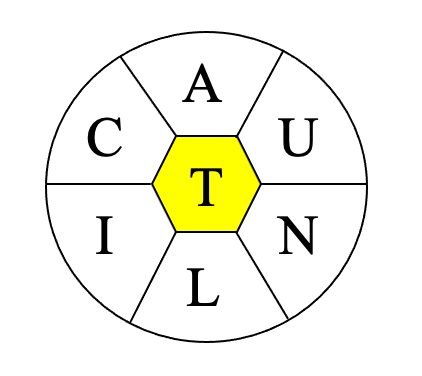
A, C, I, L, N, U, and center T (all words must include T)
Merriam-Webster says…
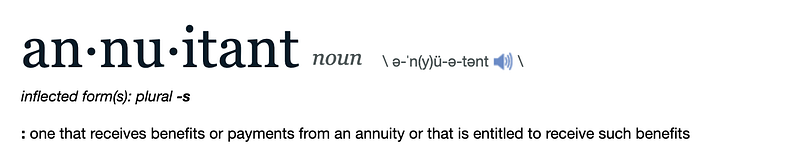
Silly little dictionary! Don’t you know annuitant can’t possibly be a word if the New York Times says it ain’t?
For further fascinating facts, check out the Spelling Bee Master.
What’s your favorite dord* from today’s puzzle?
My Two Cents
What does the photo at the top of today’s column have to do with annuitants? Not much, unless the old person is one. But my search on Unsplash was not yielding many results until I typed in “retirement”. When I came across this picture, it caught my eye. I love the details this close-up affords us: the worn armrest, the old-fashioned remote control, the wrinkly, veiny, knobby hand gently placed on top of it.
Set for life?
The word annuitant comes from the combination of annuity + the suffix -ant, meaning “person or thing connected with”.
The term is also used to refer to a retired person that has been rehired by United States Federal and State agencies without the loss of their retirement benefits. This has been done on a regular basis since 2000, and these “rehires” can usually work only a certain number of hours per year.
Our friends at Merriam-Webster define annuity as:
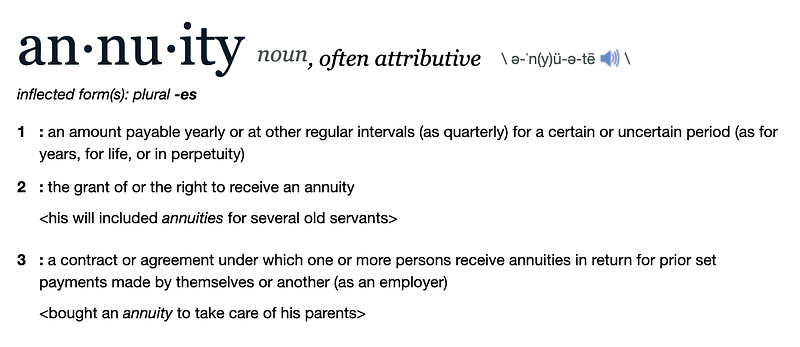
Now, what the dictionary doesn’t mention is that today most annuities are a result of a contract with an insurance company. As Wall Street Mojo explains:
Annuity refers to the contract for receiving the regular payments after a certain period of time from an insurance company as per the agreement/contract entered whereas Pension is fixed benefit received on monthly basis on retirement where an employee has contributed to pension fund maintained by employer during his term of employment. Annuities are insurance products designed to provide investors with an income stream. There are annuities which also include offer death benefits and provides the beneficiaries with the pre-decided amount in case of sudden death before the end of the tenure. Annuities can be brought with the money held in the taxable account. Annuities can be jointly owned. The pension fund is a pool of money contributed by the employer. This money is then invested and paid to the employees whose-ratio retire. This payment from the employers is termed as Pension.
The evolution of annuities has a lot to do with actuarial science, which applies mathematical and statistical methods to assess risk in insurance, finance, and other industries and professions. This includes the risk of death and continued life expectancy.
The Roman jurist Ulpian is credited with generating one of the first actuarial life annuity tables between AD 211 and 222. Here he is, making his famous “I will decide when you die” face.

And here is his famous life table. I must admit that even after reading about it, I’m not exactly sure what he was doing.
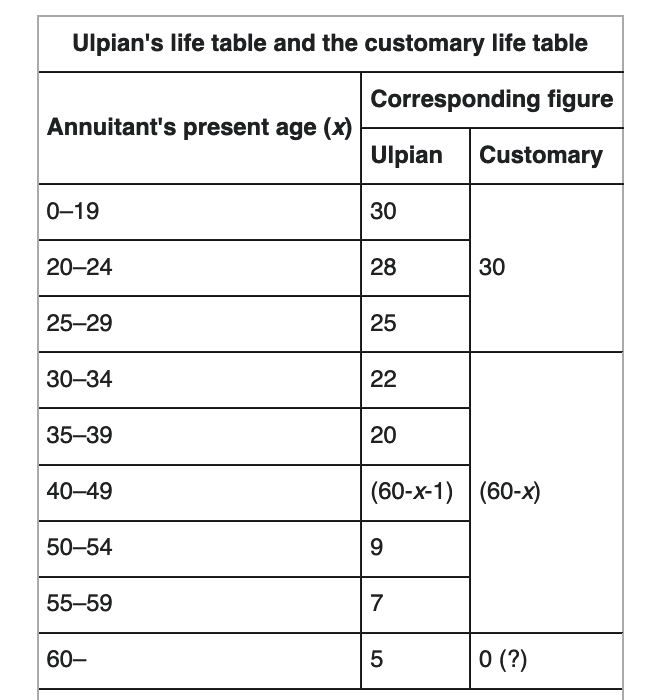
According to Wikipedia, “The age of the legatee is checked against the table; the figure recorded on the table is multiplied by annuity’s annual value. Five percent of this last figure is what is owed in tax.”
And here’s an actuarial table from 2003. Not only do I not understand it, I can’t even read it!

I need to have yet another chat with my screenshotter.
Death and taxes
These are the only two things that are certain, as per what Benjamin Franklin wrote to Jean-Baptiste LeRoy in 1789: “Our new Constitution is now established, and has an appearance that promises permanency; but in this world nothing can be said to be certain, except death and taxes.”
This was not the first recorded use of this phrase, although it may be the one most commonly quoted.
Now, Franklin was clearly not aware of vampires or zombies when he wrote that letter to his 18th-century French physicist friend. That’s not old Ben’s fault, though; he died one hundred years before Bram Stoker’s Dracula was published and more than two hundred years before The Walking Dead comic book series came out.
Ben Franklin lived to the ripe old age of 84 during a century (the 18th) in which life expectancy in the American colonies was about 28 years of age.
Wait, say what? Was Franklin actually a vampire… pretending to know nothing about vampires? Maybe that’s why he looked so pale and didn’t die that time he got hit by lightning.
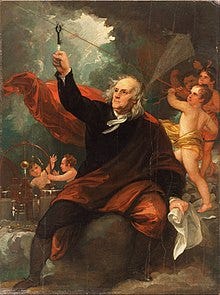
Turns out Ben just beat the odds when he was a kid. Once you survived childhood back then, the likelihood of reaching 50 or 60 years of age greatly increased and, if you did get to your sixth decade of life, you could easily expect to live another decade or two.
That’s why we hear of families having so many kids hundreds and even thousands of years ago. Franklin’s father had seventeen (!) children, ten of them with Franklin’s mom.
You see, “life expectancy” is one of those terms that’s constantly bandied about with a lot of misunderstanding. That’s why you constantly and casually hear how cavepeople died at age 30 and before modern medicine most humans lived only into their 50s.
When people say that, they are perhaps thinking of life span, the actual measure of how long someone existed. Life expectancy is the estimated number of years a person is supposed to live based on the year and location where said person was born.
During most of human history, very high rates of infant mortality (deaths before 1 year of age) and child mortality (deaths before 5 years of age) tremendously skewed the average age of death. Think of it this way: let’s say in one family there were four children born; one died at birth, one died at age 4, one lived to be 60 years of age, and one passed away at age 84, like Ben Franklin the non-vampire. The average age of death is their combined ages — 0 + 4 + 60 + 84 — divided by 4, which is 37. Now, that is not how life expectancy is calculated (its formula is more complex), but it gives you an idea of how strong the effect of dying really young can be.
However, in many societies across history, once you reached a certain adult age, you could be expected to live a few more decades, at least. This was the case even with early humans in the Paleolithic and Neolithic ages.
Today we’ve come a long way, baby, as they say. You can clearly see this in the table below, which shows how life expectancy shot up in the early 20th century and continues to do so. Which is one of the reasons our planet has such a large population. Unfortunately, many countries in Africa still have high childhood mortality rates that, among other factors, keep them from being on par with the rest of the world.
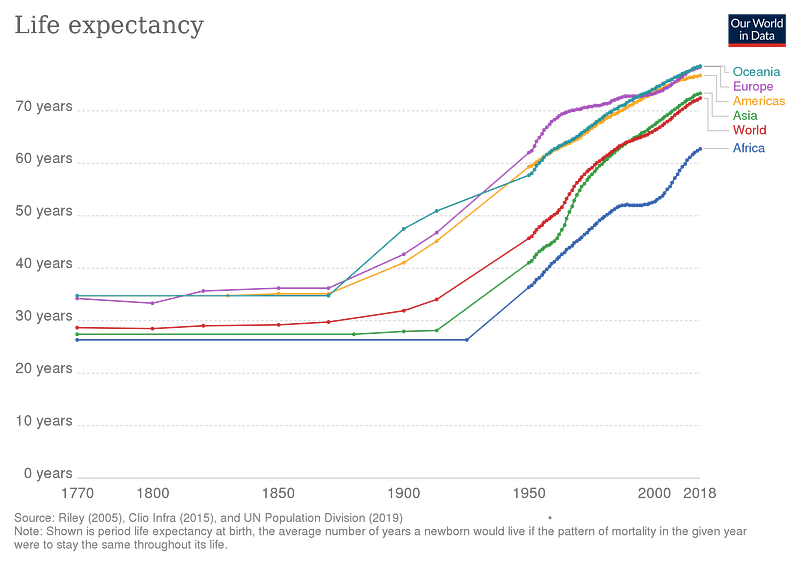
Please note, however, that this table does not account for the vampire population, which would greatly increase the overall numbers. Also, once the zombiepocalypse arrives, these statistics will completely get out of control. Imagine being an insurance company and having the undead as annuitants!
Now you know. If you receive a pension and are therefore a pensioner, you’ll be okay. But if you bought insurance and plan to get an annuity when you’re older, you may not even exist! And that’s because the editors of the Spelling Bee decided that annuitant is a dord*.
You can check out my previous entry on another dord* here:
*What the heck is a dord, you ask? Here’s the answer: