
Angry and messy. You’ll know a medium-sized black hole by its butcher’s marks
These hypothetical objects could be the key to many cosmological puzzles. They should exist, but have not been observed. However, we are beginning to guess how to look for them.
.jpg)
We know examples of “light” black holes a mass of a few Suns, which were formed by the collapse of a massive star as a result of a supernova explosion. We also know of supermassive black holes heavier than millions or even billions of Suns that form in the nuclei of galaxies. However, black holes in the range between 100–10,000 solar masses, are quite enigmatic. Previous knowledge of the formation and evolution of stars hints at the impossibility of a star so massive that, after an explosion, it transforms into a black hole with a mass of a few hundred Suns. New research led by Ph.D. student Fulya Kıroğlu, however, offers hope for the discovery of such black holes.
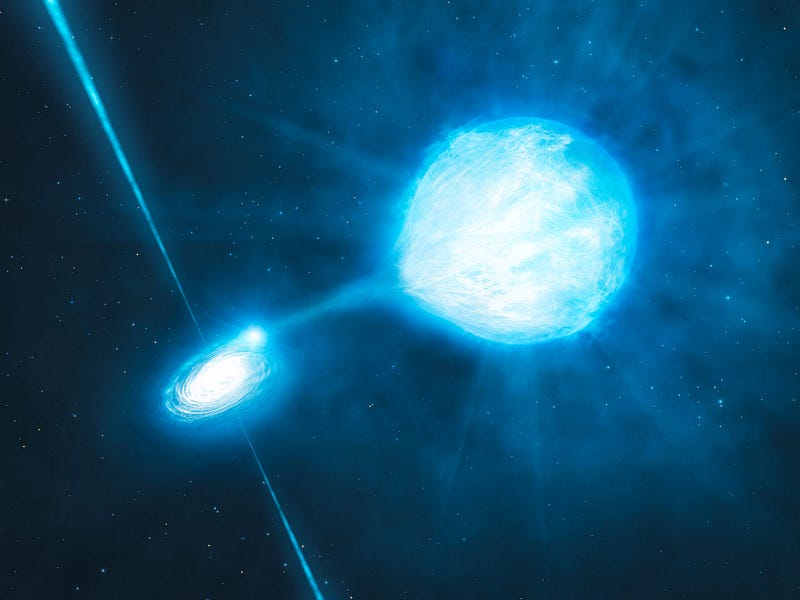
The researcher from Northwestern University in Illinois analyzed the effect of close contacts between moderately massive black holes and stars with the mass of the Sun. Simulations made with a program subtly named StarSmasher, or Star Destroyer, draw a rather dramatic picture: a star that hits close to a black hole is skinned and loses most of its mass. Before it has time to completely disintegrate, however, it flies off into space. During this time, the black hole continues to dine on the leftovers, and ejects the remnants of its meal in powerful jets.
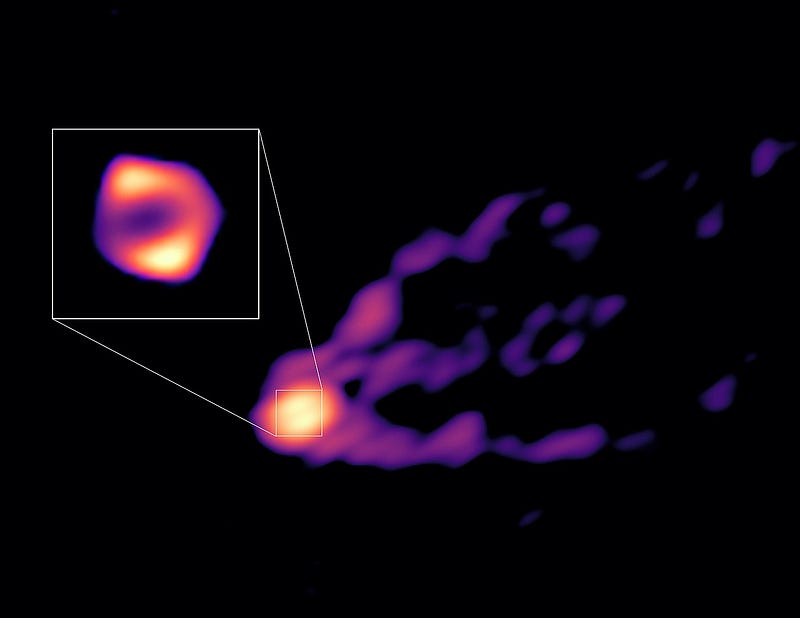
Jets, or superfast ejections of gas, are a direct consequence of matter falling on the black hole. However, since the amount of gas settling on it is much greater than it can absorb, much of it is ejected into space. Scientists first az observed simultaneously light from the immediate vicinity of the black hole and the jet ejected by it. The jet of gas ejected from the center of the M87 galaxy has long been known to scientists, but it is only now, thanks to the combined power of radio observatories, that it is possible to see exactly how the matter collected around the black hole is ejected at enormous speeds from its surroundings. An article on the subject was published in Nature.
I so far, simulations are the only way to “observe” moderately massive black holes. Imitating their behavior under gravity and analyzing the theoretical results of virtual collisions with other objects, however, allows us to understand how to discover them in space. From the research, which will be published in The Astrophysical Journal, we know, for example, that a star attracted by the mass of a black hole makes only a few laps in a spiral orbit around it. At each approach, it loses significant amounts of its mass, which falls into the black hole’s surroundings, emitting light. Each successive glow is brighter and brighter. This could be a distinctive signal to be found in casual observations of changes in the brightness of objects in the sky.
.jpg)
Another piece of information obtained by the study is that the star is ejected at a tremendous speed of several thousand kilometers per second (that’s ~1% of the speed of light). A superfast celestial body stripped of part of its envelope could therefore be evidence of a recent encounter with a moderately massive black hole. Moreover, the speed at which a star is ejected is proportional to the mass of the black hole, and this may allow even a rough estimate of its properties.
Just why look for average black holes? The thing is, they may be the key to another cosmic mystery. Giant black holes, weighing as much as billions of suns, have been observed in distant galaxies. Those that, like M87, are relatively close by (and thus are of similar age to our Galaxy), we can try to explain by gas feeding over billions of years, the effects of which, by the way, are still visible in spectacular jets (see box). Instead, it is much more difficult to explain their observation only a few hundred million years after the Big Bang. How could these monstrous objects have formed so quickly? The only known way seems to be the merger of multiple black holes with masses of several thousand solar masses. This theory could only be given credence by the detection of such objects.
Cool that you made it to the end of this article. I will be very pleased if you appreciate the effort of creating it and leave some claps here, or maybe even start following me. It would be nice if you also left a tip! Thank you!