
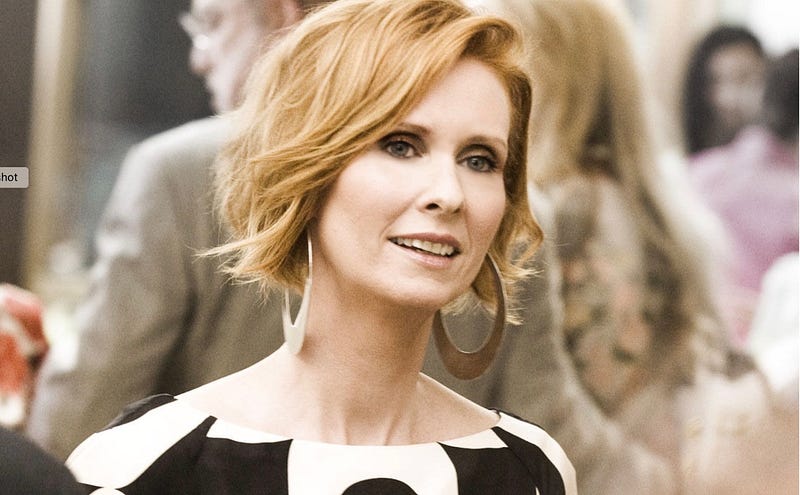
‘And Just Like That’s’ Miranda Deserves Better At Midlife, Too
Same-sex attractions later in life are not all that uncommon
If you’re been watching And Just Like That, which follows three of the four Sex and the City characters 20 years later, you know that Miranda, Carrie and Charlotte got everything they wanted in the first series — husbands.
But then life happens — Carrie’s Big dies of a heart attack and Miranda divorces Steve. To be with a woman (well, the nonbinary Che).
Wait, what?
After so many seasons watching the three women trying to find the right man (Samantha was the only one who just wanted men for sex, nothing more, although she did have a brief same-sex fling), why in the world would Miranda, played by Cynthia Nixon, leave Steve — whom Vogue calls SATC’s “last honorable man”?
Needless to say, fans are upset. Some are calling it a midlife crisis, but having a same-sex attraction at midlife is not all that uncommon.
Eat Pray Love devotees were shocked in 2016 when Elizabeth Gilbert became attracted to her best friend later in life, leaving her husband, José Nunes, aka “Felipe,” the love part of her memoir, for her. Around the same time that Gilbert was professing her love for Rayya, Glennon Doyle, author of the best-selling book Love Warrior among others, famously left her husband of 14 years and, a year later, married soccer icon and Olympian Abby Wambach.
Those are just two recent high-profile examples, but research shows that some 36 percent of women in their 40s in a same-sex relationship had been previously married to men. It’s higher for women in their 50s and older.
There wasn’t much research on the phenomenon until Nancy C. Larson’s 2006 “Becoming “One of the Girls,” in which she discovered that coming out at midlife — something she herself did after 19 years of marriage to a man — was a huge boost to women’s libido.
“[M]any women report feeling a “second adolescence,” with many of the associated feelings and behaviors. She is not crazy if she suddenly has sex on the brain all the time!”
Miranda is certainly experiencing that after many years of ho-hum sex with the likeable Steve.
Since then, more, mostly female, researchers have been exploring late-life same-sex attraction, most notably professor Lisa M. Diamond, who has found that women experience “sexual fluidity.” Often, that fluidity appears later in life.
As Diamond says:
“What we know about adult development suggests that people become more expansive in a number of ways as they get older. I think a lot of women, late in life, when they’re no longer worried about raising the kids, and when they’re looking back on their marriage and how satisfying it is, find an opportunity to take a second look at what they want and feel like.”
Nixon defends the show’s writers’ decision, saying
“Out of crises come really productive things. You’re not young anymore, but you’re not old, either. And you still have time to make sure that your life is the way you want it to be.”
Many fans insist Steve deserves better. At midlife, Miranda deserves to live a life that feels authentic to her.
Hey, I’ve written on a book on changing the narrative about middle-aged and older women, “Not Too Old For That: How Women Are Changing the Story of Aging” (April 2022). Pre-order it here and follow me on Medium, Twitter, Facebook and Instagram. If you want to support my work and have unlimited access to my writing and the writing of all Medium writers, please become a member here. And if you’re interested in individualizing your marriage, please check out the book I co-authored, The New I Do: Reshaping Marriage for Skeptics, Realists and Rebels. You can support your local indie bookstore (please do) or order it on Amazon. We’re also on Audible.
For more of the good stuff, follow Fourth Wave, where we’re changing the world for the better, one story at a time. Got one of your own? Submit to the Wave.


