
Ananym
siht drow sesrever gnihtyreve

Today’s New York Times Spelling Bee letters:
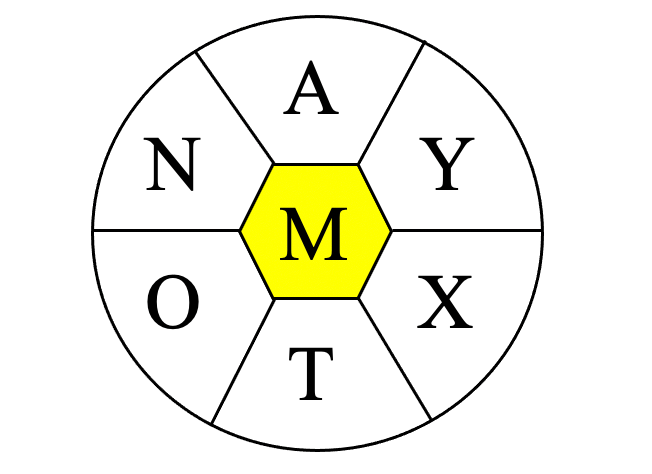
A, N, O, T, X, Y, and center M (all words must include M)
Merriam-Webster says…
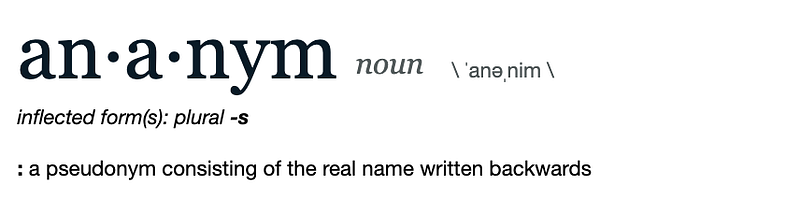
Silly little dictionary! Don’t you know that ananym can’t possibly be a word if the New York Times says it ain’t?
For further fascinating facts, check out the Spelling Bee Master.
What’s your favorite dord* from today’s puzzle?
My Two Cents
No, the subtitle to today’s article is not written in a foreign language, nor is it an incantation used by a little-known Marvel character coming soon to a theater near you. It’s just that each word has been ananymed. (I just coined the verb form, but I’m renouncing any copyright to it.) So, if you put each word in front of the mirror and transcribed it, you’d get:
This word reverses everything.
Speaking of mirrors, we here at Silly Little Dictionary! take ananym very seriously, as our not-so-esteemed screenshotter Iva Reztok can attest.
Who’s that writer?
Our friends at Merriam-Webster tell us that the first recorded use of ananym was around 1867, and that the word comes from joining the prefix ana- and the suffix -nym (as in anonym). This is a specific type of pseudonym, or pen name. Pseudonyms are temporary names, or aliases, that people choose to use for a variety of reasons. This is different from someone actually changing their name legally. Interesting fact: when you become a naturalized U.S. citizen, you are given a one-time free opportunity to legally change your name without a long drawn-out process.
Pseudonyms are used by people in different realms. Writers have often done so, yes, but so have popes, kings, and queens. Don’t believe me? Look up the list of popes and monarchs, and then check some of their “professional” names against the ones they were given at birth. Granted, this does not apply to Queen Elizabeth II, or her mother, called, um… Queen Elizabeth The Queen Mother.
Other pseudonyms include stage names, user names, nicknames, aliases, superhero or villain identities, and gamer IDs. Famous writers with pseudonyms include Samuel Clemens (Mark Twain), Charles Lutwidge Dodgson (Lewis Carroll), Ricardo Eliécer Neftalí Reyes Basoalto (Pablo Neruda), Alisa Zinovyevna Rosenbaum, a.k.a. Alice O’Connor (Ayn Rand), Chloe Ardelia Wofford (Toni Morrison), Mary Ann Evans (George Eliot), and Stephen King (Richard Bachman). Of these, Neruda ended up changing his name legally.
Ananyms are both a specific kind of pseudonym and a specific kind of anagram. You might remember that an anagram is defined as “the word or phrase made by transposing the letters of another word or phrase”. Before twitter, Facebook, Insta, and TikTok, when email ruled social media, there was one circulating around with a list of anagrams based on the names of celebrities. A few clever ones were:
- Clint Eastwood… Old West Action
- Justin Timberlake… I’m a Jerk, But Listen
- David Letterman… Nerd Amid Late TV
- Alec Guinness… Genuine Class
- William Shakespeare… I’ll make a wise phrase.
Anagrams aren’t limited to people’s names, however. The phrase “husband and wife” can be anagrammed to “fun was had in bed”, and “the eyes” can be transformed into “they see”.
Ananyms are “mirror anagrams”; basically the letters are reversed in order to create a new name or word. In the latter case, they are also known as anadromes. For example, ohm, the unit of electrical resistance, has a reciprocal unit called the siemens that is also known as the mho. Ex-Red Sox shortstop Nomar Garciaparra owes his first name (which is actually his middle name) to an ananym of the name of his father Ramon.
Oprah and prime numbers
Perhaps one of the best known ananyms (at least in the U.S.) is, Harpo, Inc, Oprah Winfrey’s media and entertainment company founded in 1986 in Chicago, Illinois. How old were you when you realized this clever logo that appeared at the end of the Oprah Winfrey show was her first name spelled backwards?
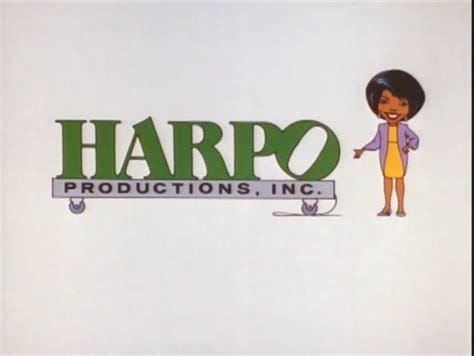
By the way, Oprah is a pseudonym of sorts. Her given first name at birth was Orpah, after the biblical figure in the book of Ruth. But people kept mispronouncing it, and the mispronunciation stuck.
Harpo, Inc. has one subsidiary, Harpo Productions, whose divisions included Harpo Print (responsible for the now-defunct O magazine) and the Oprah Winfrey Network (OWN), which today I found out replaced the Discovery Health Channel on January 1st, 2011.
What do Oprah and prime numbers have in common?
Well, prime numbers also have their ananyms. They are called emirps, and are a specific type of prime number that, when their digits are reversed, also produce a prime number. The first emirp is 13 (31 is also prime), which happens to be my favorite number, superstitions be damned! The sequence of emirps continues with 17, 31, 37, 71, 73, 79, 97, 107, 113, 149, 157, 167, 179, and 199. (There are tons more, but I’m not going to list them all.)
Emirps do not include the palindromic primes, which are prime numbers that can be read the same way from left to right as from right to left. For example, 11, 101, 131, and 151. Obviously these are primes either way because the number remains the same. What makes emirps special is that they are not palindromic. To date, the largest emirp is…

…discovered by Jens Kruse Andersen in October of 2007. I posted a screenshot of the number because I can’t figure out how to create superscripts on Medium. So, if I copied and pasted the number above, you’d see this… 1010006+941992101×104999+1, which is a much much much much smaller number.
Well, that’s it for today. Or rather… Llew, s’taht ti rof yadot.
Now you know. Next time you’re watching a rerun of The Oprah Winfrey Show and the Harpo logo comes on at the end, you can tell your friends you just saw an ananym. Don’t be surprised if they think you’re talking about a mythological creature… because the editors of the Spelling Bee decided that ananym is a dord*.
You can check out my previous entry on another dord* here:
*What the heck is a dord, you ask? Here’s the answer: